
Choosing the right legal structure is one of the most important decisions when establishing a business in Poland. Two widely used options are the Spółka z ograniczoną odpowiedzialnością (Sp. z o.o.) and Spółka Akcyjna (S.A.). Both provide limited liability and allow domestic and foreign investment, but they differ significantly in capital requirements, management, ownership, and compliance obligations. Understanding these differences helps entrepreneurs select a structure that supports their business activities, financial resources, and long-term expansion plans.
Understanding Business Structures in Poland
Poland’s Commercial Companies Code regulates company formation, shareholder rights, corporate governance, and management responsibilities. Both Sp. z o.o. and S.A. are separate legal entities. They can own assets, enter contracts, employ staff, and conduct business in their own names.
For foreign investors, Poland provides access to the European Single Market and opportunities across manufacturing, technology, logistics, and professional services. Businesses considering international expansion can explore UCI’s global company formation solutions to understand their options.
What Is a Sp. z o.o. in Poland?
A Spółka z ograniczoną odpowiedzialnością (Sp. z o.o.) is a private limited liability company commonly used by small and medium-sized businesses.
It is particularly suitable for foreign-owned subsidiaries, consulting firms, trading businesses, e-commerce companies, and privately held enterprises.
Share Capital Requirements
The minimum share capital for a Sp. z o.o. is PLN 5,000, with a minimum nominal value of PLN 50 per share. The lower capital requirement makes this structure accessible to entrepreneurs establishing smaller businesses.
However, founders should ensure their initial capital is sufficient to cover operational expenses.
Ownership and Management
A Sp. z o.o. may generally have one or more shareholders, subject to statutory restrictions on formation by another single-shareholder limited liability company. The company is managed and represented by a management board. A supervisory board is not mandatory for every Sp. z o.o., although one may be required in particular circumstances.
Advantages of a Sp. z o.o.
- Lower minimum share capital
- Limited shareholder liability
- Relatively straightforward governance
- Suitable for foreign subsidiaries
- Practical for SMEs and family businesses
These features make a Sp. z o.o. a common starting point for international entrepreneurs entering Poland.
What Is an S.A. in Poland?
A Spółka Akcyjna (S.A.) is a joint-stock company generally suited to larger businesses with significant capital requirements.
It provides a formal ownership structure and may be appropriate for companies seeking substantial external investment.
Share Capital Requirements
An S.A. requires minimum share capital of PLN 100,000. Its capital is divided into shares, allowing ownership to be distributed among investors. The higher capital requirement makes this structure less practical for businesses with limited initial funding.
Corporate Governance
An S.A. generally operates through three principal bodies.
- Management board – responsible for operations and representation.
- Supervisory board – oversees the management board.
- General meeting – allows shareholders to exercise their statutory rights.
A supervisory board is mandatory for an S.A., creating a more formal governance structure.
Advantages of an S.A.
- Suitable for larger businesses
- Structured shareholder arrangements
- Greater capacity for substantial investment
- Formal corporate oversight
- Potential access to regulated capital markets
An S.A. may therefore be appropriate for businesses with ambitious financing and expansion objectives.
Sp. z o.o. vs S.A. – Key Differences
The following comparison highlights the main differences between these Polish company structures.
| Requirement | Sp. z o.o. | S.A. |
|---|---|---|
| Company type | Limited liability company | Joint-stock company |
| Minimum capital | PLN 5,000 | PLN 100,000 |
| Ownership | Shareholders holding interests | Shareholders holding shares |
| Governance | Management board | Management and supervisory boards |
| Typical suitability | SMEs and subsidiaries | Larger businesses and investors |
Both structures provide limited liability, but their administrative complexity and financing requirements differ considerably.
Which Structure Offers Better Liability Protection?
Both Sp. z o.o. and S.A. generally protect shareholders from personal liability for company obligations. The company itself is responsible for its debts and contractual commitments. However, limited liability does not eliminate every legal risk.
Management board members may face personal liability in certain circumstances, including breaches of statutory duties or specific insolvency-related situations. Consequently, entrepreneurs should assess management responsibilities alongside shareholder protection.
For smaller privately held businesses, a Sp. z o.o. often provides a practical balance between liability protection and operational flexibility.
Also read – Polish Company Law – Sp. z o.o. vs S.A. vs Sp.k
Management and Corporate Governance Requirements
Corporate governance is another important distinction between the two structures.
Sp. z o.o. Management
A Sp. z o.o. operates through a management board responsible for everyday business activities. Shareholders exercise their rights through the shareholders’ meeting.
A supervisory board or audit commission becomes mandatory when statutory conditions are met, including where share capital exceeds PLN 500,000 and the company has more than 25 shareholders.
S.A. Management
An S.A. requires a management board and supervisory board. The supervisory board monitors management activities and provides an additional level of corporate oversight.
These arrangements may improve accountability in larger organisations but also increase administrative responsibilities.
How to Register a Sp. z o.o. or S.A. in Poland
Although the incorporation procedures differ, both structures require several important steps.
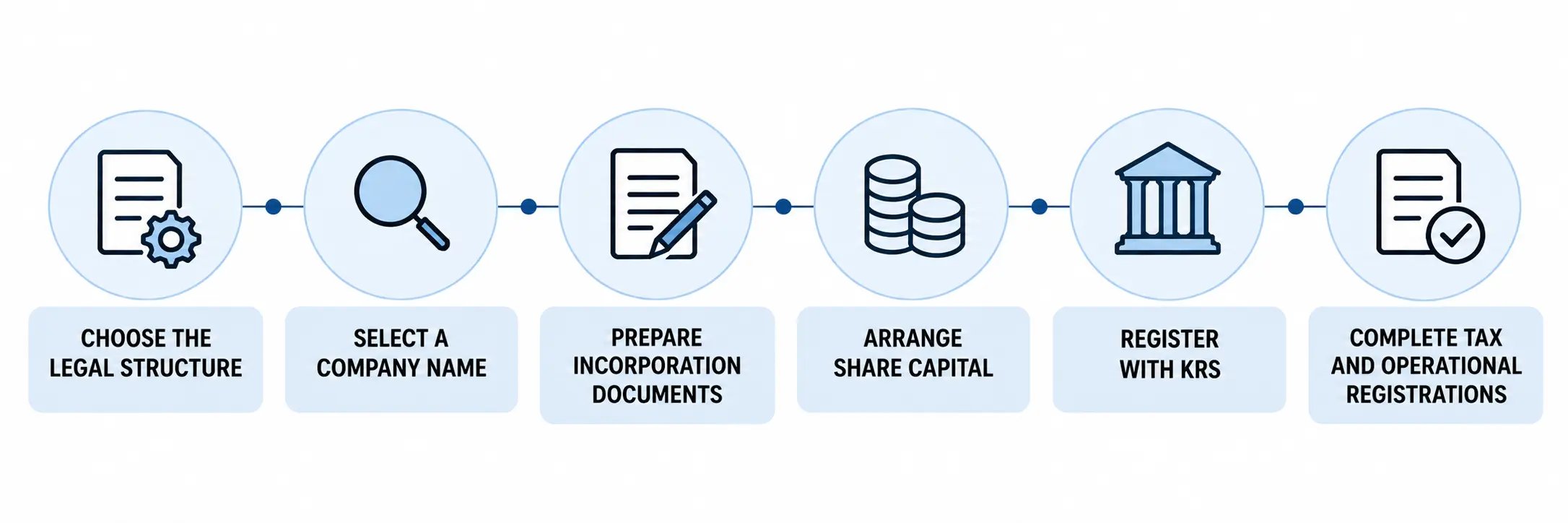
1. Choose the Legal Structure
Determine whether a Sp. z o.o. or S.A. better supports your ownership, investment, and management requirements.
2. Select a Company Name
Choose an appropriate name that complies with Polish registration requirements and includes the relevant legal designation.
3. Prepare Incorporation Documents
Prepare the articles of association or company agreement, including the business purpose, shareholders, capital, and management arrangements.
4. Arrange Share Capital
Provide the required capital contributions according to the selected structure and applicable incorporation rules.
5. Register with KRS
Submit the registration application to the National Court Register (Krajowy Rejestr Sądowy – KRS).
A Sp. z o.o. may qualify for simplified electronic formation using the S24 system, while an S.A. generally requires more formal incorporation documentation.
6. Complete Tax and Operational Registrations
Confirm tax identification details, assess VAT registration, arrange banking, and complete any required employment or business registrations.
Foreign shareholders may need additional identification or authenticated corporate documentation.
Taxation of Sp. z o.o. and S.A. Companies
Both company structures are generally subject to Polish Corporate Income Tax.
Corporate Income Tax
Poland’s standard CIT rate is 19%.
A reduced 9% rate may apply to qualifying small taxpayers and newly established businesses on eligible income, subject to statutory conditions.
The reduced rate does not generally apply to capital gains.
Dividend Taxation
Dividends distributed to shareholders may be subject to withholding tax.
The applicable treatment depends on shareholder residency, tax treaties, and available exemptions.
Foreign investors should therefore consider the tax implications of both company profits and distributions.
VAT Obligations
Businesses conducting taxable activities may need to register for VAT.
Poland’s standard VAT rate is 23%, although reduced rates and exemptions apply to certain goods and services.
Cross-border businesses should also assess EU VAT reporting requirements.
Ongoing Compliance and Reporting
After incorporation, both structures must meet applicable accounting, tax, and corporate obligations.
Common requirements include:
- Maintaining accounting records
- Preparing annual financial statements
- Filing corporate tax returns
- Updating KRS information
- Reporting beneficial ownership information
- Maintaining appropriate corporate documentation
An S.A. generally faces more extensive governance obligations due to its mandatory supervisory board and formal corporate procedures.
UCI’s legal and compliance support can assist businesses with understanding and managing their ongoing obligations.
Which Polish Company Structure Should You Choose?
A Sp. z o.o. is generally suitable for entrepreneurs seeking limited liability, manageable capital requirements, and relatively straightforward governance. It can work well for SMEs, foreign subsidiaries, service providers, and privately owned businesses. An S.A. may be more appropriate for larger companies requiring substantial investment, complex shareholder arrangements, or potential access to capital markets.
However, a higher capital requirement does not automatically make an S.A. more suitable. The final decision should consider business size, ownership plans, financing needs, management responsibilities, compliance costs, and long-term objectives.
Conclusion
Choosing between a Sp. z o.o. and an S.A. requires understanding the differences in capital, governance, ownership, and compliance. A Sp. z o.o. provides a practical structure for many SMEs and foreign investors, while an S.A. offers a more formal framework for larger businesses with substantial financing requirements. The most suitable option depends on your company’s commercial objectives and long-term strategy. For professional assistance with Polish company formation, Contact Us to discuss your business requirements.