

Choosing a business name is one of the most exciting parts of starting a company, but it’s also one of the most important decisions you’ll make. Your business name becomes more than just a brand, it forms part of your legal identity, shapes customer perceptions, influences your marketing strategy, and can even affect your ability to expand internationally.
Many entrepreneurs focus solely on finding a name that sounds creative, but overlook critical considerations such as company registration requirements, trademark availability, domain ownership, and international scalability. A name that works perfectly in one country may already be registered, trademarked, or restricted to another.
Whether you’re launching a local startup or planning to establish a business across multiple jurisdictions, choosing the right name from the beginning can save significant time, legal costs, and branding challenges later. In this guide, we’ll explore the five main types of business names, their advantages and disadvantages, and the key factors to consider before registering your company.
Why Your Business Name Matters?
Your business name is often the first interaction potential customers have with your company. Before they visit your website, read about your services, or speak with your team, they form an impression based on your name alone.
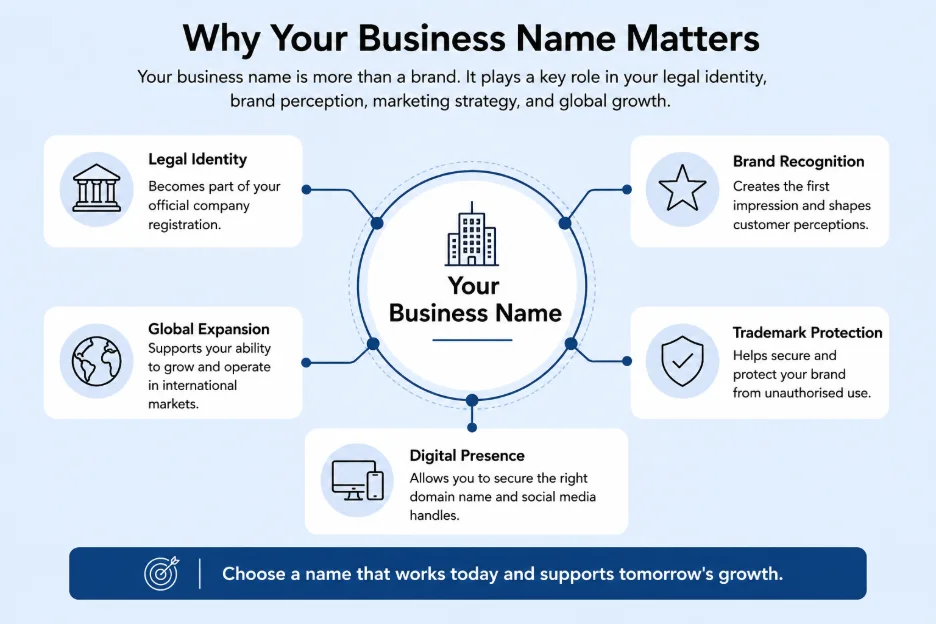
A well-chosen business name can
- Build credibility and professionalism
- Make your business easier to remember
- Improve brand recognition
- Support your marketing efforts
- Create opportunities for trademark protection
- Make future international expansion easier
On the other hand, selecting a name without considering legal availability or long-term growth can result in expensive rebranding, trademark disputes, or registration delays.
The Five Types of Business Names
Understanding the different naming styles can help you identify the best approach for your business goals.
1. Descriptive Business Names
Descriptive names clearly explain what your business does, making them easy for customers to understand immediately.
Examples
- Global Tax Advisors
- London Business Consultants
- Premier Accounting Services
Advantages
- Instantly communicates your services
- Easy for customers to understand
- Can support search engine visibility
- Builds immediate trust
Challenges
- May sound generic
- Often difficult to trademark
- Can limit future diversification if your services expand
Best For
Professional services, local businesses, consultancies, and startups seeking immediate clarity.
2. Location-Based Business Names
Location-based names incorporate a city, region, or country into the business name, helping establish a strong local presence.
Examples
- Dubai Business Solutions
- Singapore Corporate Services
- Manchester Legal Group
Advantages
- Builds local trust
- Helps target a specific market
- Reinforces regional expertise
Challenges
- Can become restrictive when expanding internationally
- May require rebranding if relocating
- Less suitable for global businesses
Best For
Local service providers, retail businesses, restaurants, and regional consultancies.
3. Founder or Family Names
Many businesses use the founder’s or family’s surname to create a personal, trustworthy identity.
Examples
- Johnson & Partners
- Smith Legal Advisors
- Wilson Consulting
Advantages
- Creates authenticity
- Builds a personal connection
- Supports long-term legacy
Challenges
- Doesn’t explain what the business does
- Can be difficult for international audiences to pronounce
- Brand reputation becomes closely linked to individuals
Best For
Law firms, financial advisors, family businesses, and professional practices.
4. Experiential or Evocative Business Names
Experiential names focus on emotions, aspirations, or experiences rather than describing products or services directly.
Examples
- Horizon
- Elevate
- Thrive
- Momentum
Advantages
- Creates strong emotional connections
- Highly memorable
- Offers greater branding opportunities
- More flexible for business growth
Challenges
- Requires marketing to establish meaning
- May not immediately explain your services
- Customer interpretation can vary
Best For
Technology companies, creative agencies, lifestyle brands, and innovative startups.
5. Abstract or Invented Business Names
Abstract names are unique words or completely new creations designed to establish a distinctive identity.
Examples
- Xerox
- Kodak
- Spotify
Advantages
- Highly distinctive
- Easier to trademark
- Unlimited branding potential
- Supports international growth
Challenges
- Requires significant marketing investment
- Doesn’t explain your services initially
- Brand awareness takes longer to build
Best For
Technology startups, global brands, SaaS companies, and businesses planning international expansion.
Choosing a Business Name for International Expansion
If your long-term goal is to operate internationally, your business name should work across multiple jurisdictions, not just within your home country.
Before deciding on a name, consider
- Is it easy to pronounce in different languages?
- Does it have unintended meanings in other cultures?
- Is the name already registered elsewhere?
- Will it still represent your business if you expand your services?
- Can it support future global branding?
- Thinking internationally from the beginning can help avoid costly rebranding as your business grows.
Legal Considerations Before Registering Your Company
Many entrepreneurs assume that registering a company automatically protects their business name. Company registration, domain ownership, and trademark protection are separate processes.
Before proceeding with incorporation, it’s important to verify
- Company Name Availability
Ensure your preferred name complies with the regulations of your chosen jurisdiction and isn’t already in use.
- Trademark Availability
Registering a company does not automatically grant trademark rights. A trademark helps protect your brand from unauthorised use and provides stronger legal protection.
- Domain Name Availability
Your website is a key part of your brand identity. Ideally, your domain name should match your business name and be secured before launching.
- Social Media Handles
Consistency across digital platforms makes your business easier to find and strengthens brand recognition.
- Jurisdiction-Specific Restrictions
Some countries restrict the use of certain words such as “Bank,” “University,” “Insurance,” “Royal,” or “Government” without additional approvals or licences.
Common Mistakes to Avoid
Many businesses experience branding challenges because they overlook important considerations during the naming process.
Avoid these common mistakes
- Choosing a name that’s difficult to pronounce or spell
- Selecting a name that’s too similar to competitors
- Ignoring trademark availability
- Using location-specific names when planning international expansion
- Choosing a name that’s too limiting for future growth
- Forgetting to secure the matching domain name
- Overlooking cultural or language differences
A little research today can prevent expensive changes tomorrow.
A Practical Checklist for Choosing the Right Business Name
Before finalising your decision, ask yourself
✔ Is the name memorable?
✔ Is it easy to pronounce?
✔ Does it reflect your brand?
✔ Is it suitable for future expansion?
✔ Is the company name available?
✔ Can you register the trademark?
✔ Is the matching domain available?
✔ Are the social media handles available?
✔ Does the name work internationally?
✔ Will it still make sense five years from now?
If you can confidently answer “yes” to each question, you’re likely making a strong long-term decision.
How UCI Can Help?
Choosing the right naming style is an important step in building a brand that can grow with your company. Beyond deciding whether a descriptive, location-based, founder-led, evocative, or abstract name suits your business, you should also consider legal availability, memorability, and future expansion. For additional guidance, read our guide on how to choose the perfect name for your business before finalising your decision.
At UCI, we help entrepreneurs, startups, and international businesses navigate every stage of the company formation process. From selecting the right jurisdiction and registering a company to trademark registration, business licensing, tax registration, and ongoing compliance, our team provides practical guidance tailored to your expansion goals.
Whether you’re launching your first business or expanding into new international markets, UCI helps simplify the complexities of global company formation.
Final Thoughts
A business name is far more than a creative decision, it becomes the foundation of your company’s identity, reputation, and long-term growth. By understanding the different types of business names, considering international expansion from the outset, and protecting your brand through proper registration and trademark strategies, you’ll build a stronger platform for future success.
Take the time to choose a name that not only reflects your business today but also supports where you want it to be tomorrow. With careful planning and the right guidance, your business name can become one of your most valuable long-term assets.