


In 2026, over 50 countries offer a dedicated digital nomad visa. That number sounds like freedom, and for entrepreneurs it genuinely can be. But it has also produced one of the most expensive misunderstandings in international tax planning the belief that obtaining a digital nomad visa settles the question of where you pay tax. It does not. A visa is an immigration document. It gives you the legal right to live and work in a country for a defined period. It says nothing about where you owe tax, which country has the right to tax your worldwide income, or whether your home country has agreed to release you from its tax register.
Governments are no longer passive about this gap. The OECD Common Reporting Standard now facilitates automatic data exchange between more than 100 tax authorities worldwide. Employers use AI compliance software that flags extended foreign working arrangements. The era of simply moving abroad and hoping for the best is over. This guide is written for entrepreneurs, freelancers, and remote-working founders who want to structure their global setup correctly, not just find an attractive place to open a laptop. It covers the six countries that genuinely work for entrepreneurs in 2026, the critical transition mistakes that generate unexpected tax bills, how to properly establish new tax residency, and how to make sure your company structure is aligned with your personal position.
The Key Distinction – Visa vs Tax Residency
Most entrepreneurs conflate the visa and tax questions because they appear to arrive together. You apply for a visa, you relocate, and you assume your tax situation has shifted accordingly. In most cases it has not, at least not automatically. A digital nomad visa is an immigration instrument. It is issued by a country’s interior ministry, immigration authority, or consulate. It permits you to live there, to rent an apartment, to work for foreign clients, and to access local services.
What it does not do is register you as a tax resident, notify your home country that you have left, or trigger any formal change in your tax obligations. Tax residency is a separate legal status governed by domestic tax law in each country. It determines which government has the right to assess tax on your worldwide income. Tax residency is established by different criteria in different countries, some based purely on days spent, others incorporating ties such as property, family, and business interests. The table below illustrates the core differences that every entrepreneur planning a relocation must understand before making any decisions.
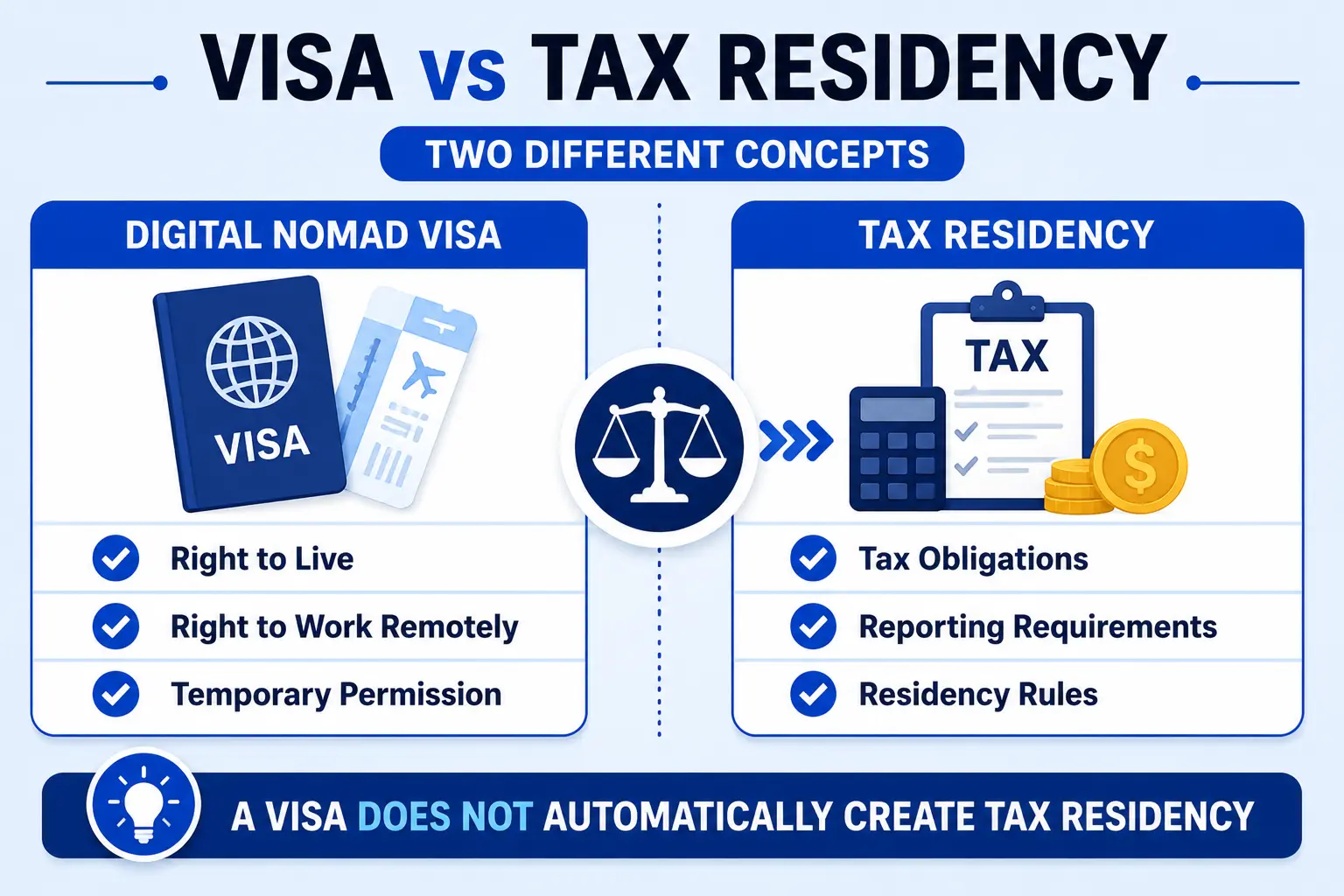
| Digital Nomad Visa | Tax Residency |
| Legal right to live and work in a country for a set period | Determines which country has the right to tax your worldwide income |
| Granted by an immigration or interior ministry | Determined by domestic tax law based on days, ties, and domicile |
| Can be active without making you a tax resident | Can exist even without a visa, for example through UK domicile rules |
| Does not automatically start or stop tax obligations | Must be formally established and formally ended through official channels |
| Issued to individuals; company not affected | Separate from your company, which has its own tax residency rules |
The practical consequence of this distinction is that you can hold a valid digital nomad visa in Spain and still be a full tax resident of Germany if you have not broken German tax residency. Spain has issued the visa. Germany has issued nothing. Germany continues to tax you on your worldwide income until you formally sever that connection. This is not a technicality. It is the single most common and most expensive error made by entrepreneurs in international relocations. Professional advice taken before the move, rather than after the first tax assessment arrives, is the only reliable way to avoid it.
The 183-Day Rule and What It Does Not Tell You
The 183-day rule is widely known as the key threshold for tax residency. Spend more than half the year in a country and that country generally considers you a tax resident, with the right to tax your worldwide income. This rule applies in most of Europe, in most of Asia, and across much of the rest of the world. It is a useful starting point. But treating it as the complete answer is a mistake that tax advisors encounter constantly. The 183-day rule is a trigger, not the only test. Most countries apply at least one secondary test alongside it, and some of those secondary tests can establish tax residency even if you have not reached 183 days. Understanding these secondary tests is essential for any entrepreneur who splits time across multiple countries.
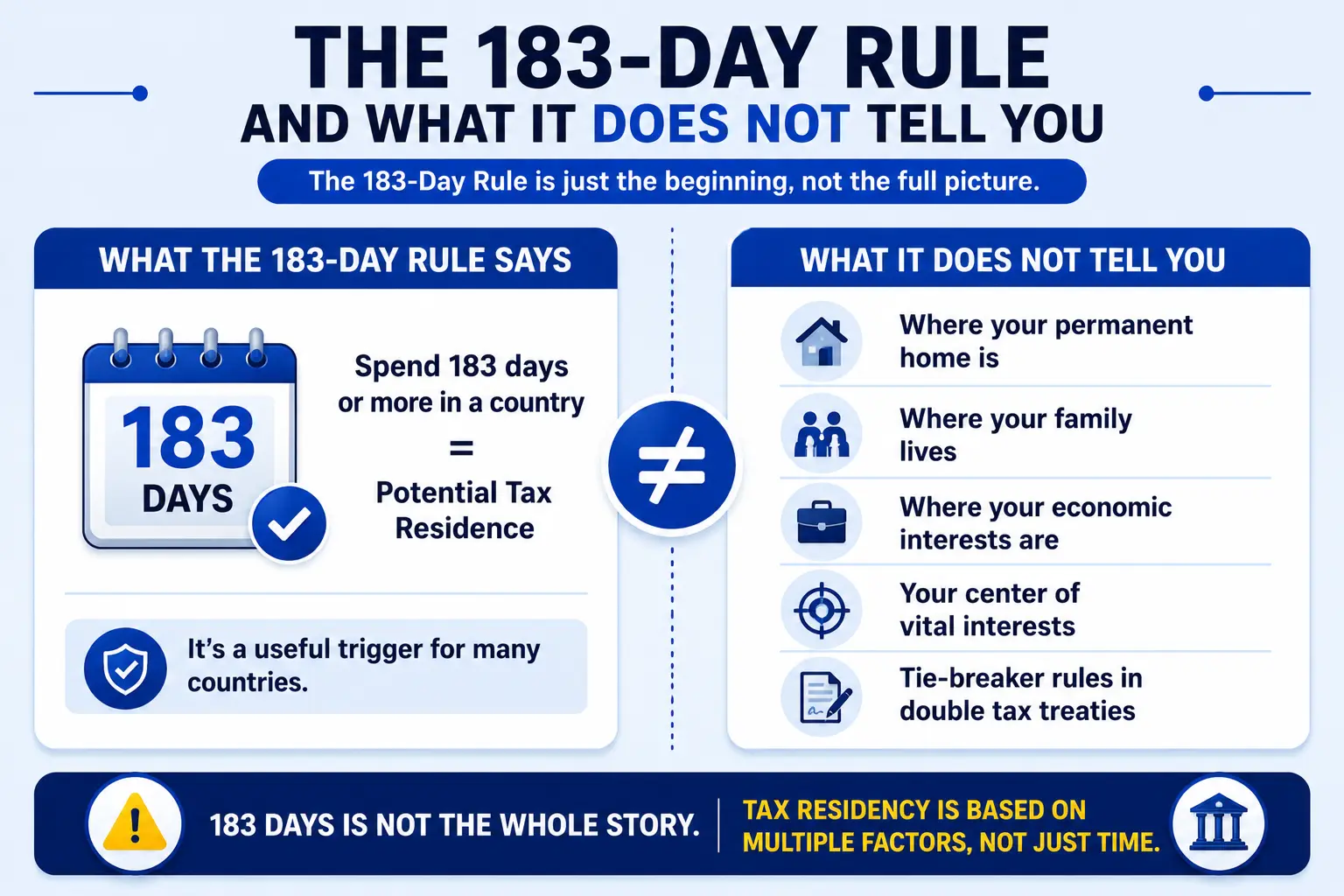
Permanent home availability
If you maintain a property that is available for your use in a country, many jurisdictions will consider you a resident there regardless of how many days you actually spent in it. The key word is available. A house that you could stay in, even if you chose not to, is a tie that sustains residency. Renting the property on a genuine long-term lease removes this tie in most jurisdictions.
Centre of vital interests
Where your life is centred matters. Tax authorities look at where your spouse or civil partner lives, where your children attend school, where your main bank accounts are held, where your business is registered and managed, and where your most significant economic and personal ties exist. Moving yourself to a new country while leaving all of these behind does not constitute a complete break.
Domicile
The UK, Ireland, and several Commonwealth jurisdictions use a concept called domicile that is distinct from both residence and physical presence. Domicile is broadly the country of your origin or the country you have chosen as your permanent home. UK-domiciled individuals who cease to be UK resident can still face UK tax on income remitted to the UK, even after years of absence. This is a specialist area that requires specific advice.
Intention to return
Some jurisdictions, particularly Australia and certain US states, factor in your intention. If you can be shown to have always intended to return to your home country, that intention may sustain residency during your absence. Maintaining memberships, business registrations, and a registered address can all be used as evidence of continuing ties. The broader point is that tax residency is not just a counting exercise. It requires an assessment of your overall connection to a country. For entrepreneurs with significant assets, family ties, or long-established business relationships in their home country, breaking tax residency often requires a deliberate and documented process of severing those ties, not simply buying a plane ticket.
The Compliance Environment in 2026
Digital nomad taxation has changed fundamentally in the past two years. What was once a grey area tolerated by most governments has become an area of active enforcement. Three developments have driven this shift.
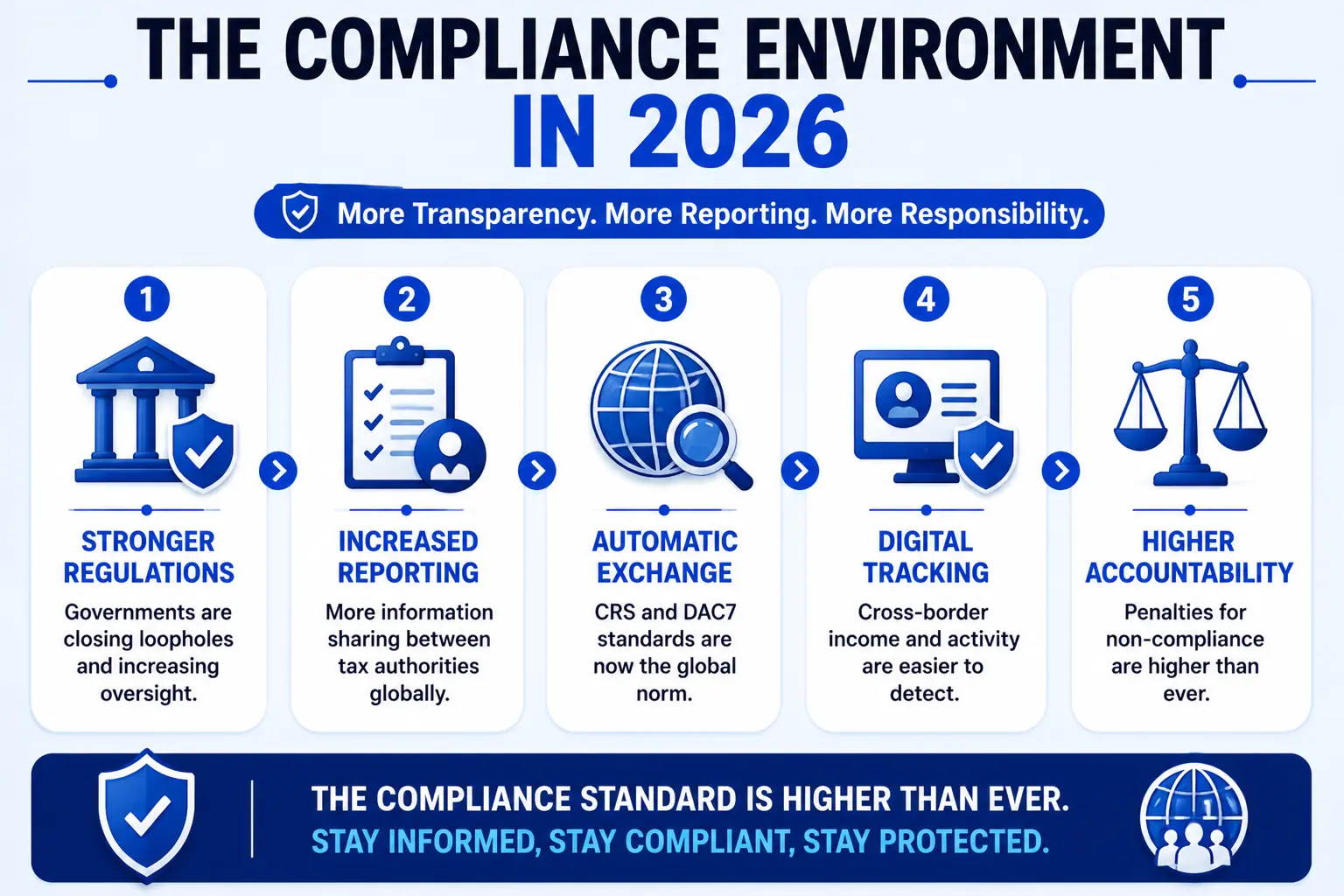
Automatic information exchange
The OECD Common Reporting Standard (CRS) now connects more than 100 countries in a framework of automatic financial data sharing. Banks in participating countries report account balances, interest income, dividend income, and transactions to their domestic tax authority, which then shares that data with the tax authorities of the account holder’s country of residence. If you maintain bank accounts or investment portfolios in your home country while claiming to be resident elsewhere, the data will surface. Source oecd.org/tax/automatic-exchange.
Employer compliance technology
Large employers and professional services firms now use software that monitors employee login locations and flags extended periods of foreign working. Many have introduced formal policies requiring employees to notify HR before working abroad for more than 30 days. For entrepreneurs who also hold employment relationships, this creates an additional compliance layer. Extended working from a foreign country without an Employer of Record arrangement can create payroll tax and social security obligations for the employer in that country.
Crypto-Asset Reporting Framework (CARF)
The OECD’s CARF framework, rolling out across major jurisdictions through 2025 and 2026, extends automatic reporting to cryptocurrency transactions and holdings. This closes a significant reporting gap that some nomads used to hold wealth outside the traditional banking system. Crypto exchanges operating in CARF jurisdictions are now required to report transaction data to tax authorities. The combined effect is that the information available to tax authorities has expanded dramatically. Entrepreneurs who have relied on informal arrangements, incomplete deregistration, or the assumption that tax authorities in their home country would not notice their relocation should treat 2026 as a year of correction, not continuation.
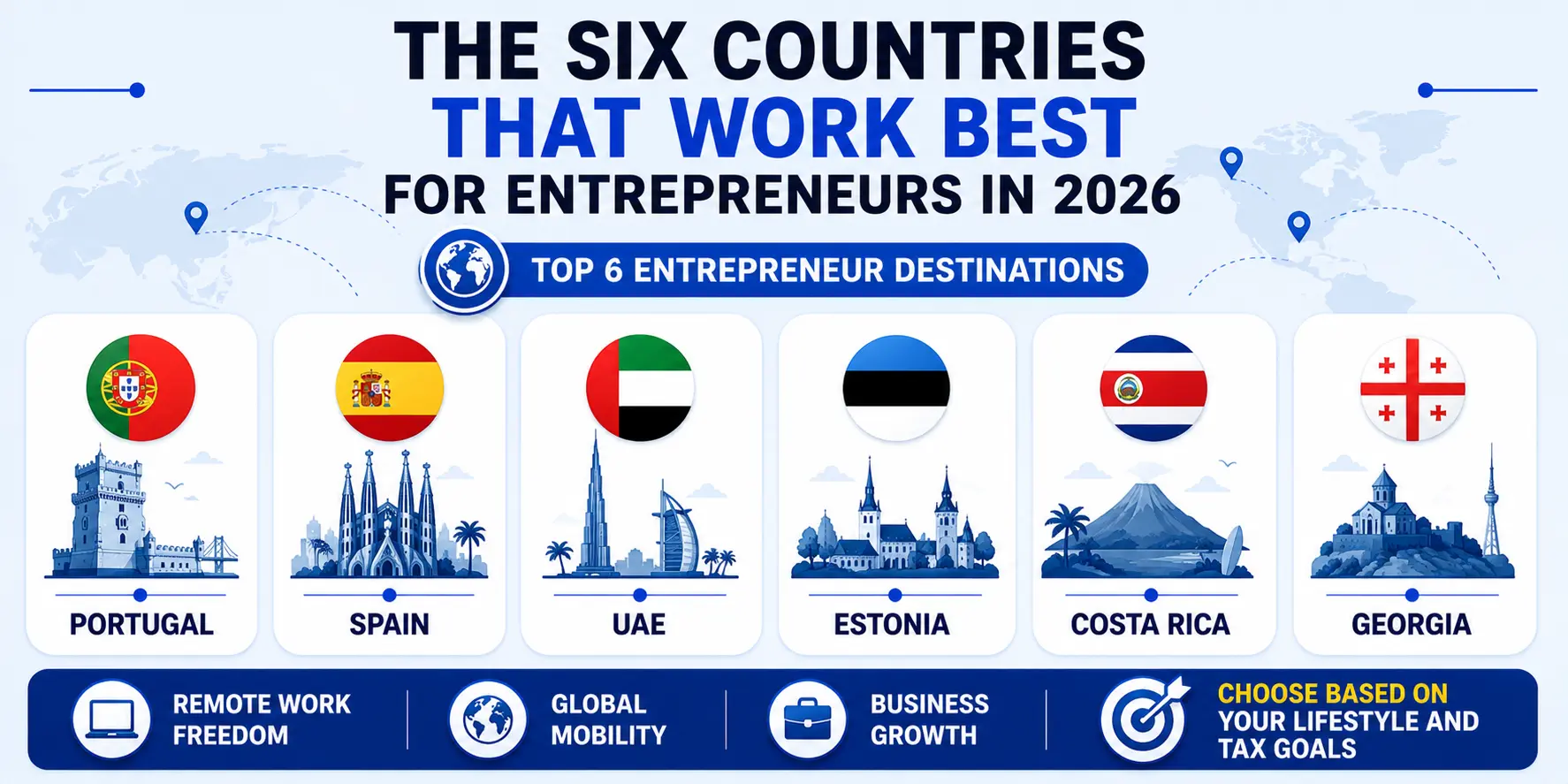
The Six Countries That Work Best for Entrepreneurs in 2026
Many countries offer digital nomad visas. Far fewer offer the full combination that entrepreneurs actually need a credible and stable immigration pathway, a defined tax regime with genuine advantages, and recognised company formation options that work for international business. The following six countries deliver all three.
Spain – The Gold Standard for European Entrepreneurs
Spain’s Startup Act Digital Nomad Visa, introduced in 2023 and now well established, is the strongest all-round package in Europe for founders who want an EU base with meaningful tax advantages.
Visa structure
The visa is valid for one year when applied for from outside Spain and for three years when applied from within Spain. It is renewable and leads to permanent residency after five years, with Spanish citizenship available after ten years. The income requirement is a minimum of 2,850 EUR per month, and at least 80 percent of income must come from sources outside Spain.
The Beckham Law
Spain’s Regimen Especial de Impatriados, known internationally as the Beckham Law because it was originally used by the footballer David Beckham on his move to Real Madrid, allows qualifying new residents to pay a flat 24 percent rate on Spanish-sourced income up to 600,000 EUR per year. Income above that threshold is taxed at 47 percent. Critically, foreign-sourced income is taxed at zero percent for up to six years. The Beckham Law is a separate application from the visa and must be submitted within six months of first registering as a Spanish resident. Entrepreneurs who move to Spain but fail to make this application on time lose access to the regime and face standard progressive rates of up to 47 percent instead. Standard Spanish personal income tax operates on a progressive scale from 19 percent at the lowest band to 47 percent at the highest, making the Beckham Law a very substantial benefit for founders with significant income.
Company options
The Spanish Sociedad Limitada (SL) is the standard private limited company and the appropriate vehicle for operating businesses based in Spain. For entrepreneurs holding international investments, the ETVE structure (Entidad de Tenencia de Valores Extranjeros) is a holding company regime that provides largely tax-free treatment of dividends received from foreign subsidiaries and capital gains on the sale of qualifying shares.
The shadow payroll risk
Entrepreneurs who have foreign employers or who employ others remotely should be aware that Spanish authorities may require foreign employers to register for Spanish social security withholdings even without a legal entity in Spain, if an employee is habitually working from Spanish territory. This is a specialist area requiring dedicated payroll advice.
Verdict – Spain
Best for founders who want an EU base with genuine tax efficiency for up to six years. The Beckham Law is one of the most attractive incentive regimes in Europe. Ideal for entrepreneurs with significant foreign income who are seeking a high quality of life in a major European country with full access to the EU single market.
Portugal – Established Ecosystem with the Clearest Citizenship Pathway in Europe
Portugal has been a benchmark for digital nomad relocation since 2020 and remains among the most compelling destinations in 2026, despite significant changes to its tax incentive regime. –
Visa structure
The D8 Digital Nomad Visa is valid for two years and is renewable. It leads to permanent residency after five years and EU citizenship after ten years. Portugal’s ten-year citizenship pathway is the most established in the EU for non-European founders and remains a major draw for entrepreneurs who want long-term EU access and the optionality of a European passport.
Income requirement
The minimum income threshold for the D8 visa is 3,680 EUR per month, equivalent to four times the Portuguese minimum wage.
The IFICI regime
Portugal ended its Non-Habitual Resident (NHR) tax programme in January 2024. The NHR had provided a ten-year flat tax rate of 20 percent on Portuguese-sourced professional income and exempted most foreign-sourced income entirely. Its replacement, the IFICI (Incentivo Fiscal a Investigacao e Inovacao), targets a narrower group of qualifying professionals, primarily those in technology, scientific research, and innovation-led industries. IFICI provides a flat 20 percent rate on Portuguese-sourced employment and self-employment income for ten years. Foreign-sourced income remains potentially exempt under the terms of the regime, though the rules are more tightly defined than under the old NHR. Founders who do not qualify for IFICI face standard progressive rates ranging from 13.25 percent to 48 percent.
Community and infrastructure
Portugal’s nomad and startup ecosystem is genuinely established. Lisbon and Porto have active founder communities, co-working infrastructure, and a growing number of international investors. The Algarve has become a second hub for remote-working entrepreneurs who prioritise quality of life alongside business infrastructure.
Company options
The Portuguese Lda (Limitada) is the standard private limited company. Portuguese holding structures are available for international investment income.
Verdict – Portugal
Best for founders who want a long-term European base with the clearest citizenship pathway available to non-EU entrepreneurs. The IFICI regime is more restrictive than its predecessor but still competitive for qualifying professionals. The community, lifestyle, and decade-long pathway to EU citizenship make Portugal a compelling long-term choice.
Estonia – The Digital-First EU Company Without the Commute
Estonia occupies a unique position among nomad destinations because its most valuable feature, the e-Residency programme, does not require you to live in Estonia at all. For entrepreneurs who want a credible EU-registered company with genuine digital infrastructure, Estonia offers something no other country does.
Visa structure
The Estonian Digital Nomad Visa provides a stay of up to one year for remote workers. It requires proof of remote employment or self-employment serving foreign clients. Estonia is a full EU member and Schengen country, so the visa provides freedom of movement within the Schengen Area.
E-Residency
Estonia’s e-Residency programme allows any entrepreneur anywhere in the world to register and operate an Estonian private limited company (OE) entirely online. E-residency is a digital identity card that enables access to Estonian business registration, banking services, digital signing, and tax filing. More than 100,000 e-residents from over 170 countries have used the programme to access EU business infrastructure without relocating. It is important to understand that e-residency is not tax residency and is not a visa. An e-resident who does not live in Estonia is not an Estonian tax resident. The Estonian company they manage may, depending on the circumstances, be tax resident in the country where the e-resident actually lives and makes decisions. This is the management-and-control principle discussed in detail in the company structure section below.
Tax treatment
Estonian companies pay zero percent corporate tax on retained and reinvested profits. Distributed dividends are taxed at 20 percent. This means that profits left inside the company for reinvestment compound without any corporate tax cost, which is a significant structural advantage for growth-stage businesses. If an entrepreneur becomes personally resident in Estonia by spending 183 or more days there, standard personal income tax rates apply.
Company options
The Estonian OE (Osaeuhing) established via e-Residency is the primary vehicle. It provides EU VAT registration, SEPA banking, and access to the EU single market with a strong international reputation.
Verdict – Estoni
Best for founders who want an EU-registered company that can be managed remotely. The e-Residency programme is unmatched globally for digital company administration. Less suited as a primary personal tax residency unless you genuinely relocate to Estonia. The zero percent reinvestment tax makes it particularly attractive for capital-intensive businesses.
Georgia – The Lowest Tax Option Outside the European Union
Georgia is the outlier on this list. It is not an EU member, does not offer an EU passport pathway, and has limited banking recognition for European and US client relationships. But it offers something no EU country can match a legitimate tax rate of one percent on business turnover for qualifying small businesses.
Entry and residency
Citizens of more than 95 countries, including most of Europe, the US, UK, Canada, and Australia, can enter Georgia visa-free for up to 365 days per year under bilateral agreements. The Remotely from Georgia programme is a free, fully online registration process that takes approximately ten business days and formalises the remote worker relationship with the Georgian government.
Income requirement
There is no minimum income threshold to enter or maintain presence in Georgia. This makes it uniquely accessible compared to every other destination on this list.
Tax treatment
Georgia operates two particularly relevant regimes for entrepreneurs. The small business regime applies a flat one percent tax on annual business turnover up to GEL 500,000, which is approximately 185,000 USD. This rate is on turnover rather than profit, which means the effective tax rate as a percentage of profit depends on the margin of the business. For high-margin professional services, consulting, or digital businesses, the effective rate is very low. The Georgian IT Virtual Zone programme goes further. Companies registered as IT Virtual Zone entities pay zero percent corporate tax on income earned from foreign clients. Distributions of those profits as dividends are subject to a five percent withholding tax. For technology founders serving non-Georgian clients, this can represent a combined effective rate significantly below one percent of gross revenue.
Limitations
Georgian banking has limited correspondent relationships with major European and US banks. Some clients, particularly in regulated industries, may require suppliers to be incorporated in EU or common law jurisdictions. Georgia should be assessed against the specific client relationships and banking needs of each entrepreneur.
Company options
Georgian Individual Enterprise (sole trader structure) or a Georgian LLC. Both are straightforward to establish and relatively inexpensive to maintain.
Verdict – Georgia
Best for cost-conscious founders who prioritise tax efficiency above all else and whose client relationships do not require EU or UK incorporation. The one percent small business rate and zero percent IT Virtual Zone are the most aggressive legitimate tax regimes available anywhere. The absence of EU access and limited banking credibility are the primary trade-offs.
Cyprus – The Best Non-Domiciled Tax Regime in Europe
Cyprus has been a tax planning jurisdiction for decades. In 2026, it became genuinely compelling for entrepreneurs because it combines the lowest corporate tax rate in the EU with one of the most generous personal tax exemptions available anywhere in Europe, wrapped in a Schengen Area residency.
Visa structure
Cyprus offers a Digital Nomad Visa for remote workers. More significantly for founders, Cyprus operates a 60-day tax residency rule spend a minimum of 60 days per year in Cyprus, do not spend more than 183 days in any other single country, and maintain certain minimum ties (a business presence or employment in Cyprus), and you qualify for Cypriot tax residency with non-domiciled status. This 60-day rule is the most flexible residency threshold available in any EU country. It allows founders to maintain a genuinely mobile lifestyle while establishing a recognised EU tax residency with very limited physical presence requirements.
Income requirement
The Digital Nomad Visa requires a minimum income of 3,500 EUR per month.
Non-Domiciled status
Cyprus non-domiciled residents pay zero percent personal tax on dividend income and interest income for a period of 17 years. This is the longest and most generous dividend tax exemption available within the EU. An entrepreneur who takes profits from their business as dividends through a Cyprus company and who has non-dom status pays no personal tax on those dividends for 17 years. Standard Cypriot income tax rates apply to employment and self-employment income and operate on a progressive scale from zero to 35 percent. The non-dom benefit is specifically on passive income dividends and interest.
Corporate tax
Cyprus has a corporate income tax rate of 12.5 percent, one of the lowest in the EU. The combination of 12.5 percent corporate tax and zero percent personal dividend tax for non-dom shareholders means that a founder can extract business profits through a Cyprus company at a total effective rate of 12.5 percent for 17 years.
Schengen access
Cyprus joined the Schengen Area in 2024, completing its transition from a country that required separate entry to one that provides full freedom of movement across 29 European countries.
Company options
Cyprus Ltd is a widely recognised EU holding and operating company. It is used extensively in international tax planning because of its combination of low corporate tax, treaty network, and EU status.
Verdict – Cyprus
Best for high-earning founders who want near-zero effective tax on business profits within the European Union. The combination of a Cyprus Ltd company, 12.5 percent corporate tax, and 17 years of zero percent dividend tax for non-dom shareholders is the most efficient legitimate structure available in the EU for dividend-generating businesses. The 60-day residency threshold makes it compatible with a flexible lifestyle.
UAE – The Top Choice Outside Europe for High-Earning Founders
The UAE, and Dubai in particular, has positioned itself as the global reference point for zero-tax entrepreneurship. Its combination of zero personal income tax, strong international banking, world-class infrastructure, and a ten-year residency visa makes it the most attractive non-European option for founders with globally distributed income.
Visa structure
The UAE offers two relevant pathways. The Dubai Virtual Working Programme provides a one-year renewable visa for remote workers. The UAE Golden Visa provides ten-year residency with no requirement to be tied to a specific employer or business, and is available to entrepreneurs, investors, and high-skilled professionals. The Golden Visa is the more appropriate option for founders planning a genuine long-term relocation.
Income requirement
Approximately 3,500 USD per month for the virtual working programmes. The Golden Visa has investment or income thresholds that vary by category.
Tax treatment
The UAE levies zero percent personal income tax. There is no capital gains tax, no inheritance tax, and no withholding tax on dividends paid to UAE residents. Corporate tax of nine percent was introduced in 2023 and applies to business profits exceeding AED 375,000 (approximately 102,000 USD). Qualifying businesses operating within UAE free zones retain a zero percent corporate tax rate on qualifying income. UAE tax residency for the purpose of deregistering from a home country requires physical presence of 90 to 120 days per year and the issuance of a UAE tax residency certificate by the Federal Tax Authority. This certificate is the document that most home countries require as evidence that an individual has established tax residency elsewhere. Without it, deregistration from high-tax jurisdictions is difficult to complete.
Banking
UAE banking is among the strongest globally for international entrepreneurs. Major international banks operate full-service branches in Dubai and Abu Dhabi, and free zone companies have access to multi-currency accounts, international transfers, and credit facilities that are comparable to or better than European alternatives.
Company options
UAE free zone companies provide 100 percent foreign ownership, zero percent corporate tax on qualifying income, and access to international banking. The DIFC (Dubai International Financial Centre) and ADGM (Abu Dhabi Global Market) are common law free zones that are particularly well-suited to financial services and technology businesses.
Verdict – UAE
The top choice for high-earning founders who want zero percent personal tax and premium international banking. The UAE does not provide EU market access or a citizenship pathway. It is best suited to entrepreneurs whose client base and business relationships are global rather than specifically EU-focused.
Case Study – How a UK Software Founder Restructured to Cyprus Profile
James is a 36-year-old founder of a UK-based B2B software company. He draws an annual salary of 52,000 GBP and takes dividend distributions of 280,000 GBP per year. His previous tax residency was the UK, where he was also UK-domiciled. His effective personal tax rate on dividends at the highest rate exceeded 39 percent.
The Problem
James was paying approximately 110,000 GBP per year in personal tax on his dividend income alone, in addition to income tax on his salary. He wanted to legally reduce this liability without losing access to EU client relationships or the credibility of his UK company for existing contracts.
The Structure
- James obtained Cyprus non-domiciled tax residency by satisfying the 60-day residency rule, spending 65 days in Cyprus in the first year, and maintaining a Cyprus-registered business presence.
- He formally deregistered from UK tax residency by satisfying HMRC’s Statutory Residence Test non-resident conditions, spending fewer than 16 days in the UK in the following tax year.
- A Cyprus Ltd holding company was established. Dividends flowed from the UK operating company to the Cyprus holding company, and from there to James personally. Under Cyprus non-dom rules, these dividends attracted zero percent personal tax.
- The UK operating company was retained for all client relationships and contracts, providing continuity and credibility. The holding structure above it was reorganised.
The Outcome Year one tax saving – approximately 95,000 GBP.
Ongoing annual saving – approximately 110,000 GBP.
The structure is fully compliant with UK, Cyprus, and OECD substance requirements. James now spends the majority of the year between Cyprus and Portugal, with limited UK time.
Key Lesson
The structure only worked because James formally broke UK tax residency and obtained a Cyprus tax residency certificate. Simply obtaining a Cyprus visa without completing the deregistration process would have left full UK tax liability intact. The certificate was the document that closed the UK tax file.
Countries to Approach with Caution
Not every popular digital nomad destination is suitable for entrepreneurs who need credible, long-term tax and business structures. The following destinations deserve careful consideration before commitment.
Thailand
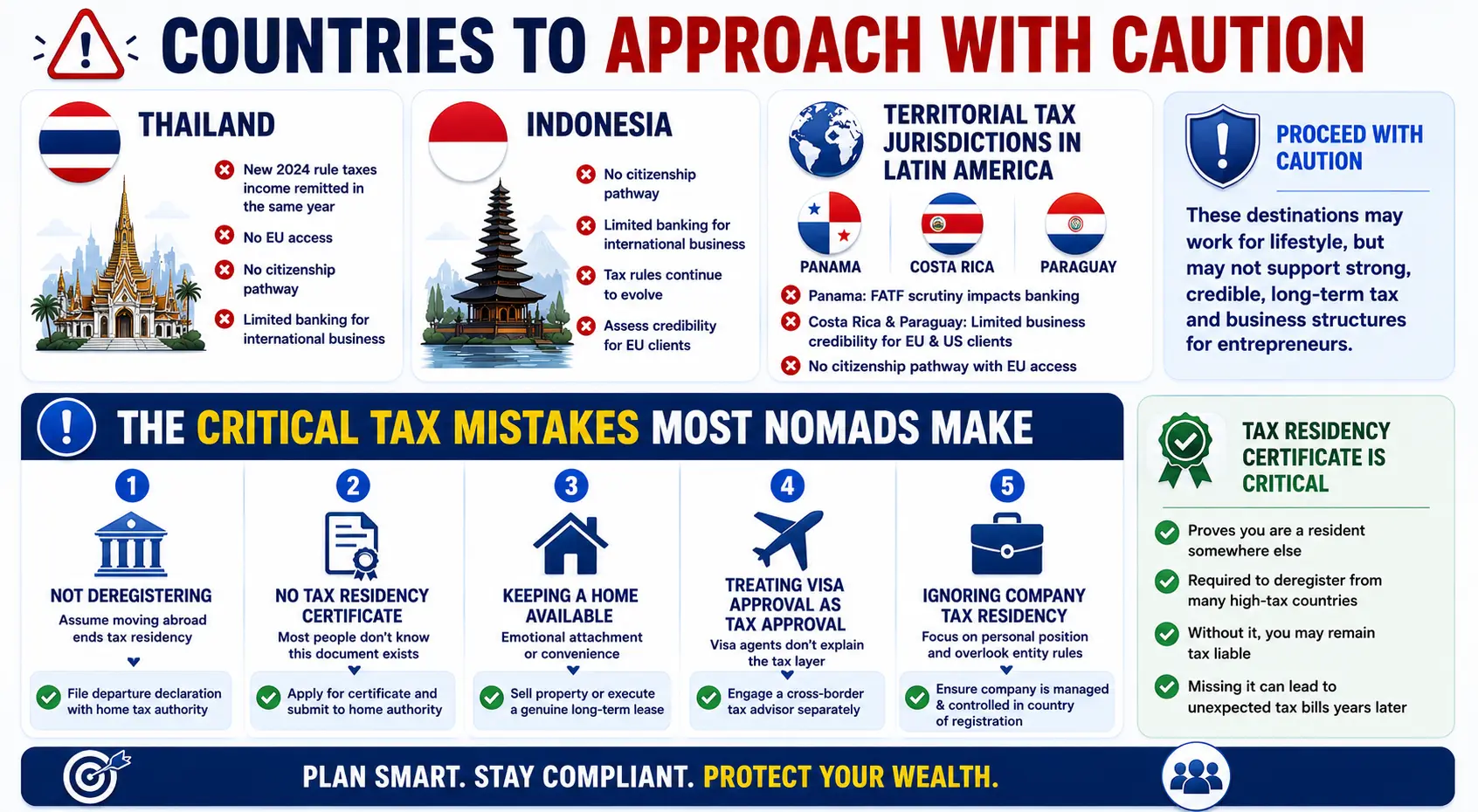
Thailand’s Destination Thailand Visa offers a five-year stay that is attractive on the surface. However, a 2024 rule change by the Thai Revenue Department means that income remitted into Thailand in the same year it is earned may now be subject to Thai personal income tax, even if it is foreign-sourced income. Previously, deferring remittance by a year avoided this. The new rules have created significant uncertainty for nomads using Thailand as a low-cost base. Thailand also offers no EU access, no citizenship pathway, and limited banking infrastructure for international business.
Indonesia
Bali’s E33G visa legitimised long-term stays in Indonesia for the first time and is widely popular in the nomad community. However, it offers no citizenship pathway, limited banking infrastructure for international business, and tax rules that continue to evolve. Entrepreneurs dependent on EU client relationships should assess whether Indonesian incorporation serves those relationships adequately.
Territorial tax jurisdictions in Latin America
Countries including Panama, Costa Rica, and Paraguay operate territorial tax systems that do not tax foreign-sourced income. This can appear very attractive. However, all three have limitations for international entrepreneurs Panama has faced Financial Action Task Force scrutiny in recent years, which affects banking relationships; Costa Rica and Paraguay have limited business credibility for EU and US client relationships; and none offer a citizenship pathway that carries significant EU or international access value.
The Critical Tax Mistakes Most Nomads Make
Understanding the right destination is only part of the challenge. The transition must also be handled correctly. These are the five mistakes that generate the largest unexpected tax bills for entrepreneurs who relocate internationally.
| Common Mistake | Why It Happens | How to Fix It |
| Not deregistering from home country tax authority | Entrepreneurs assume moving abroad ends tax residency automatically | File a formal departure declaration with your home tax authority before or shortly after leaving |
| No tax residency certificate from new country | Most people do not know this document exists | Apply to your new country for a certificate confirming tax residency, then submit it to your home authority |
| Keeping a home available in home country | Emotional attachment or logistical convenience | Sell the property or execute a genuine long-term lease; availability alone sustains residency in many jurisdictions |
| Treating visa approval as tax approval | Visa agents often do not explain the tax layer | Engage a cross-border tax advisor separately from your immigration advisor |
| Ignoring company tax residency | Founders focus on personal position and overlook entity rules | Confirm where your company is managed and controlled; ensure genuine substance in the country of registration |
The tax residency certificate deserves specific emphasis because it is the document most frequently overlooked and most consequential to get wrong. When you leave a high-tax country, that country’s tax authority does not automatically know you have gone. Your continued tax obligations persist until you formally notify the authority of your departure. The mechanism for doing so in most countries is submitting a tax residency certificate issued by your new country, which proves to your home authority that another jurisdiction has accepted you as a resident. Without this certificate, the deregistration process in countries like Germany, the UK, Australia, and the Netherlands is either impossible to complete or can be challenged years later. Entrepreneurs who have been living abroad for two or three years and assumed they had broken their home country tax residency have received unexpected assessments as a result of not completing this step.
Practical Checklist – Steps to Properly Establish New Tax Residency
- Consult a cross-border tax advisor before moving, not after the first tax assessment arrives.
- File a formal departure or deregistration declaration with your home country’s tax authority.
- Ensure any property in your home country is either sold or placed on a genuine long-term lease with a third party.
- Establish qualifying physical presence in your new country, meeting their specific residency threshold.
- Apply for a tax residency certificate from your new country’s tax authority as soon as you are eligible.
- Submit that certificate to your home country’s tax authority as part of formal deregistration.
- Review your company structure to ensure it is managed where you actually are and has appropriate substance.
- Open local bank accounts in your new country and transfer primary financial relationships there.
- Retain records of all days spent in each country for at least five years following relocation.
What About Your Company? Choosing the Right Structure
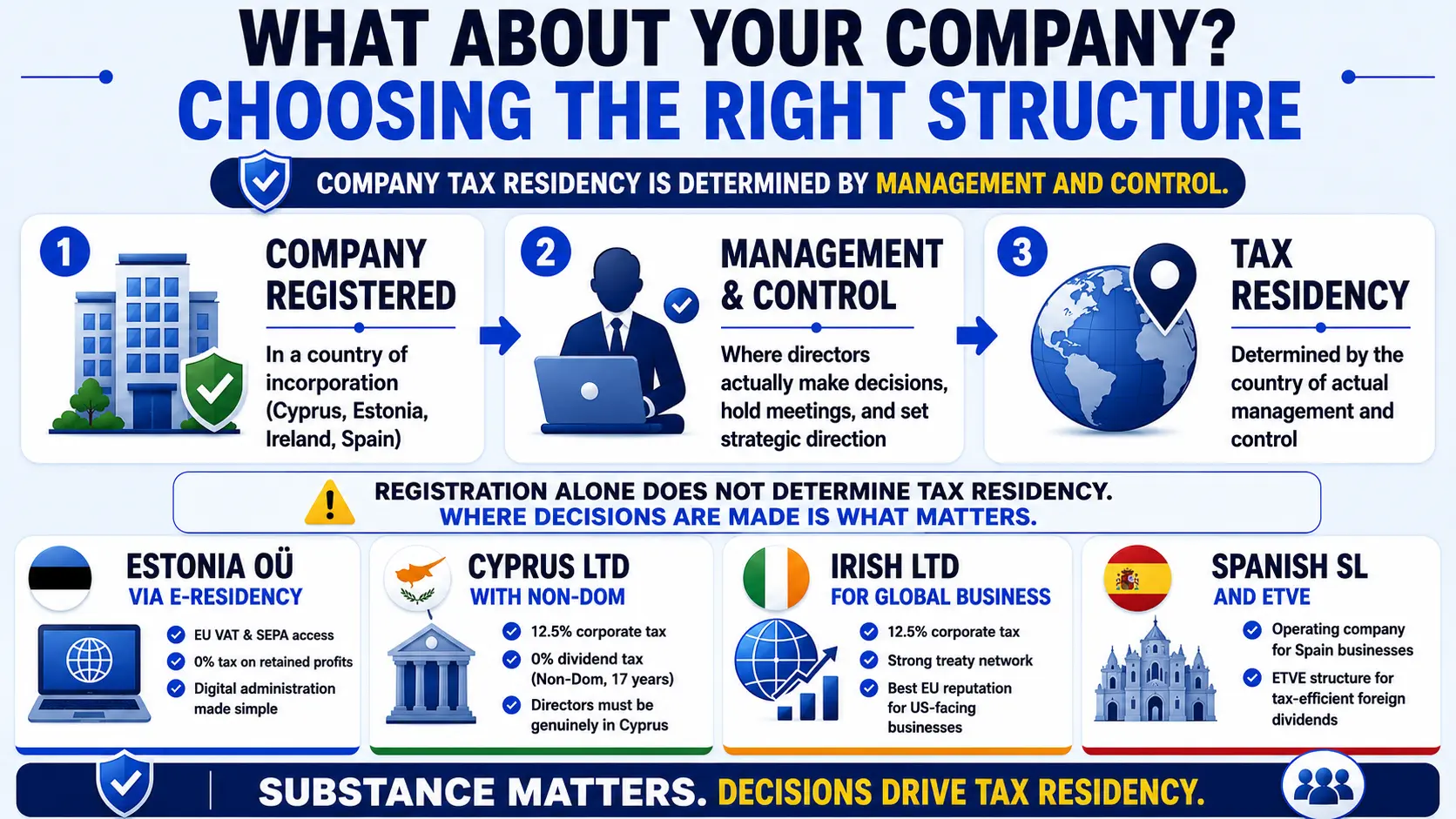
Personal tax residency and company tax residency are governed by different rules and must be addressed separately. An entrepreneur who has correctly established personal tax residency in Cyprus but whose company is managed entirely from the UK has not solved the problem the company remains UK-managed and potentially UK-tax-resident for the same reasons. Company tax residency is determined by a principle called management and control. A company is tax resident in the country where its directors actually make decisions, where its board meetings take place, and where its strategic direction is set. Registration in a particular country does not override this.
Estonian OE via e-Residency
The Estonian company provides EU VAT registration, SEPA banking, and access to the EU single market. Zero percent corporate tax applies to retained profits, with 20 percent due on distributions. The e-Residency infrastructure makes digital administration straightforward. The caveat is management and control if you manage the company from outside Estonia, you may be creating a tax presence in your country of actual residence.
Cyprus Ltd
Combined with Cyprus non-dom personal residency, the Cyprus Ltd structure is the most tax-efficient legitimate structure available within the EU for dividend-generating businesses. Twelve-and-a-half percent corporate tax, zero percent personal dividend tax for non-dom shareholders for 17 years. Directors must genuinely be present in Cyprus to satisfy management and control.
Irish Ltd
Ireland’s corporate tax rate of 12.5 percent applies to trading profits. Ireland offers an English-language legal system, strong treaty network, and the best EU reputation for US-facing businesses. For entrepreneurs whose primary client relationships are in the United States or who want access to US institutional investors, an Irish structure provides credibility that other EU jurisdictions struggle to match.
Spanish SL and ETVE
The Sociedad Limitada is the appropriate operating company for Spain-based businesses. The ETVE holding company structure allows Spanish-resident holding companies to receive dividends from foreign subsidiaries largely free of Spanish tax, making it an efficient option for founders who are genuinely based in Spain long-term.
2026 Comparison Table – Top Nomad Destinations for Entrepreneurs
| Country | Visa Duration | Income Req. | Personal Tax Rate | Company Option | EU Access | Citizenship Path |
| Spain | Up to 5 years | 2,850 EUR per month | 24% flat (Beckham Law) | SL or ETVE | Yes | Yes (10 years) |
| Portugal | Up to 5 years | 3,680 EUR per month | 20% flat (IFICI) | LDA | Yes | Yes (10 years) |
| Estonia | 1 year | Varies by applicant | 20% if resident | OEU via E-Residency | Yes | Yes |
| Georgia | Up to 1 year (visa-free many) | None | 1% on turnover | Individual Enterprise | No | Not applicable |
| Cyprus | 1 year | 3,500 EUR per month | 0% on dividends (Non-Dom) | Cyprus Ltd | Yes | Yes |
| UAE | 10 years (Golden Visa) | Approx 3,500 USD per month | 0% personal tax | Free Zone Company | No | Not applicable |
How UCI Ltd Can Help
UCI Ltd advises entrepreneurs at the intersection of visa strategy, tax residency planning, and company formation. These three areas must be addressed together for a global setup to work legally and efficiently. Treating any of them in isolation is the most common cause of unexpected tax liabilities, compliance failures, and the need for costly retrospective restructuring. UCI’s services for internationally mobile entrepreneurs include
- Company formation in Ireland, Spain, Estonia, Portugal, and Cyprus with full incorporation, banking setup, and ongoing compliance support.
- Cross-border tax residency planning, including home country deregistration advisory and new residency establishment.
- Support with tax residency certificate applications in destination countries.
- Nominee director and registered office services to support substance requirements for EU companies.
- ETVE and international holding structure advisory for founders with multi-country income streams.
- Coordination between immigration advisors and tax professionals to ensure visa applications and tax planning align from the outset.
Conclusion
The right digital nomad setup in 2026 is not just about finding an attractive destination with a well-priced visa. It is about building three things in alignment: a credible and renewable immigration pathway, a defined tax residency with genuine advantages over your home country position, and a company structure that is properly managed and substantiated in the country where you need it to be. The six countries covered in this guide, Spain, Portugal, Estonia, Georgia, Cyprus, and the UAE, each deliver this combination in different ways and for different types of entrepreneurs. Spain suits founders who want an EU lifestyle with a powerful short-term tax incentive. Portugal suits those who think in decades and want a citizenship pathway. Estonia suits founders who want EU company infrastructure without the obligation to live there. Georgia suits those for whom cost efficiency is the primary driver. If you need guidance on choosing the right structure for your circumstances, contact UCI to discuss your international business and residency requirements.