

Starting a limited company in the UK is an important step for entrepreneurs looking to establish a professional business presence. Registering with Companies House provides your business with a separate legal identity, helping protect shareholders’ personal finances while creating opportunities for business growth. Whether you are a UK resident or an international entrepreneur, understanding the registration process, legal requirements, and ongoing responsibilities can help you establish your company efficiently and avoid unnecessary delays.
What Is Companies House?
Companies House is the UK’s official registrar of companies. It is responsible for incorporating businesses, maintaining company records, and making certain corporate information publicly available.
Registering a limited company creates a legal entity separate from its owners. This means the company can enter contracts, own assets, and conduct business in its own name. Shareholders generally benefit from limited liability, although personal guarantees and certain legal responsibilities can create additional exposure.
Entrepreneurs seeking professional assistance can explore UCI Ltd for international company formation and corporate support services.
Why Register a Limited Company in the UK?
A UK limited company offers several advantages for entrepreneurs, startups, and international investors.
Limited Liability Protection
Shareholders are generally responsible for company debts only up to the amount unpaid on their shares. This provides a degree of separation between business liabilities and personal finances.
Professional Business Identity
A registered company receives an official company number and certificate of incorporation. These documents help establish its legal status when dealing with suppliers, customers, and financial institutions.
Business Growth Opportunities
A limited company can issue shares, appoint additional directors, and establish formal ownership arrangements. This structure can be useful for businesses planning expansion or external investment.
Also read – Complete Guide to UK Company Formation for Non-Residents
How to Register a Limited Company with Companies House?
The following steps explain the main requirements for registering a private limited company in the UK.
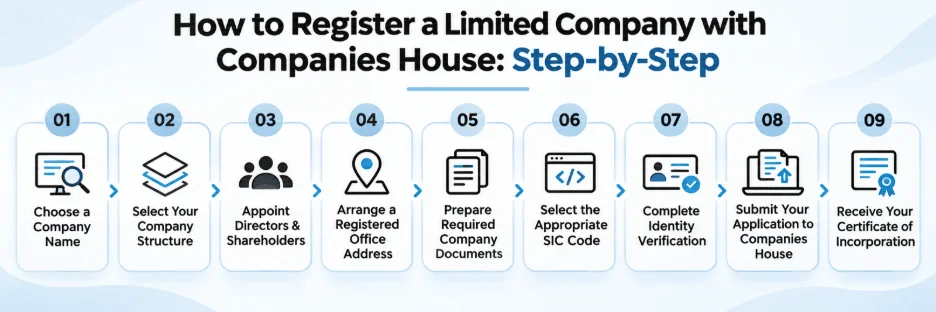
Step 1 – Choose a Suitable Company Name
Start by selecting a unique company name that complies with Companies House regulations. Most private limited companies must include “Limited” or “Ltd” at the end of their registered name.
Before applying, check whether your preferred name is available. You should also review existing trademarks to avoid potential legal disputes.
Step 2 – Select Your Company Structure
Most commercial businesses register as private companies limited by shares. This structure allows shareholders to own the business through shares and receive dividends when legally permitted.
Companies limited by guarantee are another option, commonly used by certain nonprofit organisations and membership bodies.
Choose the structure that best supports your business objectives.
Step 3 – Appoint Directors and Shareholders
Every private limited company must have at least one director. A company limited by shares must also have at least one shareholder, who may be the same person as the director.
You must identify people with significant control (PSCs), including individuals who hold more than 25% of the company’s shares or voting rights.
Directors must meet legal eligibility requirements and complete applicable identity verification procedures.
Step 4 – Arrange a Registered Office Address
Your company must have an appropriate registered office address in the UK. The address must be located in the same UK jurisdiction where the company is registered.
It must be a physical address where official correspondence can be delivered and acknowledged. A PO Box alone is not acceptable.
You must also provide a registered email address, which Companies House does not publish on its public register.
Step 5 – Prepare the Required Company Documents
Before submitting your application, prepare the documents and information needed for incorporation.
These typically include
- Memorandum of association
- Articles of association
- Statement of capital and initial shareholdings
- Director and shareholder details
- People with significant control information
The memorandum confirms the initial shareholders’ intention to establish the company, while the articles explain how the company will be governed.
Step 6 – Select the Appropriate SIC Code
A Standard Industrial Classification (SIC) code describes your company’s business activities.
You must select the code or codes that best represent your intended operations. Choosing accurate codes helps Companies House maintain appropriate business information.
Companies can update their SIC codes when submitting a confirmation statement.
Step 7 – Complete Identity Verification
Companies House requires relevant individuals to verify their identities under the applicable registration rules.
Identity verification can be completed through GOV.UK One Login or an Authorised Corporate Service Provider (ACSP).
After verification, individuals receive a Companies House personal code, which is used when required for company appointments and filings.
Step 8 – Submit Your Application to Companies House
Once your information is ready, complete the incorporation application through the official Companies House registration service.
You will need to provide the company name, registered office, directors, shareholders, PSC details, SIC codes, and incorporation documents.
The standard online registration fee is £100. Most straightforward applications are processed within 24 hours, although complex applications may take longer.
Step 9 – Receive Your Certificate of Incorporation
After Companies House approves your application, you will receive a certificate of incorporation.
This document confirms that your company legally exists and includes its registered name, company number, and incorporation date.
You can then proceed with business banking arrangements, tax administration, and other operational requirements.
Documents Required for Companies House Registration
Preparing the necessary information in advance can help avoid delays.
| Requirement | Description |
|---|---|
| Company Name | Unique name complying with UK regulations |
| Registered Office | Appropriate physical UK address |
| Director Details | Personal information and verification details |
| Shareholder Information | Ownership details and share allocation |
| Incorporation Documents | Memorandum, articles, and capital information |
Additional information may be required depending on the ownership structure and business activities.
How Much Does It Cost to Register a Limited Company?
Companies House charges different fees depending on the registration method.
| Registration Method | Companies House Fee |
|---|---|
| Standard Online Registration | £100 |
| Postal Registration | £124 |
| Same-Day Software Incorporation | £156 |
These are official filing fees. Professional formation services, registered office facilities, and other business support services may involve additional charges.
What Happens After Registering Your Company?
Registering your company is only the beginning. Directors must ensure that the business meets its ongoing legal and financial obligations.
Corporation Tax Registration
Companies are generally registered for Corporation Tax when incorporated through the online service, unless registered as dormant. You should ensure your HMRC business tax account is correctly configured and notify HMRC when required.
Business Bank Account
Opening a dedicated business bank account helps separate company finances from personal transactions. Banks may request incorporation documents, director identification, ownership information, and evidence of business activities.
Annual Accounts and Confirmation Statements
Companies must submit annual accounts and confirmation statements within the applicable deadlines. They must also maintain accurate accounting records and notify Companies House of relevant corporate changes.
VAT and PAYE Registration
Depending on your business activities, turnover, and employment arrangements, you may need to register for VAT or PAYE.
Professional UK company formation services can help entrepreneurs understand incorporation procedures and ongoing administrative requirements.
Conclusion
Registering a limited company with Companies House is a structured process that involves choosing a suitable business name, appointing directors, preparing incorporation documents, completing identity verification, and submitting the registration application.
By understanding these requirements, entrepreneurs can establish their companies efficiently while preparing for ongoing tax, accounting, and reporting responsibilities.
Whether you are a UK resident or an international investor, professional assistance can help simplify the process. Contact Us to discuss your company formation requirements and explore suitable UK business registration solutions.