

Choosing a business name is one of the most consequential decisions you will make as an entrepreneur. It is more than a label. Your name shapes how customers perceive you, how easily they find you online, how memorable your brand becomes, and whether your business can even be legally registered in the first place. Get it right and your name becomes a powerful asset that grows with your business. Get it wrong and you face costly rebranding, legal disputes, or an online presence that is impossible to build.
In 2026, AI business name generators have become essential tools in the founder’s toolkit. These platforms promise to deliver brand-ready names in seconds, replacing what used to take days of brainstorming, agency meetings, and creative workshops. For time-pressed entrepreneurs, that promise is enormously appealing. But how reliable are these tools in practice? Which ones are worth your time? And what do you still need to do yourself?
This guide answers all of those questions. We review the six best AI business name generator tools available in 2026, examine how they work under the hood, share real examples of names they produce, and explain the critical steps you must take after generation to ensure your chosen name is legally safe. Whether you are a first-time founder or an experienced entrepreneur launching a new venture, this guide will help you name your business with both creativity and confidence.
What Is an AI Business Name Generator?
An AI business name generator is an online tool that uses artificial intelligence and natural language processing to suggest potential business names. These tools have evolved significantly over the past few years. Early versions were little more than keyword combiners. Modern tools use sophisticated machine learning models trained on thousands of successful brand names, linguistic patterns, and industry-specific naming conventions.
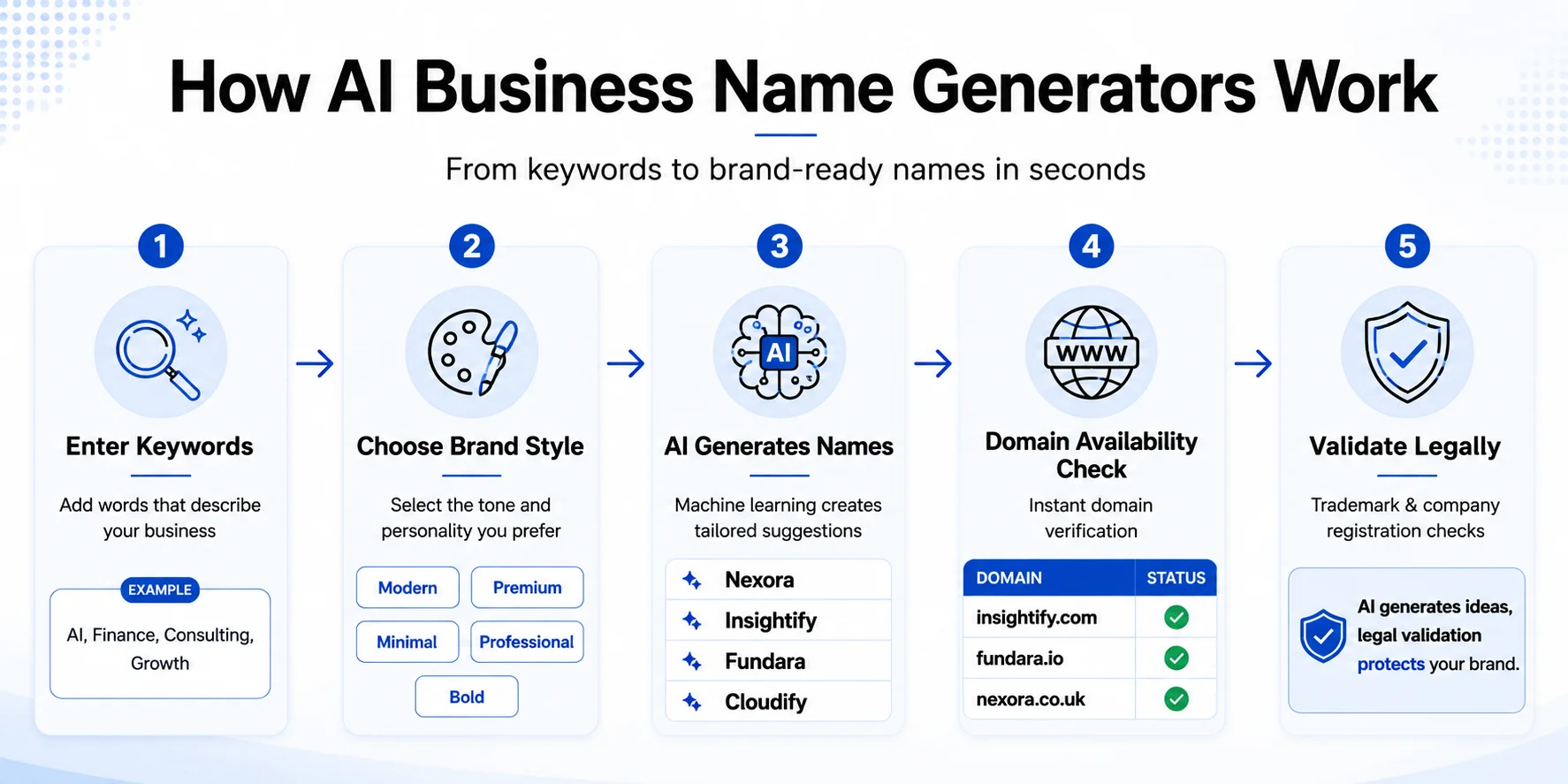
When you use one of these generators, the process typically unfolds in a few straightforward steps:
- You enter keywords related to your business words that describe what you do, your values, or the problem you solve
- You select your industry category so the AI can tailor suggestions to your sector
- You choose a preferred brand style, such as modern and minimal, bold and energetic, or professional and trustworthy
- The AI generates between 50 and 500 name suggestions based on your inputs
- Most tools then check domain availability in real time, showing you which names have available .com, .co.uk, .io, or other extensions
The technology behind these tools analyses linguistic patterns in successful brand names, studies how different industries use language, and applies these learnings to generate suggestions that sound professional, relevant, and original. Some tools also generate complementary logo concepts alongside each name, giving you a visual sense of how the brand might look.
One crucial point to understand from the outset: AI name generators are creative tools, not legal tools. They help you discover and explore potential names. They do not verify whether those names are trademarked, whether other businesses are already using them, or whether they meet the specific legal requirements for company registration in your country. That verification work remains your responsibility.
How Do AI Business Name Generators Actually Work?
Understanding the mechanics behind these tools helps you use them more effectively and set the right expectations. While each platform has its own proprietary approach, most AI name generators share a common underlying process.
The foundation is a large language model or a specialised machine learning model trained on a corpus of real business names, brand names, and product names. The model learns which naming patterns correlate with successful, memorable brands in different industries. It learns that technology companies tend to favour short, coined words with modern sounds, while law firms tend to use founder surnames or words suggesting reliability and expertise.
When you submit your keywords and preferences, the model does not simply match your words against a database. Instead, it generates new combinations using the patterns it has learned. It might blend parts of your keywords with common brand-forming components, create entirely new words that follow the phonetic patterns of successful brands in your sector, or apply stylistic transformations to produce names that feel contemporary and relevant.
The domain availability check happens separately, in real time, by querying domain registrar databases as the names are generated. This is why you see green or red indicators next to each suggestion, telling you whether the .com or other extension is available.
What the AI cannot do is equally important to understand. It has no access to trademark databases. It does not know whether another company has registered a similar name or holds an active trademark. It cannot account for regional naming restrictions, regulated industries, or jurisdiction-specific legal requirements. These gaps in the AI’s knowledge are not a flaw in the technology; they reflect a genuine difference between creative name generation and legal name validation.
Best AI Business Name Generators in 2026
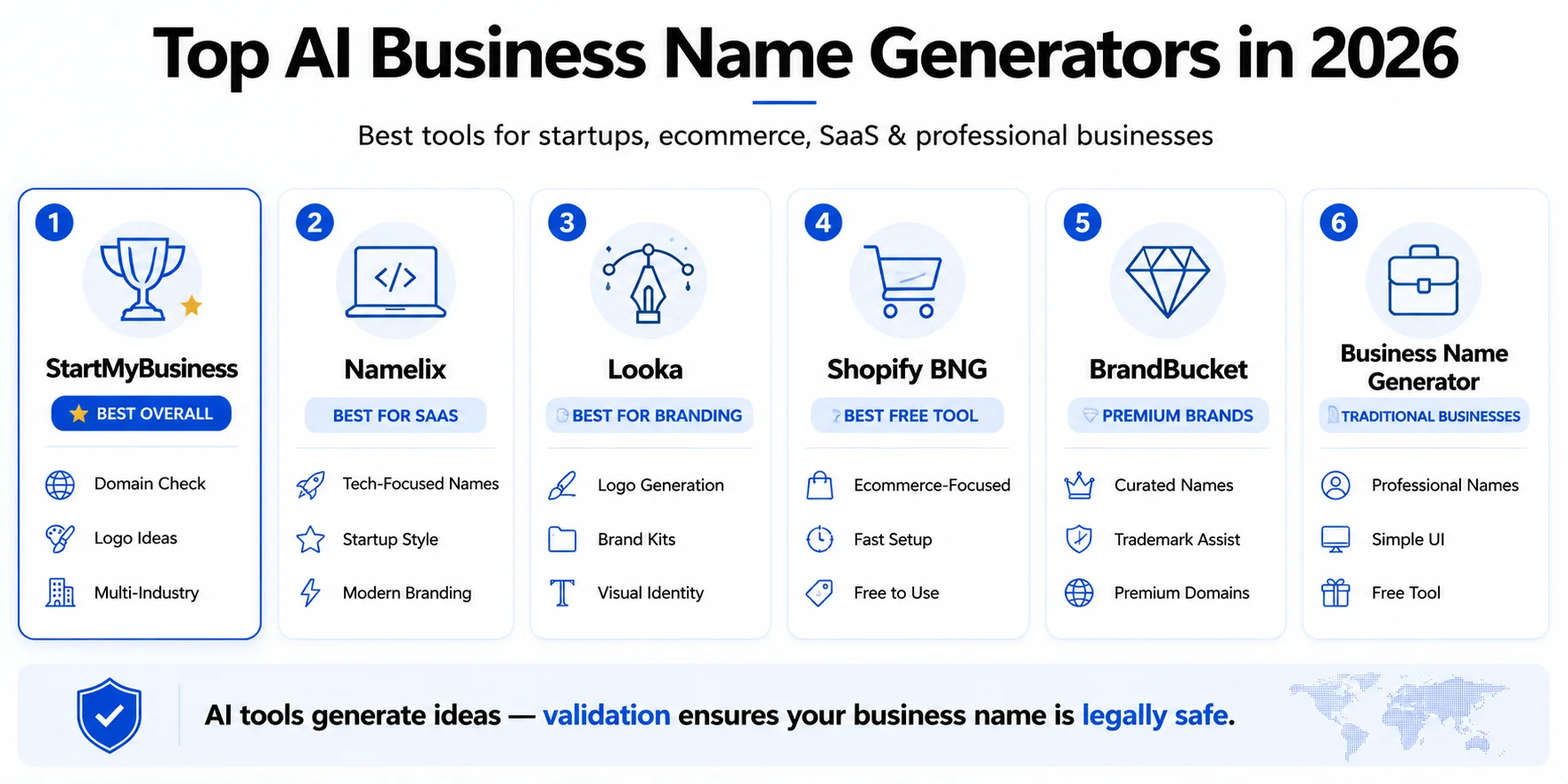
After testing these platforms extensively, here are the six tools we recommend, with an honest assessment of what each does well and where it falls short.
1. StartMyBusiness: Best Overall
StartMyBusiness has established itself as the leading choice for entrepreneurs across all industries. What distinguishes it from competitors is not any single feature but the overall quality and consistency of its output. While other tools might excel in a specific niche or with a particular style of business, StartMyBusiness delivers reliably strong results whether you are naming a fintech startup, a bakery, a consulting firm, or an ecommerce store.
The platform’s interface is refreshingly straightforward. You do not need prior experience with AI tools or branding to use it effectively. Enter a handful of keywords, pick your industry and brand style, and the tool generates high-quality suggestions in under 30 seconds. The suggestions are curated rather than simply numerous — you receive fewer but better options rather than an overwhelming flood of random combinations.
Key features that set StartMyBusiness apart:
- Real-time domain availability checking across .com, .co.uk, .io, and a range of other extensions
- Integrated logo design suggestions that help you visualise the brand alongside the name
- Filtering tools to narrow results by name length, word structure, or stylistic tone
- Support for multiple brand styles from minimal and modern to bold and descriptive
- A clean, intuitive interface that works equally well on desktop and mobile
A practical example demonstrates how the tool performs in real use. A founder building a SaaS analytics platform entered keywords including ‘analytics,’ ‘ai,’ and ‘insights.’ StartMyBusiness returned suggestions including Analync, Insightify, DataMind, and Predictive. Every suggestion had an available .com domain. She chose Insightify, registered the domain the same day, and subsequently built a recognised brand around that name.
As with all AI generators, StartMyBusiness does not perform trademark checks. Every name requires independent legal validation before you use it for company registration or brand investment.
2. Namelix: Best for Tech and SaaS
Namelix has earned a devoted following in the startup community specifically because of its focus on technology companies and software products. The platform uses machine learning trained on successful tech and SaaS brand names, enabling it to generate names that genuinely sound like they belong in the startup world rather than generic business names that could apply to any industry.
The names Namelix produces tend to be short, phonetically modern, and stylistically consistent with the naming conventions of successful software companies. If you have ever noticed that many tech startups use coined words, modified spellings, or short invented terms, Namelix is designed to generate names in exactly that tradition. This specificity is both its greatest strength and its primary limitation.
Key features of Namelix:
- Machine learning model specifically trained on tech and startup brand naming patterns
- Short, punchy name suggestions that align with software and digital product conventions
- Adjustable filters for name length, naming style, and visual logo preferences
- High-quality logo suggestions are included with each generated name
- Strong domain availability checking is integrated throughout the results
The platform’s main limitations are worth knowing before you commit to it. Premium domain names sometimes carry additional purchase costs beyond the standard registration fee. The tool works primarily in English, making it less useful for businesses targeting non-English speaking markets or founders who want multilingual options. And like all AI generators, it provides no trademark checking or legal validation of any kind.
3. Looka: Best for Visual Branding
Looka takes a fundamentally different approach to the naming problem. Rather than treating the name in isolation, Looka understands that a business name only truly makes sense when seen in the context of a complete brand identity. Its platform combines AI-powered name generation with professional visual branding tools, allowing you to see what your chosen name looks like as a finished brand before you commit to it.
When you use Looka, you do not just receive a list of text suggestions. Each name comes paired with a professional logo concept, a colour palette recommendation, and a set of brand mockups showing how the name and logo would appear on business cards, websites, social media profiles, and other marketing materials. For founders who are visual thinkers, this integrated approach is genuinely transformative. You go from abstract name to tangible brand in a single session.
Key features of Looka:
- AI-generated names paired with professional logo concepts and full brand identity mockups
- Colour palette and typography recommendations aligned with each suggested name
- Brand mockups showing real-world application across business cards, websites, and signage
- Particularly well-suited to creative businesses, lifestyle brands, and design-conscious founders
- Design quality that rivals professional agency output rather than generic templates
The trade-offs are real and worth considering. Downloading your logo and brand assets requires payment, so the visual elements you see during the exploration phase are not freely available for use. You also have somewhat less control over the pure name generation process compared to keyword-focused tools, because the platform prioritises visual coherence. Some founders find this limiting if they have specific language preferences. As always, no legal validation is included.
4. Shopify Business Name Generator: Best Free Option
Shopify built its business name generator with a specific audience in mind: entrepreneurs launching online stores and ecommerce businesses who need to move quickly and do not have a budget for premium naming tools. The tool is completely free, requires no account creation to use, and is deliberately simple.
You input your industry keywords and preferred style, and the tool returns name suggestions tailored for online retail and e-commerce. Because it is built by Shopify, the results integrate naturally with the Shopify ecosystem. You can check domain availability, register a domain directly through the platform, and begin setting up your store without leaving the workflow.
Key features of Shopify’s generator:
- Completely free with no subscription or sign-up required
- Optimised for e-commerce and online retail naming conventions
- Seamless integration with Shopify’s domain registration and store setup tools
- Fast and simple interface results in seconds with minimal inputs
- Useful starting point even for non-Shopify businesses due to the zero cost
The limitation that most users notice quickly is that the suggestions tend toward the generic. The platform generates names that are safe and functional but often lack the distinctive character or memorable quality that makes a brand stand out in a competitive market. If you are building a commodity product store, this may not matter. If you are building a premium brand or a highly specialised retail business, Shopify’s suggestions may not give you the differentiation you need. The tool is best used as a free starting point for brainstorming rather than a definitive naming solution.
5. BrandBucket: Best for Premium Quality
BrandBucket operates on a fundamentally different model from every other tool on this list. Rather than generating names algorithmically on demand, BrandBucket offers a curated marketplace of premium business names that have been hand-selected and refined by professional naming experts. Artificial intelligence plays a supporting role in the curation process, but what you are ultimately buying is human editorial judgement applied at scale.
Each name in the BrandBucket marketplace comes as a complete package. The name has already been checked for basic trademark conflicts. A matching domain is included. Logo suggestions, colour palette recommendations, and in many cases assistance with trademark registration are all part of the offering. You are not just buying a name; you are buying a brand foundation.
Key features of BrandBucket:
- Professionally curated names with markedly higher quality than algorithmically generated alternatives
- Each purchase includes the matching domain; no separate domain registration required
- Logo suggestions and colour palette recommendations included in the package
- Basic trademark checking is performed before names are listed on the marketplace
- Trademark registration assistance available as part of the premium offering
The obvious and significant drawback is cost. BrandBucket names are priced at a premium, typically starting from several hundred pounds and rising to several thousand for the most distinctive or desirable names. A subscription is required to browse the full marketplace. This makes BrandBucket inaccessible for bootstrapped founders or entrepreneurs testing early-stage ideas. The investment makes most sense for well-funded startups, established businesses launching new product lines, or founders for whom the brand name is a primary competitive asset.
6. Business Name Generator (BNG): Best for Traditional Businesses
Business Name Generator is the most straightforward tool on this list. It does not attempt to be sophisticated or visually impressive. Its value proposition is simplicity: enter your keywords, pick your industry from more than 50 categories, and receive practical name suggestions with domain availability checks. Nothing more, nothing less.
This simplicity turns out to be exactly right for a specific type of business. Consultants, accountants, solicitors, tradespeople, and local service businesses do not need a trendy tech name or a visually stunning brand identity tool. They need a professional-sounding name that communicates what they do and earns the trust of local customers. For these businesses, BNG’s practical, unpretentious approach often produces more appropriate results than tools designed with startups in mind.
Key features of BNG:
- Over 50 industry categories providing genuinely tailored suggestions for traditional sectors
- Fast and simple interface with no unnecessary features or distractions
- Domain availability checking for every suggestion
- Save and shortlist favourite names for later comparison
- Completely free to use with no account required
The limitation is that the AI underpinning BNG is less sophisticated than newer platforms. The suggestions sometimes follow predictable patterns and can feel repetitive after the first page of results. If you are looking for a truly distinctive or creative name, BNG will likely require more refinement work on your part before you find something you love. It is best thought of as a solid foundation for brainstorming rather than a source of ready-to-use names.
Tool Comparison at a Glance
The table below compares all six tools across the dimensions that matter most when choosing a name generator for your business.
|
Tool |
Best For |
Domain Check |
Logo Included |
Pricing |
Legal Validation |
|
StartMyBusiness |
Any business type |
Yes |
Yes |
Free / Paid tiers |
No |
|
Namelix |
Tech & SaaS startups |
Yes |
Yes |
Free (premium domains extra) |
No |
|
Looka |
Visual / creative brands |
Yes |
Yes (paid download) |
Paid subscription |
No |
|
Shopify BNG |
Ecommerce / online stores |
Yes |
No |
Free |
No |
|
BrandBucket |
Funded / premium brands |
Included in package |
Yes |
Premium (£500–£5,000+) |
Trademark assist included |
|
Business Name Generator |
Traditional & professional services |
Yes |
No |
Free |
No |
Real Examples of AI-Generated Company Names by Industry
The best way to evaluate these tools is to look at the kinds of names they actually produce. The following table shows real examples of AI-generated names across six industries, explains why they work as brand names, and identifies which tool is most likely to produce that style of suggestion.
|
Industry |
Example Names |
Why They Work |
Best Tool |
|
Technology / Software |
Nexora, Cloudify, Zyntra, Lumina Tech, Velocity AI |
Short, modern, hints at function, easy to remember |
Namelix, StartMyBusiness |
|
Consulting / Professional Services |
AdvisoryOne, ProCore Solutions, BizNest, Insight Partners |
Communicates trust, credibility, and expertise |
Business Name Generator |
|
Retail / E-commerce |
Shopivo, TrendNest, UrbanCart, PulseMarket, VendorHub |
Commercial feel, modern, appeals to online shoppers |
Shopify BNG, StartMyBusiness |
|
Creative Agencies |
CreatWeave, PixelForge, BrandForce, IdeaSpark, DesignFlow |
Emphasises creativity, process, and innovation |
Looka, Namelix |
|
Health & Wellness |
Vitalize, WellNest, PureCore, CalmPath, NourishCo |
Conveys care, positivity, and wellbeing without clinical coldness |
StartMyBusiness, Looka |
|
Finance & Fintech |
Fundara, ClearLedger, CapitalNest, WealthEdge, Payvio |
Sounds secure and professional, hints at growth or clarity |
Namelix, BrandBucket |
A few patterns emerge from these examples that are worth noting. The most effective AI-generated names tend to be short, typically one or two syllables, because short names are easier to remember, spell, and say aloud. They often use coined words or modified spellings to ensure uniqueness and domain availability. And they consistently hint at the business’s purpose without describing it too literally, leaving room for the brand to evolve.
Advantages of Using AI Business Name Generators
AI name generators have become popular for good reason. They offer several genuine advantages over traditional naming approaches that matter to founders working under real constraints.
Speed is the most immediate benefit. Traditional brainstorming sessions can consume days or even weeks, involving multiple stakeholders, creative workshops, and rounds of review. AI generators produce hundreds of options in under a minute. This allows you to explore multiple naming directions simultaneously and move quickly from the idea stage to actual brand decisions. For entrepreneurs on tight timelines, this compression of the creative process has real commercial value.
Breadth of ideas is the second major advantage. Even the most creative human brainstormer has cognitive blind spots. We tend to reach for familiar patterns and overlook combinations that feel unusual. AI generators do not have this limitation. They explore the full space of possible name constructions, surfacing combinations you would never have considered on your own. Many founders report that while they did not use the AI suggestions directly, exploring them helped them understand what kind of name they were actually looking for and inspired their eventual choice.
The practical value of integrated domain checking should not be underestimated. Before these tools existed, founders would often fall in love with a name and then discover the domain was taken or prohibitively expensive. AI generators eliminate this frustration by showing domain availability as part of the generation process, allowing you to filter for names that have practical online viability from the start.
Cost efficiency is the final key advantage. Professional naming agencies charge between £2,000 and £10,000 for comprehensive naming services. AI tools are either free or available for under £100 per month. For bootstrapped startups or solo founders managing tight budgets, this cost difference is the difference between being able to afford professional-quality creative exploration and not.
Critical Limitations You Must Understand
The advantages of AI name generators are real, but so are their limitations. Understanding these limitations is not optional it is essential to use these tools safely.
The most important limitation is the complete absence of trademark checking. AI generators do not search trademark databases. They have no way of knowing whether your chosen name is already registered as a trademark by another company. This matters enormously because trademark law does not require exact duplication to create a conflict. A name that is confusingly similar to an existing trademark can give rise to legal action even if the exact spelling is different. If you use an AI-generated name without conducting a proper trademark search, you may be building your brand on legally unstable ground.
Related to this is the risk of unknown name conflicts. AI models are trained on patterns in existing names, which means they sometimes generate names that are already in use by other businesses, particularly smaller companies that do not have high online profiles. A name that appears original to the AI may already be associated with an existing business in your region or industry.
AI generators also do not know jurisdiction-specific legal requirements. The UK requires companies to include a suffix such as Ltd or PLC. Certain words are restricted in company names and require regulatory approval to use. Different countries have different naming rules, and some industries face additional restrictions. An AI generator will not flag any of these issues. It will happily suggest names containing restricted words or structures that cannot be legally registered.
There is also a subtler risk worth naming: the false confidence that comes from seeing a polished name with an available domain. When a tool presents you with a name, a logo concept, and a green tick on the domain availability, it creates an impression of completeness. Many founders mistake this sense of completeness for genuine validation. They skip the legal checks because everything looks ready to go. Then they discover problems months later, after they have already invested in branding and marketing.
The key limitations to remember:
- No trademark database access, you must run your own searches
- No knowledge of existing businesses using similar names in your region
- No awareness of restricted words or industry-specific naming regulations
- No understanding of jurisdiction differences in company registration rules
- Domain availability is not the same as legal availability. A name can have an open domain but be trademarked
How to Choose the Right Business Name
Choosing a business name is both a creative decision and a practical one. The creative part is about finding a name that resonates, feels right for your brand, and appeals to your target customers. The practical part is about ensuring that the name is actually available, legally safe, and operationally viable. Both parts matter equally.
Start the creative process with a clear brief. Before you open any AI tool, spend 20 to 30 minutes writing down answers to a few key questions: What does your business do, and who does it serve? What feeling do you want your brand to evoke? What are the core values you want your name to reflect? What competitors or comparable brands do you admire, and why? Having clear answers to these questions gives the AI much more to work with and helps you evaluate suggestions more quickly when they appear.
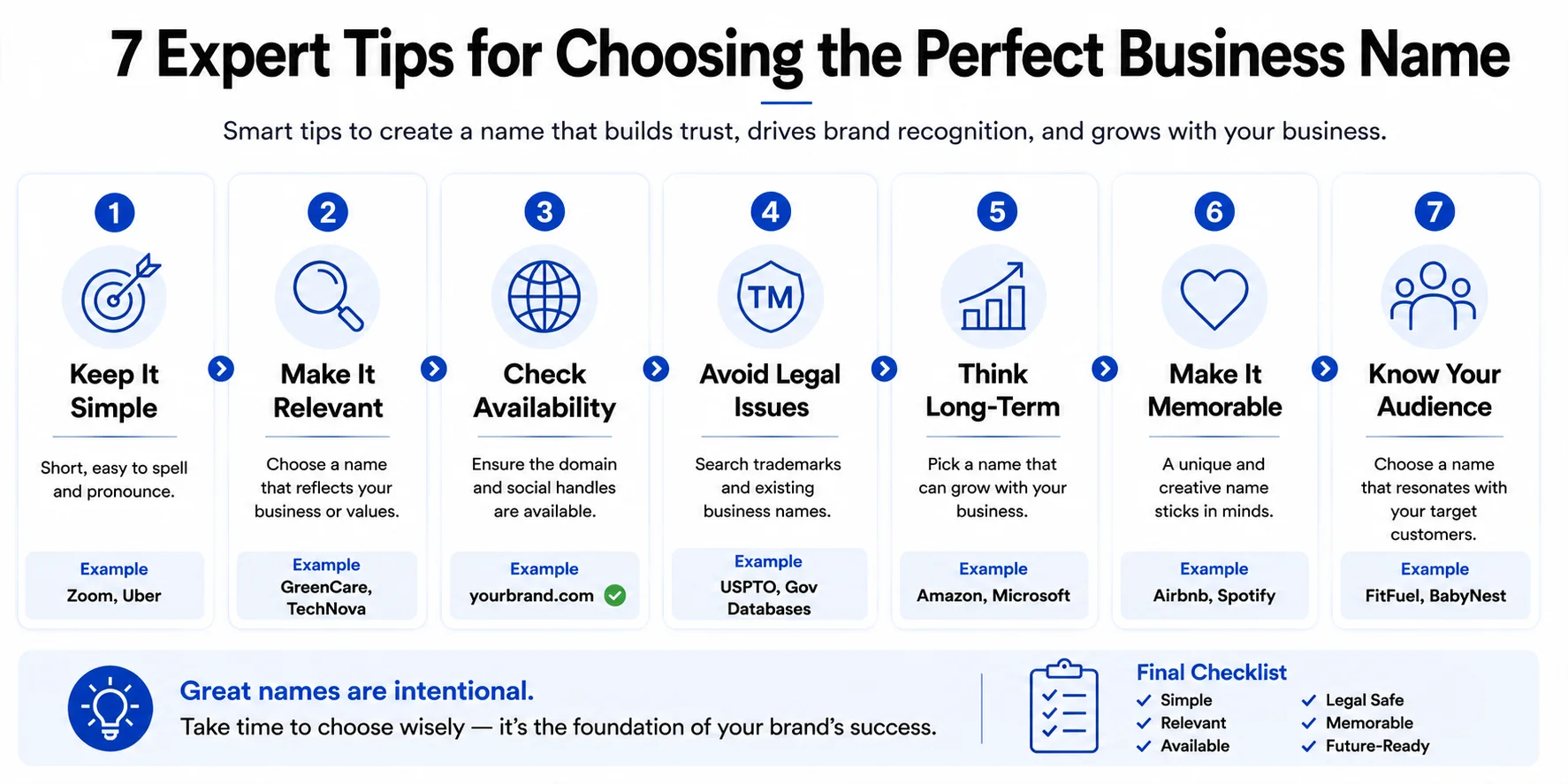
When you are evaluating names, apply these practical criteria:
- Easy to pronounce and spell: people should be able to spell it correctly after hearing it once, without asking you to repeat it
- Memorable: short, distinctive, and different enough from competitors to stand out in people’s minds
- Relevant without being limiting: hints at what you do but does not trap you in a narrow description that becomes a problem as you grow
- Visually workable: consider how it will look in a logo, on a business card, and as a URL
- Domain available: ideally as a .com or the most relevant extension for your market
- Social handles available: you should be able to claim matching handles on the platforms relevant to your business
- Legally available: no conflicting trademarks, no existing business using the same name, compliant with local registration rules
Beyond the immediate practical criteria, think about longevity. A name should not be tethered to current trends or fashionable terminology that may feel dated in five years. It should be broad enough to accommodate the evolution of your product or service offering. And it should mean something to your target customers — ideally something positive that reinforces why they should choose you.
A useful exercise before making a final decision is to test your shortlisted names with a small group of people from your target audience. Say each name aloud, show it in text, and ask people what they think the business does and how they feel about the name. You will often learn things that no AI generator could tell you.
Step-by-Step Name Validation Guide
This is the process every founder should follow before committing to a business name. Each step is important. Do not skip any of them, especially if you are planning to invest in branding, website development, or marketing materials before completing your company registration.
|
Validation Step |
Tool / Resource |
Time & Cost |
|
1. Trademark search |
USPTO (US), EUIPO (EU), IPO (UK) — all free |
15–20 mins, free |
|
2. Company registry check |
Companies House (UK); state or country business registry |
5–10 mins, free |
|
3. Domain history check |
WHOIS lookup, Wayback Machine (archive.org) |
5 mins, free |
|
4. Google & social media search |
Google, Instagram, X/Twitter, LinkedIn, Facebook |
10–15 mins, free |
|
5. International name check |
WIPO Global Brand Database for international marks |
20–30 mins, free |
|
6. Professional legal review |
Qualified IP lawyer or online legal service |
3–5 days, £500–£1,500 |
Steps 1 through 5 can all be completed yourself using free online resources. Allow approximately two to three hours to work through all of them thoroughly for a single name. If you are validating several shortlisted names, block out half a day.
Step 6, the professional legal review, is an investment rather than an expense. An IP lawyer will conduct a more comprehensive trademark search than you can do yourself, review jurisdiction-specific naming requirements, provide written legal opinion on the name’s availability and risks, and advise on trademark registration strategy. The typical cost of £500 to £1,500 is modest compared to the cost of discovering a trademark conflict after you have spent thousands on branding and website development.
For businesses where the brand name is central to success — which is most businesses — professional legal review before registration is not optional. It is the step that transforms an AI-generated suggestion into a legally protected business name.
Real-World Case Studies
Case Study 1: The Founder Who Got It Right
An experienced entrepreneur decided to use Namelix to generate names for her new SaaS startup in the project management space. She spent 20 minutes entering different keyword combinations and experimenting with the tool’s style filters. She generated several hundred suggestions in total and shortlisted eight names she genuinely liked.
Rather than immediately registering a domain and starting branding work, she spent the next morning working through her validation checklist. She searched the USPTO and EUIPO trademark databases for each of her eight names. Three had conflicts she had not anticipated. She removed those from her list and rechecked the remaining five on Companies House and her state business registry. Two more were eliminated because similar names were already registered.
With three names remaining, she verified domain availability, checked social media handle availability, and ran Google searches to look for any companies or products using similar names. She then hired an IP lawyer for £750 to conduct a comprehensive trademark search and provide written legal opinion on her preferred choice.
The lawyer confirmed that her chosen name, CloudSync, was available and clear for registration. She registered her company, secured her domains and social handles, and invested in professional branding. Her business launched without any naming complications, and CloudSync became a recognised name in its niche within two years of launch.
Case Study 2: The Costly Shortcut
A different founder took a very different approach. She was excited about a name she had found using a free online generator. She thought it sounded professional, the .com domain was available, and she loved how it looked as a logo concept. Within 48 hours of finding the name, she had registered the domain, commissioned a logo design, and paid a web developer to begin building her site.
She did not run a trademark search. She did not check the company registry. She did not do a Google search to see if other businesses were using the same or similar names. She was excited and wanted to move fast.
Over the following months, she invested approximately £5,000 in branding, website development, and marketing materials. She launched her business and began building an audience. Six months after launch, she received a solicitor’s letter. A UK company held an existing trademark on a nearly identical name in the same industry. The letter demanded she cease using the name immediately.
She was forced to rebrand entirely. She lost her domain, her logo, her website, and all of the brand recognition she had built over six months. The rebrand cost her additional thousands in design and development fees, and she lost months of momentum that she could have spent growing her business. Every element of this outcome was preventable. A morning spent on basic validation would have identified the conflict before a single pound had been spent on branding.
Should You Use AI Business Name Generators?
The answer is yes but with a clear understanding of what they can and cannot do for you. AI business name generators are excellent tools for the creative phase of the naming process. They help you explore possibilities, discover naming styles you might not have considered, and generate a large pool of options quickly and cheaply. Used in this way, they are genuinely valuable tools that most entrepreneurs would benefit from.
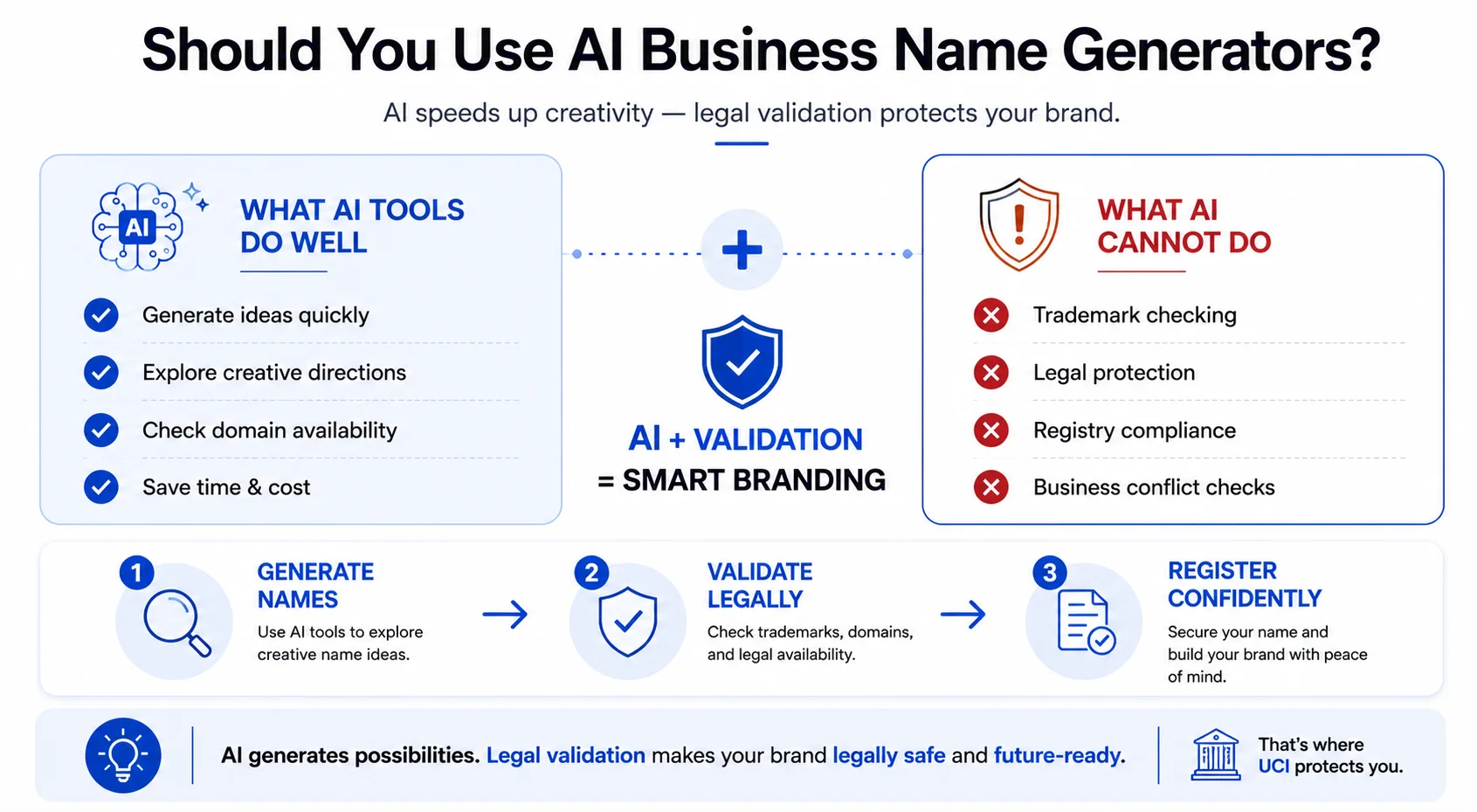
The problem arises when founders treat AI generators as the entire naming process rather than the first stage of it. When you use a generator, get excited about a name, see the domain is available, and immediately start spending money on branding, that is when things go wrong. The tool has given you a creative starting point. It has not given you legal certainty.
The balanced approach that experienced founders use combines three stages:
- AI generation for speed and creative inspiration: use free or low-cost tools to explore hundreds of options quickly
- Self-directed validation using free tools: work through the trademark databases, company registries, and social media checks yourself
- Professional legal review before registration: Invest in an IP lawyer to confirm your chosen name is clear before you build your brand around it
This three-stage approach gives you the speed and creativity of AI tools without sacrificing the legal protection your business needs. It typically costs between £500 and £1,500 in total, mostly for the legal review, and can usually be completed within a week. That is a very small investment relative to the cost of getting it wrong.
Expert Tips for Naming Success in 2026
After working with hundreds of founders through the naming and registration process, here is the practical advice that makes the biggest difference:
- Start with more options than you think you need, generate at least 100 names before shortlisting, because good names are rare, and you want a large pool to draw from
- Do not fall in love with your first great idea. The excitement of finding a name you like can prevent you from exploring options that might be even better
- Test names by saying them aloud in context, ‘Hi, I’m from [name]’ and ‘Have you heard of [name]?’ reveal how a name sounds in real conversation
- Get feedback from people who match your target customer profile, not just family and friends who will tell you what you want to hear
- Check the name’s meaning in other languages if you plan to operate several well-known brand names internationally, as this has caused embarrassment because of unintended meanings in other markets
- Think about abbreviations and initials, make sure the shortened form of your name does not spell or suggest something unfortunate
- Register your domain as soon as you have a serious candidate, even before completing all your validation. Good domains move quickly
- Secure social media handles simultaneously with domain registration, even if you do not plan to use every platform immediately
- Use AI tools for inspiration, not as a substitute for judgment. The best final names often combine an AI-generated idea with your own refinement and personal input
Final Advice
Your business name deserves serious thought, but it should not be a source of paralysis. The naming process is one of the areas where founders most commonly overthink the creative elements and under-invest in the legal and practical elements. AI generators can help you move through the creative phase quickly and inexpensively. The legal validation phase is where you need to slow down and be thorough.
The most successful naming outcomes we have seen combine three things: a distinctive, memorable name that genuinely fits the brand; a domain and social media presence that reinforces it; and legal confirmation that the name is clear for use and registration. AI tools can help you find the first. The validation process secures the second and third. None of these three elements is optional.
Many of the most recognisable businesses in the world today operate under names that were generated, at least in part, by AI tools or algorithmic processes. The name itself is not what determines success. What determines success is the combination of the right name, properly validated, and the quality of the business behind it.
Take the process seriously. Use the best tools available. Do the validation work. Then move forward confidently with a name that is both creative and legally protected.