

A competitor SWOT analysis is a structured method for evaluating a rival’s strengths, weaknesses, opportunities, and threats so you can sharpen your own competitive positioning. Unlike a standard SWOT analysis that looks inward at your own business, this version turns the lens outward, focusing entirely on competitors, and feeds your strategic planning with actionable market intelligence.
Most businesses know their own strengths. Far fewer have a clear, evidence-based picture of where their competitors are vulnerable, where the market is shifting, and what specific gaps they can exploit right now. That is the gap a well-executed competitive SWOT analysis closes.
Used correctly, this framework helps you understand why certain rivals rank higher in search results, price their services more effectively, or retain clients at a higher rate. It also reveals where they are weakest, and where you have a realistic opportunity to outperform them.
According to a Bain and Company study, companies that regularly conduct competitor analysis and act on the findings outperform their peers by up to 30%. The difference is not just doing the analysis; it is building a systematic process that turns competitive intelligence into concrete strategic decisions.
This guide walks you through that process, step by step, with real-world examples, practical tools, and a ready-to-use framework you can apply immediately to your business.
What Is a Competitive SWOT Analysis?
A competitive SWOT analysis, also referred to as a competitor SWOT or a SWOT for competitor analysis, is the process of mapping a specific rival’s internal capabilities and external environment across four dimensions. The acronym SWOT stands for Strengths, Weaknesses, Opportunities, and Threats.
The SWOT framework was originally developed as an internal business planning tool. Applying it to competitors is a natural extension that has become standard practice in strategic planning, competitive intelligence, and market positioning work across virtually every industry.
| SWOT Dimension | What It Reveals About a Competitor | How You Use It Strategically |
| Strengths | What they excel at and why clients trust them | Benchmark your own quality and identify where you must match or exceed them |
| Weaknesses | Where they fall short or frustrate their clients | Identify service gaps and positioning opportunities you can capture |
| Opportunities | External trends or shifts they are capitalising on | Understand where market demand is heading and move early |
| Threats | External risks pressing on their business model | Prepare your own defences before the same threats affect you |
The key conceptual distinction is this: a standard SWOT analysis is a mirror, reflecting your own business at you. A competitive SWOT analysis is a window, giving you a clear view of how rivals operate, where they are exposed, and what they are doing that you are not.
Important: The goal is not to copy competitors. It is to understand the landscape well enough to make smarter decisions about where to compete, how to differentiate, and which opportunities to pursue first.
Why Competitive SWOT Analysis Matters and Beyond
Markets move faster than they ever have. A competitor that appeared weak six months ago may have secured new funding, launched a digital product, redesigned their onboarding, or aggressively built backlinks. Without a regular competitive analysis process, you are navigating by memory in a market that has already moved on.
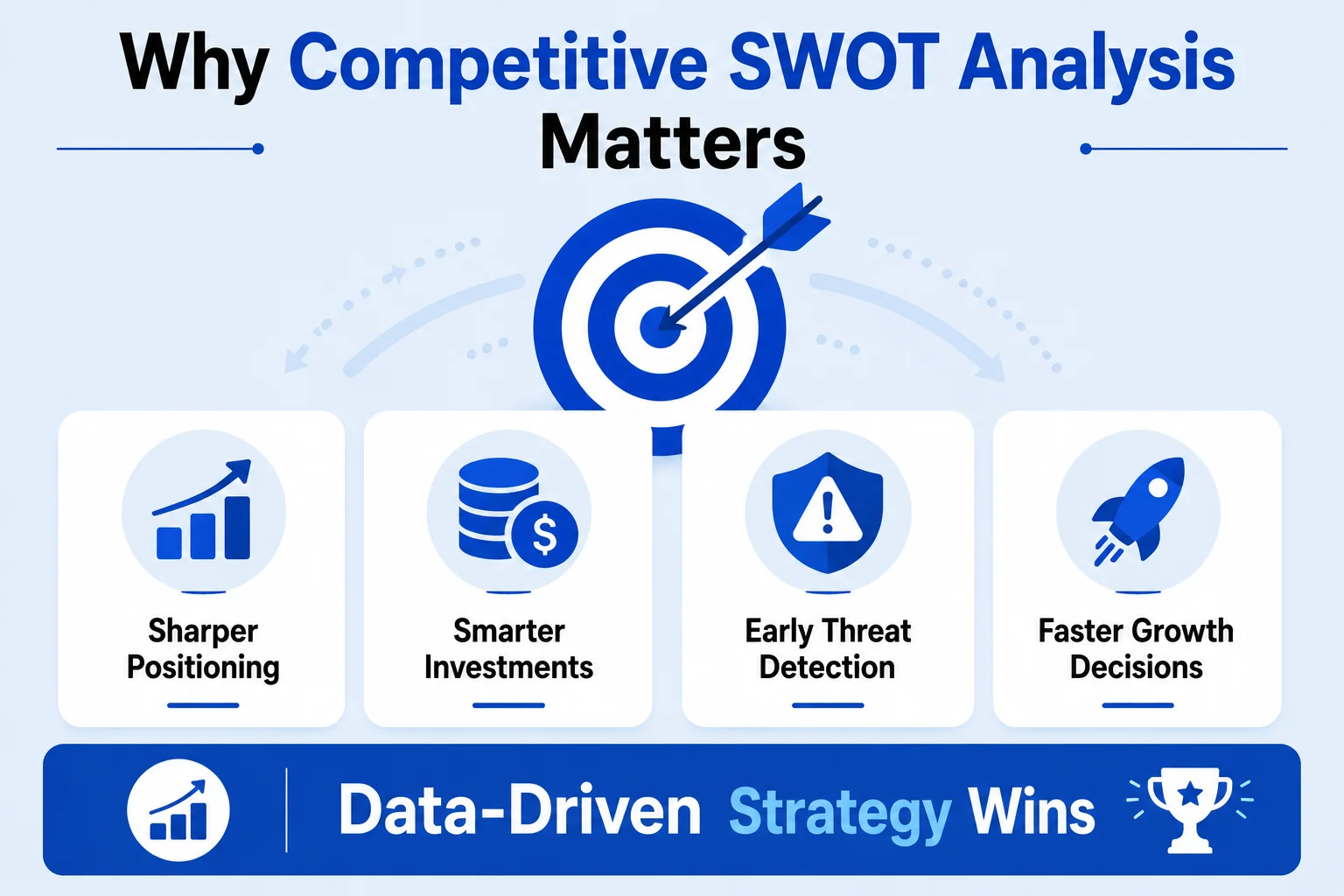
Here are the core business outcomes a well-executed competitive analysis SWOT enables:
- Sharper positioning. When you know exactly what competitors do well and where they fall short, you can craft messaging that fills the gap rather than repeating what everyone else says.
- Smarter resource allocation. Instead of investing across all fronts, competitive intelligence tells you where targeted investment will produce the highest return.
- Earlier threat detection. Identifying potential threats before they materialise, whether regulatory shifts, new market entrants, or technology disruption, gives you time to respond rather than react.
- Better client conversations. Sales teams equipped with competitive SWOT data can handle objections more effectively and articulate differentiation with evidence rather than claims.
- Stronger strategic planning. Long-term planning is only as good as the market assumptions underneath it. Competitive SWOT analysis grounds those assumptions in reality.
Harvard Business Review consistently highlights that companies with systematic competitor monitoring are significantly more likely to anticipate disruptive market shifts and respond before their market share erodes. The firms that struggle are those that wait until a competitive threat is already visible in their revenue before acting.
Step 1: Identify the Right Competitors to Analyse
The quality of your competitive SWOT analysis depends almost entirely on picking the right rivals. Analysing a company that is not actually competing for the same clients in the same markets is a waste of time. Analysing one that is competing aggressively and winning is essential.
Start by mapping your competitive landscape into two tiers.
Direct Competitors
These are businesses offering the same core service or product to the same target markets at a comparable price point. For corporate services and company formation firms, this typically includes:
- Company formation agencies operating in your target jurisdictions (UK, EU, UAE, US)
- Accounting and tax advisory firms that also handle incorporation for international founders
- Online incorporation platforms such as Stripe Atlas, 1st Formations, or Company Bureau
- Legal firms that specialise in cross-border business setup and corporate structuring
Indirect Competitors
These are businesses solving the same underlying problem but through a different model or at a different price point. They are often overlooked but increasingly important as the market evolves. Examples include:
- DIY incorporation guides and template services targeting cost-conscious founders
- Local accountants who occasionally handle registrations as a side service
- Freelance consultants offering ad hoc setup support via platforms like Upwork
- Government digital company registration services, such as the Estonia e-Residency model, which enable self-service incorporation
How to Identify Your Competitors Systematically
Do not rely on memory or instinct. Use a structured approach:
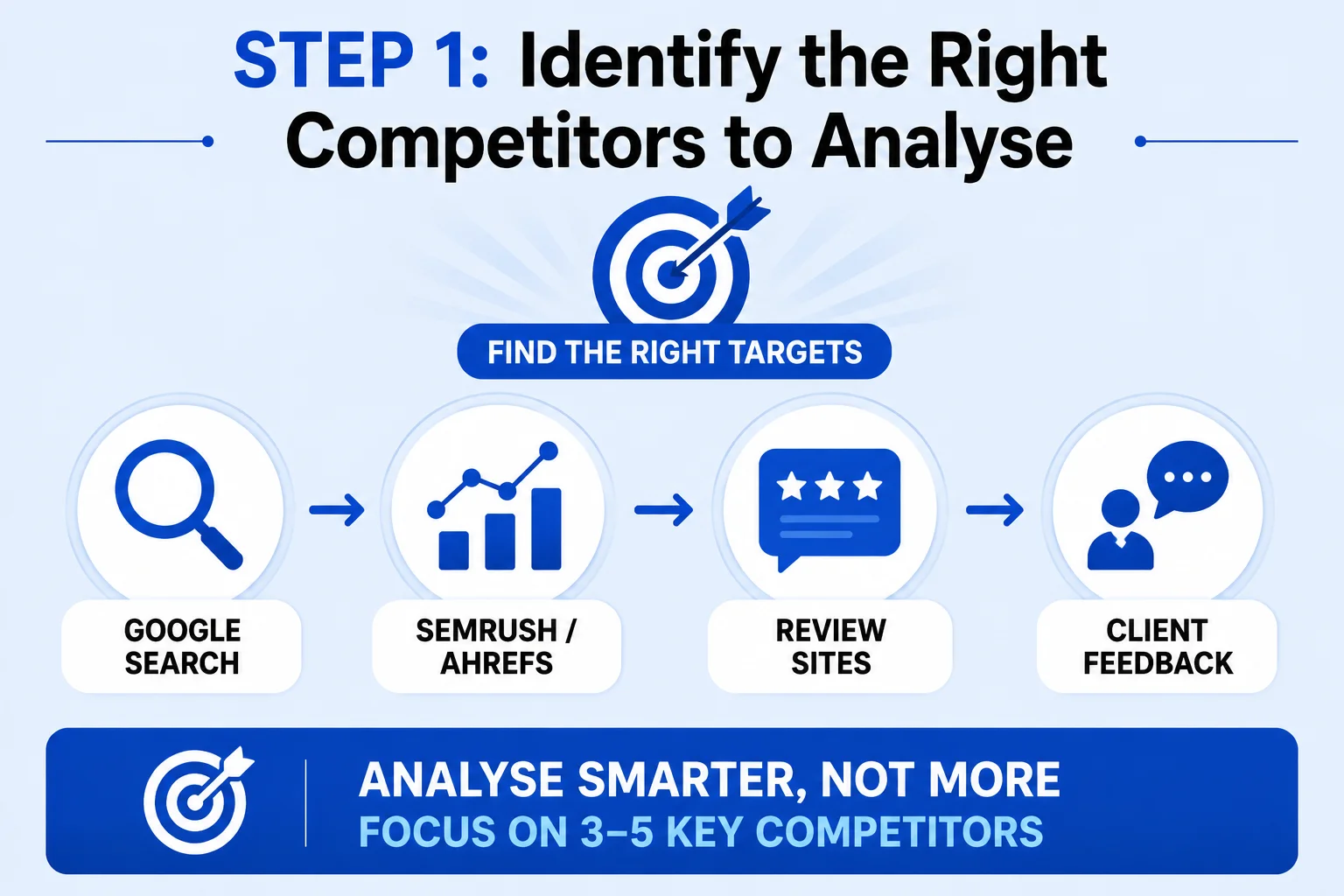
- Google Search. Search your primary target keywords (for example, “company formation UK” or “incorporate in Netherlands”) and list the top 10 organic results. These are the sites winning the traffic you want.
- SEMrush or Ahrefs. Enter your domain and use the Competitors or Organic Competitors report to find sites targeting the same keyword clusters.
- Review Platforms. Search Trustpilot, Clutch, and Google Reviews for your service category. Rated alternatives are actively winning clients.
- Community Research. Founder communities on LinkedIn, Reddit (r/entrepreneur, r/smallbusiness), and Slack groups regularly recommend specific services. Monitor these mentions to understand who founders choose and why.
- Client Feedback. Ask clients which other providers they considered before choosing you. The answer is often more useful than any tool.
Recommendation: Analyse 3 to 5 direct competitors thoroughly rather than attempting to cover 15 superficially. Depth produces actionable insight. Breadth produces noise.
Step 2: Analyse Competitor Strengths
Analysing a competitor’s strengths means understanding what they do better than most players in the market, and why clients consistently choose them. This is the first quadrant of the SWOT framework and often the most humbling to complete honestly.
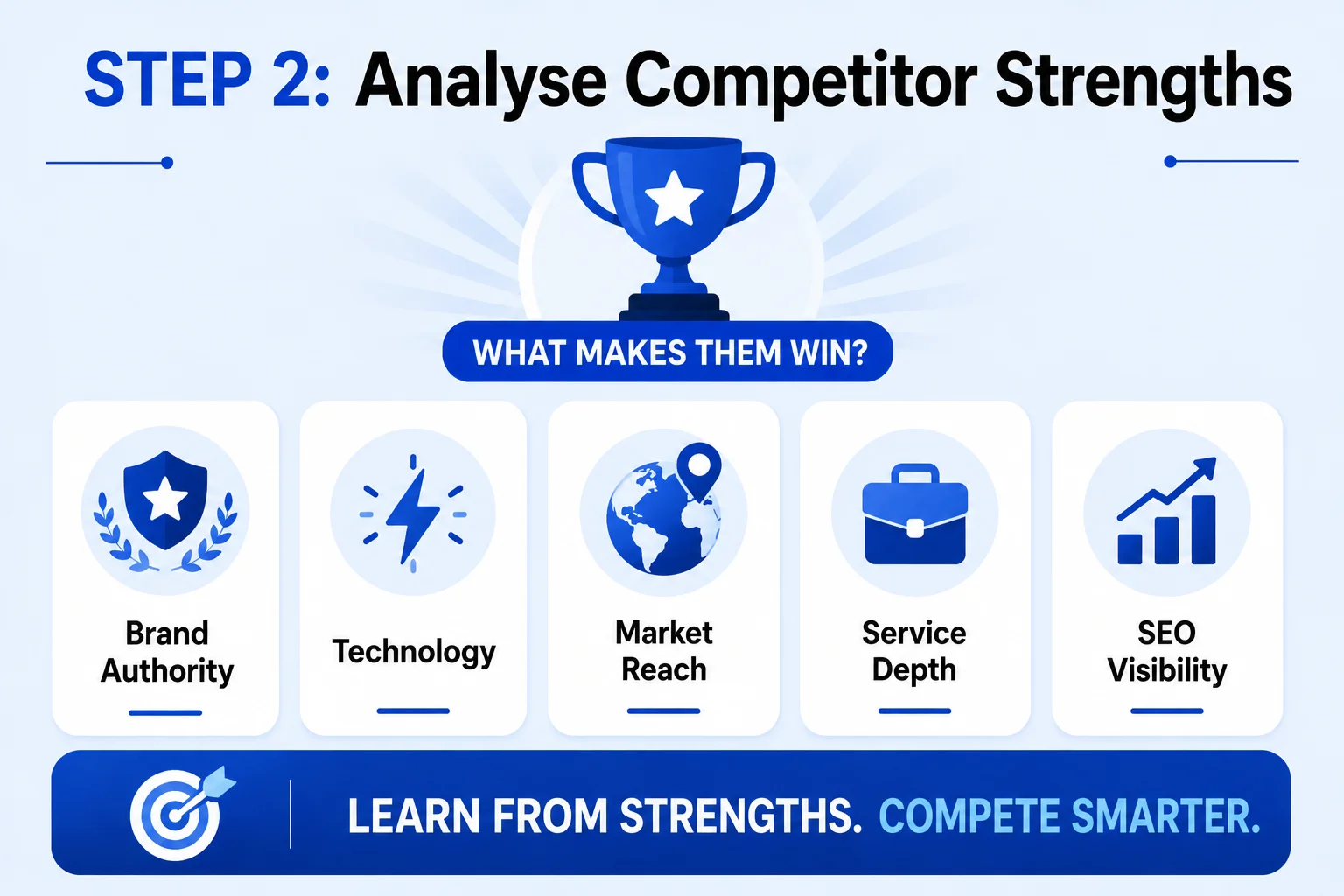
Look for strengths across these dimensions:
- Brand authority and trust signals. How long have they been in business? Do they have significant press coverage, industry awards, or high-profile clients? Trust takes years to build and is a genuine competitive advantage.
- Market share and geographic footprint. Which jurisdictions or markets do they dominate? A competitor with deep expertise in a specific country or region has a meaningful advantage over generalists there.
- Technology and automation. Do they offer a slick digital onboarding experience? Automated document generation? A client portal? Technology reduces cost and improves the client experience simultaneously.
- Service depth. Do they offer a genuinely end-to-end service, covering incorporation, banking, accounting, payroll, compliance, and immigration? Full-service provision is a significant differentiator for high-value clients.
- Pricing strategy. Are they competing on price, on value, or on exclusivity? Understanding their pricing model tells you how they are positioned and what client segment they are targeting.
- Content and SEO authority. High-ranking content, a strong backlink profile, and consistent publishing indicate an investment in long-term visibility that generates ongoing inbound leads.
- Client retention. High review scores, long client relationships, and low churn signal a service experience that meets expectations consistently. This is one of the hardest strengths to replicate quickly.
Real-World Example: Competitor Strength Mapping
| Competitor | Identified Strength | Why It Matters | Your Strategic Response |
| Competitor A | Automated online onboarding, incorporation completed in under 24 hours | Clients increasingly expect fast, digital-first experiences | Match the speed with your own digital onboarding, or compete on personalised support for complex cases |
| Competitor B | Deep brand authority in UAE and UK markets, 15 years of client testimonials | Trust is a primary decision factor for high-value incorporations | Target markets where they have less presence, such as Poland, Portugal, or the Netherlands |
| Competitor C | Multilingual support across six languages, dedicated account managers per region | International founders expect support in their preferred language | Prioritise multilingual capability for your two or three highest-revenue client regions first |
When documenting competitor strengths, be honest and specific. Vague notes like “they have a good website” are not actionable. “Their site converts visitors with a two-step quote calculator that removes friction” is actionable because it tells you exactly what to evaluate and potentially replicate or improve upon.
Step 3: Map Competitor Weaknesses
A rival’s weakness is your opening. This quadrant is where the competitive SWOT analysis starts generating direct revenue and positioning opportunities, because every gap in a competitor’s service is a reason a client might choose you instead.
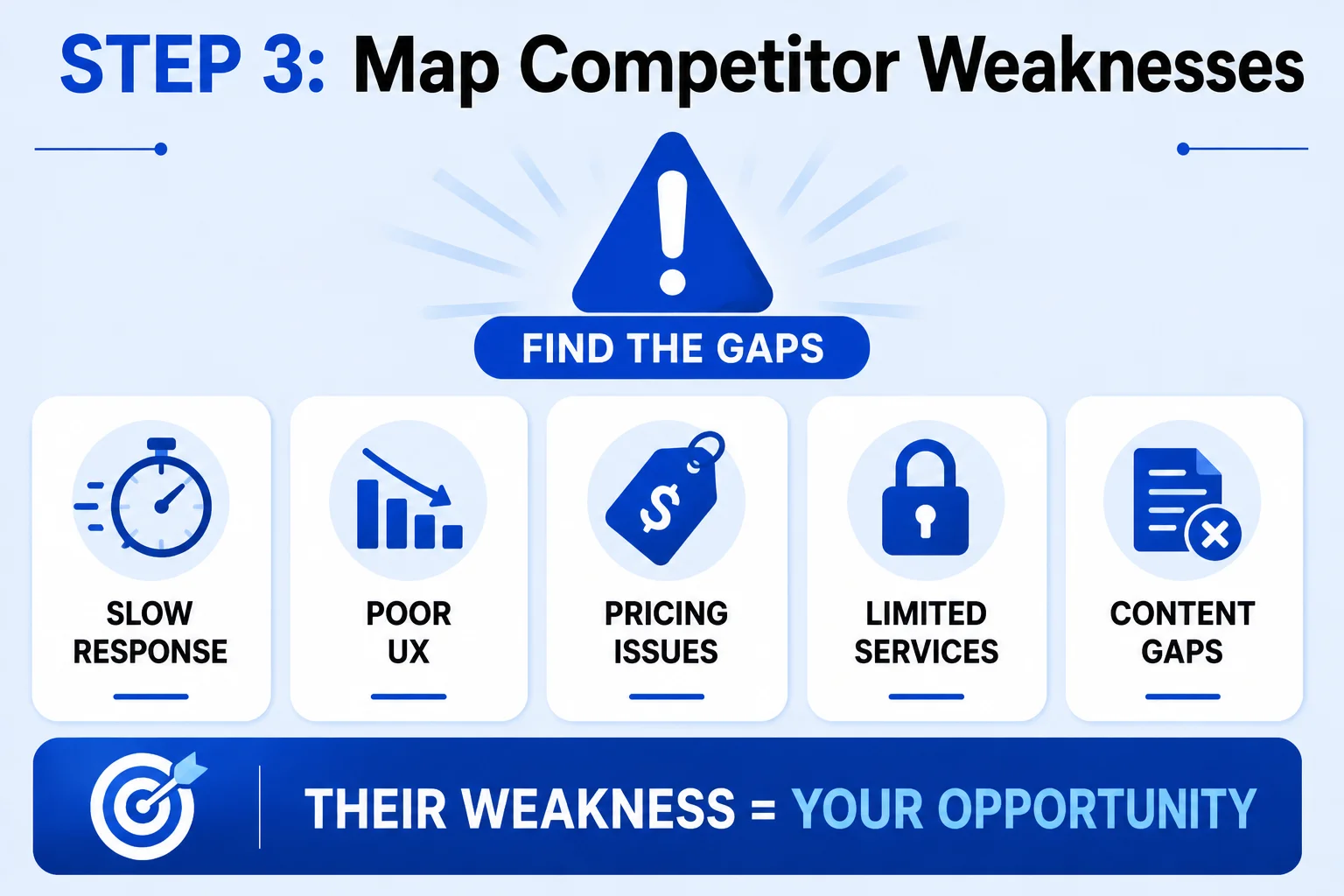
Common weaknesses in the corporate services sector include:
- Limited jurisdiction coverage. A competitor that only handles UK and US incorporations cannot serve a founder who needs an EU entity. That founder is available to you.
- Slow response times. Client reviews frequently mention how long it took to get a response. If a competitor’s average review mentions days-long waits, that is a proven differentiator for a firm that responds within hours.
- No post-incorporation support. Many formation services stop at registration. If a client needs accounting, payroll, VAT registration, or ongoing compliance, they have to go elsewhere. That gap is a retention risk for the competitor and an opportunity for you.
- Weak digital experience. An outdated website, clunky document upload process, or lack of a client portal signals an organisation that is not investing in its product. Clients notice and mention it in reviews.
- High prices without transparent value. If clients feel overcharged but cannot see what they are paying for, churn is inevitable. Transparent pricing is a genuine competitive differentiator.
- Thin or outdated content. A blog that has not been updated in 18 months, missing FAQs, and sparse guides signal a lack of investment in education and SEO. These are keyword gaps you can capture.
How to Surface Competitor Weaknesses with Evidence
Every weakness you identify should be backed by observable evidence, not assumption. Use these methods:
- Review mining. Read every 1-star and 2-star review on Google, Trustpilot, and Clutch for each competitor. Clients are remarkably specific about what went wrong. Common themes across reviews are confirmed weaknesses, not outliers.
- SimilarWeb analysis. High bounce rates and low average session duration signal a poor content or user experience. If a competitor’s visitors leave within 30 seconds, something is not meeting expectations.
- Competitive content audit. Use SEMrush or Ahrefs to identify topics and keywords your competitors rank for. Then look for obvious gaps: topics a client would search for that none of them cover well. Those are your content opportunities.
- Personal testing. Sign up for competitor newsletters, request a quote, or start their onboarding process. First-hand experience reveals friction points that no tool can detect.
- Social media monitoring. Use Google Alerts or tools like Mention to track competitor brand mentions. Complaints on social media are often unfiltered and highly specific.
Step 4: Identify Market Opportunities in the Competitive Landscape
Opportunities in the SWOT framework are external factors: market trends, shifts in the business environment, underserved client segments, regulatory changes, or emerging technologies that create new demand. The question at this stage is not just what opportunities exist, but which ones competitors are already pursuing and which ones they are ignoring.
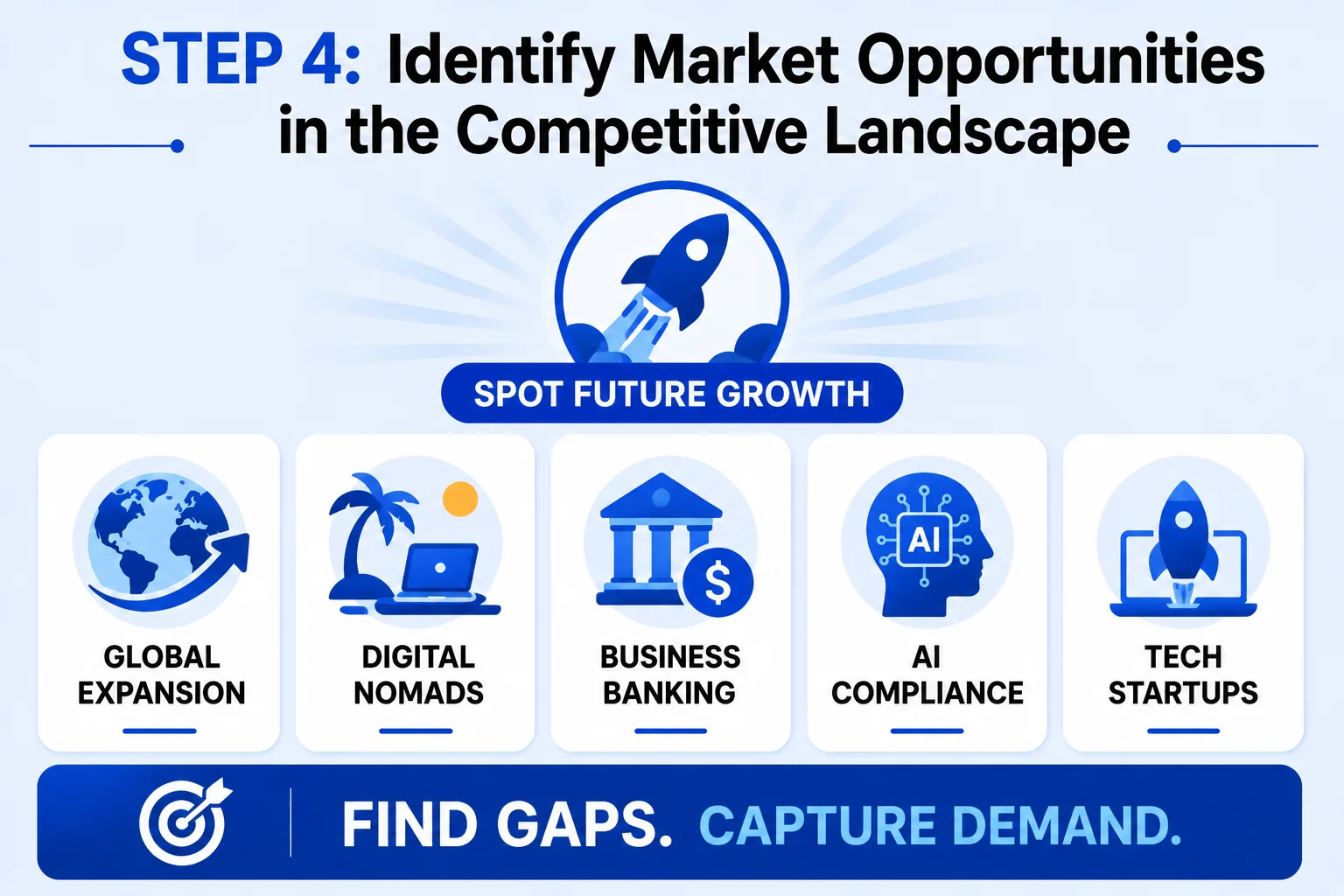
The gaps between what clients need and what competitors currently offer are where growth is found.
Key Market Opportunities in Corporate Services (2025)
- Remote international entrepreneurship is accelerating. More founders are registering companies outside their home countries to access better banking, lower tax environments, or specific regulatory frameworks. This trend shows no sign of reversing.
- Digital nomad visa expansion across EU member states. Countries including Portugal, Spain, and Croatia have introduced or expanded digital nomad visas, creating demand for fast, compliant company formations from non-residents who need legal business structures.
- Cross-border tax structuring demand is growing. SaaS businesses, e-commerce operators, and digital agencies operating across multiple jurisdictions increasingly need expert guidance on transfer pricing, VAT registration, and international tax efficiency.
- Non-resident business banking remains a pain point. Helping founders open business bank accounts as non-residents is notoriously difficult. Firms that have built relationships with suitable banking providers and can guide clients through this process have a significant advantage.
- AI-powered compliance tools are reducing the cost of serving SMEs. Firms that adopt intelligent compliance software can profitably serve smaller clients who were previously too costly to support, opening an entirely new market segment.
- Founders in emerging tech sectors need specialist support. SaaS founders, Web3 businesses, fintech startups, and creator economy businesses have structuring needs that generalist formation agencies are not equipped to handle. Specialisation here commands premium pricing.
According to Statista, cross-border e-commerce revenue is projected to surpass $7.9 trillion by 2027. Every one of those international sellers is a potential client for formation, compliance, and accounting services. The question is whether your firm is visible and positioned when they search for help.
When mapping opportunities through your competitive SWOT lens, ask two questions for each trend you identify. First, which competitors are already moving into this space? Second, how well are they serving it? If they are present but doing it poorly, that is an opportunity. If no competitor is addressing it, that is a first-mover opportunity.
Step 5: Assess External Threats Affecting the Competitive Landscape
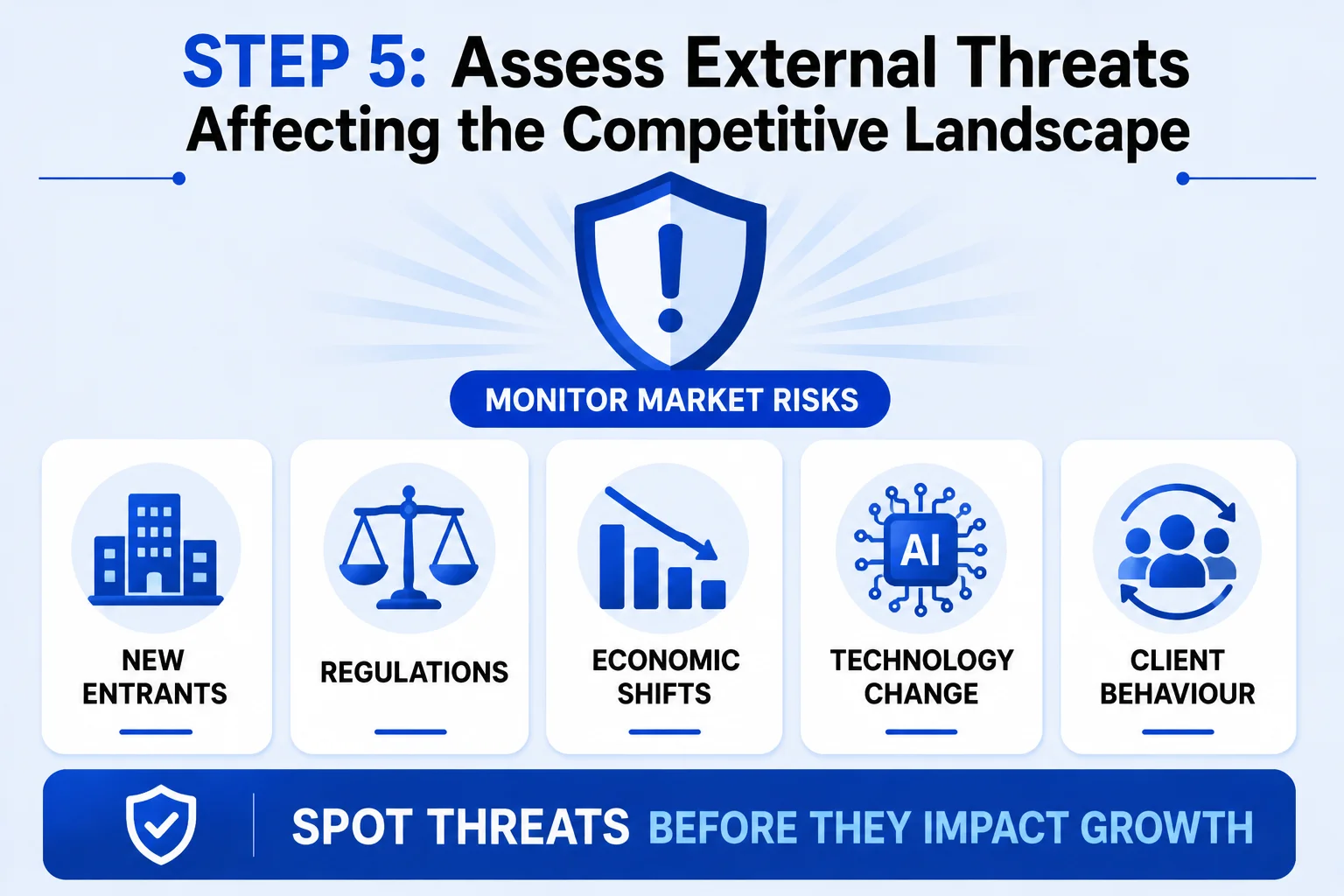
Threats are external factors in the broader business environment that could harm your market position. Crucially, many of the threats pressing on your competitors are the same threats pressing on you. Identifying them early through competitive analysis gives you more time to prepare.
| Threat Category | Specific Example | Impact Level | How to Prepare |
| New market entrants | VC-backed incorporation platforms offering services at near-cost to acquire market share rapidly | High | Compete on expertise, trust, and comprehensive post-incorporation support that platforms cannot replicate |
| Regulatory tightening | Stricter EU AML and KYC requirements adding compliance burden for service providers | High | Invest in compliance infrastructure, staff training, and technology to stay ahead of regulatory changes |
| Economic contraction | Reduced new business formation rates during economic downturns | Medium | Diversify service offering to include restructuring, cost optimisation, and advisory services that are recession-resilient |
| Technology disruption | Government digital company registration platforms (modelled on Estonia) reducing the need for intermediaries | Medium | Differentiate on human expertise, advisory depth, and complex cross-border cases that technology cannot handle |
| Shifting client behaviour | Founders preferring self-service, low-cost digital platforms over managed services | Medium | Develop a tiered service model that offers a self-serve entry point alongside full-service options |
| Talent and knowledge gaps | Inability to attract specialists in emerging areas such as crypto regulation, digital assets, or AI governance | Low to Medium | Build training programmes and partner networks that give access to specialist knowledge without full-time hiring |
The threats that cause the most damage are rarely the ones that arrive suddenly. They are the ones that were visible for years but not taken seriously until they had already eroded revenue. Using the threat quadrant of your competitive SWOT analysis as an early warning system is one of its most valuable applications.
Step 6: Gather Data Using Competitive Intelligence Tools
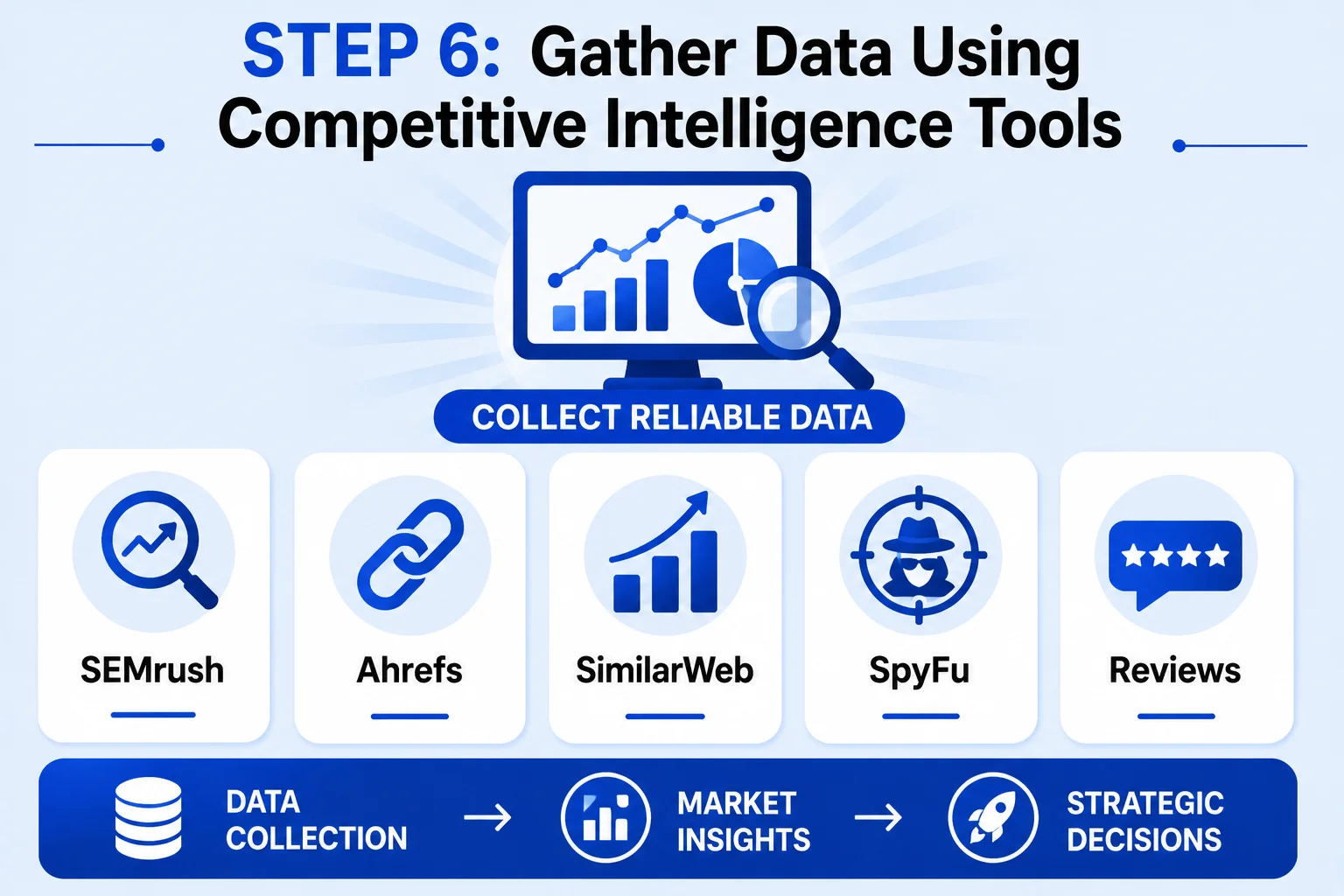
A competitive SWOT analysis is only as credible as the data supporting it. Opinions and impressions have their place, but a data-driven analysis is far more defensible and far more useful in strategic planning conversations. Here are the tools professionals rely on:
- SEMrush (semrush.com). The most comprehensive SEO and competitive intelligence platform. Use it to analyse competitor keyword rankings, organic traffic estimates, backlink profiles, paid advertising strategies, and content gaps. The Competitor Analysis and Keyword Gap tools are particularly valuable for SWOT research.
- Ahrefs (ahrefs.com). Particularly strong for backlink analysis and content research. The Content Gap tool identifies keywords competitors rank for that you do not, surfacing both content opportunities and indicators of their authority in specific topic areas.
- SimilarWeb (similarweb.com). Provides estimates of competitor website traffic, traffic source breakdown (organic, paid, referral, social, direct), audience demographics, and engagement metrics. High bounce rates and low session duration are measurable indicators of UX or content weaknesses.
- SpyFu (spyfu.com). Specialises in paid search intelligence. See which keywords competitors are bidding on, their estimated ad spend, and historical campaign data. Particularly useful for identifying which services they prioritise commercially.
- BuzzSumo (buzzsumo.com). Analyses content performance across the web and social media. Identify a competitor’s most-shared articles and formats, which tells you what resonates with your shared audience.
- Google Alerts (google.com/alerts). A simple, free tool for monitoring competitor brand mentions across the web in real time. Set alerts for competitor names, their key executives, and their primary product names.
- Trustpilot, Google Reviews, and Clutch. Qualitative gold. Client reviews are among the most reliable sources of competitor weakness data available. Read them systematically, not selectively.
According to a McKinsey Global Institute report, organisations that adopt data-driven approaches to competitive strategy grow 23% faster and are 19 times more likely to be profitable than competitors relying primarily on intuition. The tools above make data-driven competitive analysis accessible to businesses of any size.
Case Study: How One Corporate Services Firm Used Data Intelligence to Drive Growth
Case Study: UK-Based Company Formation Agency
A mid-sized UK company formation agency conducted a competitive SWOT analysis using SEMrush and SimilarWeb against its five primary competitors. The analysis revealed three significant findings:
- None of the five competitors ranked for search terms related to non-resident founders or overseas entrepreneurs. These were high-intent, low-competition keyword clusters generating thousands of monthly searches.
- The highest-rated competitor had a 4.8-star average but consistently received complaints about post-incorporation banking support. Clients wanted help opening accounts and were not getting it.
- Two competitors had not published new content in over 12 months, leaving multiple relevant topic areas entirely uncovered.
Actions taken: They built a dedicated landing page and content cluster targeting non-resident incorporations, added a banking guidance service, and published 15 articles on the uncovered topic areas.
Results: Organic traffic from non-resident founders increased by 47% within six months. The banking guidance service became their most-mentioned positive in new client reviews.
Step 7: Convert SWOT Insights into Strategic Action
This is the step where most competitive SWOT analyses fail. The research gets done, the matrix gets filled in, and then it sits in a presentation deck that no one looks at again. The framework only creates real business value when findings feed directly into decisions and plans.
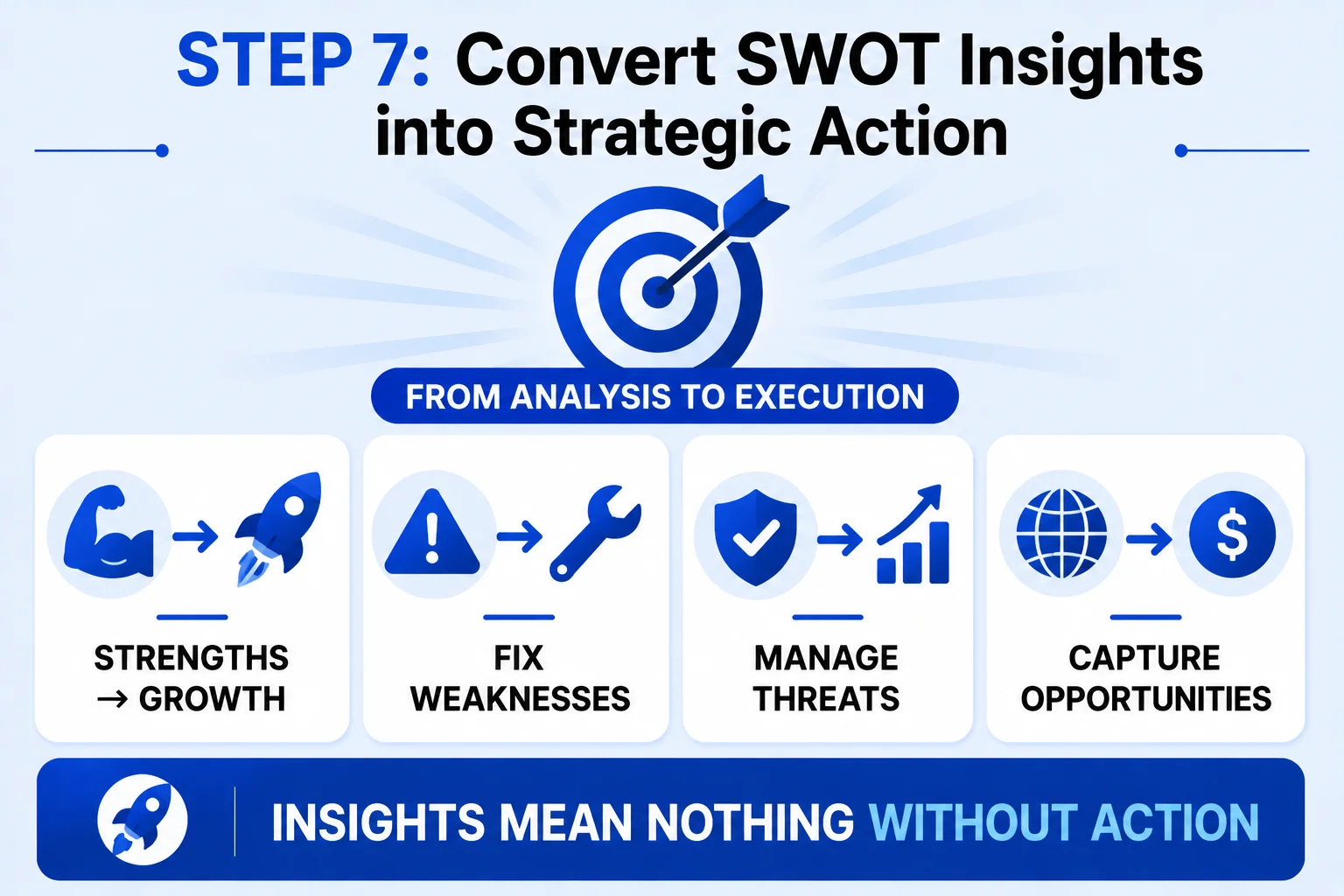
Use the four cross-matrix strategies to turn insights into actions:
SO Strategy: Strengths applied to Opportunities
Deploy your competitive advantages to capture the market opportunities you have identified. This is your most aggressive growth play.
Example: If your strength is end-to-end service (incorporation plus accounting plus compliance) and the identified opportunity is the growing number of SaaS founders needing cross-border tax structuring, build a dedicated offering and content strategy specifically for this segment.
WO Strategy: Weaknesses addressed to unlock Opportunities
Identify which of your internal capability gaps are preventing you from capitalising on a market opportunity. Prioritise fixing those specific weaknesses over others.
Example: If the opportunity is non-English-speaking founders in Western Europe but your weakness is single-language support, the strategic action is investing in multilingual capability for the two or three highest-value language markets first.
ST Strategy: Strengths deployed against Threats
Use your strongest assets to defend your market position against incoming threats. This is your defensive competitive play.
Example: If the threat is low-cost online formation platforms commoditising basic incorporations, and your strength is deep regulatory expertise and personalised advisory, move upmarket into complex, high-value cases where price is not the primary decision factor.
WT Strategy: Weaknesses mitigated to reduce Threat exposure
Identify combinations of internal weakness and external threat that represent your highest-risk scenarios. Address these proactively before they converge into a revenue problem.
Example: If your compliance infrastructure is underdeveloped (weakness) and regulatory scrutiny in your primary markets is increasing (threat), the WT action is immediate investment in compliance systems, not a 12-month roadmap.
Review and update your competitive SWOT analysis every 6 to 12 months. In fast-moving sectors, quarterly reviews are advisable. A competitor funding round, a product launch, a regulatory change, or a shift in search rankings should trigger an immediate partial update rather than waiting for the scheduled cycle.
Competitive SWOT Analysis Template (Ready to Use)
Use this template to structure your analysis for each competitor you are evaluating. Complete one table per competitor, then compare findings across competitors to identify patterns and priority actions.
| SWOT Element | Questions to Answer | Recommended Data Sources | What to Look For |
| Strengths | What do they do better than most? Why do clients consistently choose them over alternatives? | Client reviews, website, LinkedIn, SEMrush traffic data | Trust signals, service depth, technology quality, brand authority, pricing strategy |
| Weaknesses | Where do clients complain? What services are absent? Where does the experience break down? | Trustpilot, Google Reviews, Clutch, SimilarWeb engagement data, personal testing | Response time complaints, missing services, UX friction, pricing confusion, thin content |
| Opportunities | What market trends are they capitalising on? What adjacent needs are they ignoring? | Industry reports, Google Trends, keyword gap tools, founder community discussions | Underserved segments, emerging service needs, geographic gaps, content white space |
| Threats | What regulatory, economic, or competitive shifts could harm their current position, and yours? | Regulatory publications, industry news, competitor monitoring alerts | New entrants, regulatory changes, technology disruption, shifting client behaviour |
Common Mistakes to Avoid in Competitor SWOT Analysis
Knowing how to do the analysis well is only half the challenge. Understanding where practitioners go wrong is equally important.
Relying on Assumptions Instead of Data
The most common failure mode is filling in a SWOT matrix based on impressions rather than evidence. Saying a competitor is weak in customer service because you heard it once from a contact is not competitive intelligence. Reviewing 50 client testimonials and identifying that 30% mention slow response times is competitive intelligence.
Analysing Too Many Competitors
Attempting to analyse 10 or 15 competitors simultaneously produces shallow insights across all of them. Three to five deep, evidence-based competitor analyses will generate far more actionable findings than a broad scan of everyone in the market.
Failing to Update the Analysis
A competitive SWOT analysis completed 18 months ago reflects a market that no longer exists. Competitors have changed their pricing, launched new services, improved their technology, and shifted their marketing. Stale analysis leads to outdated strategy. Build the update cycle into your planning calendar.
Not Connecting Findings to Actions
Many organisations complete the SWOT matrix and stop there. The matrix is a diagnostic tool, not a strategy. Without a clear set of strategic responses tied to each insight, the exercise produces no business value. Every significant finding should have a corresponding action, an owner, and a timeline.
Ignoring Indirect Competitors
The clients you lose to a low-cost DIY platform are just as lost as the clients you lose to a direct competitor. Indirect competitors often signal broader shifts in client expectations and buying behaviour that deserve strategic attention.
How Often Should You Run a Competitive SWOT Analysis?
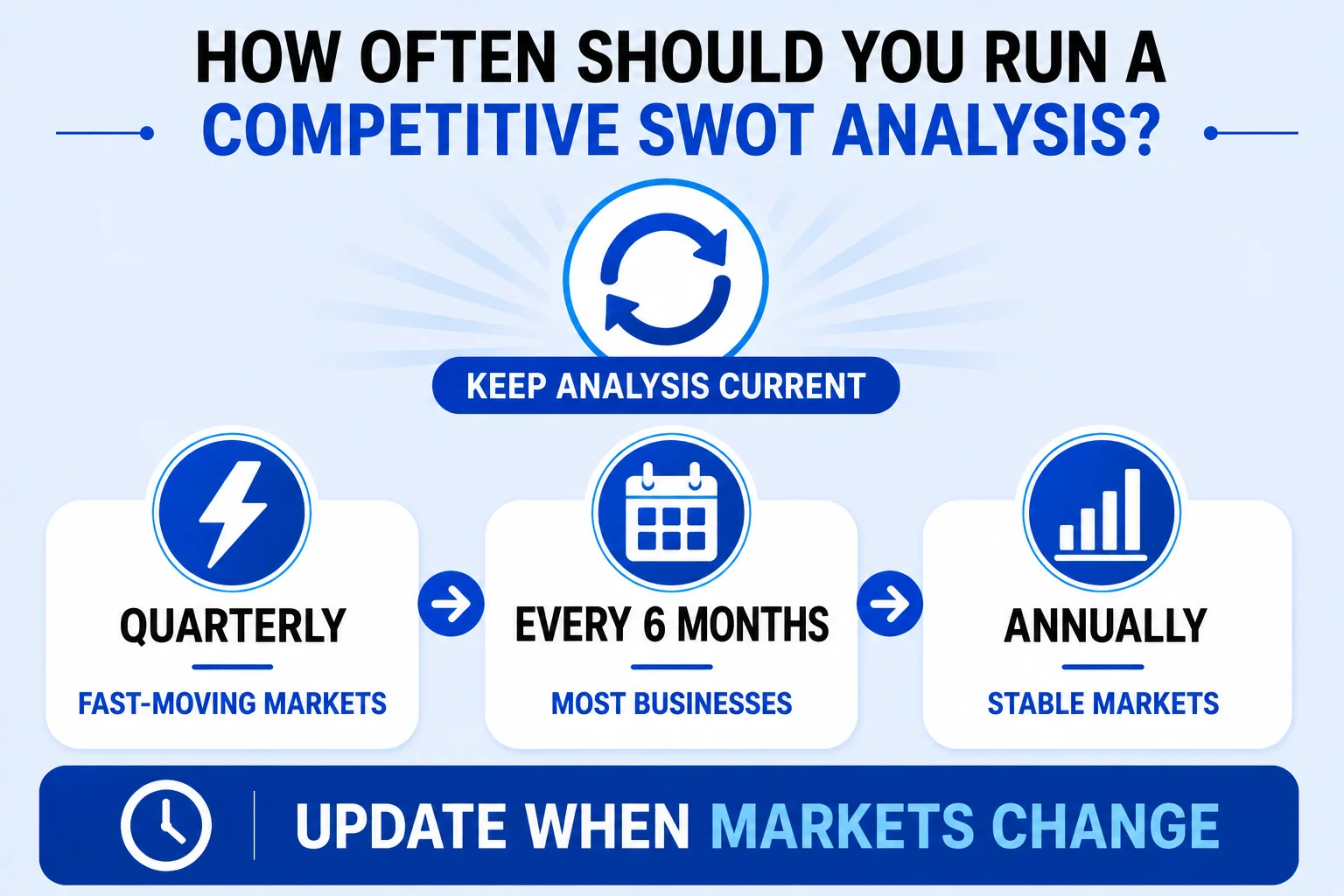
The right cadence depends on how fast your market moves. As a general guide:
- Quarterly reviews. For high-growth, fast-changing sectors such as fintech, legal tech, or any market experiencing regulatory change or new entrant activity. A lighter-touch update, focused on significant changes, rather than a full rebuild.
- Bi-annual reviews. For most corporate services businesses. A thorough update every six months ensures your strategy reflects current market reality without creating excessive research overhead.
- Annual deep dives. For more stable markets. A comprehensive analysis once a year, supplemented by ongoing monitoring of major developments.
- Event-triggered updates. Regardless of your scheduled cycle, certain events should trigger an immediate partial analysis: a competitor raises funding, launches a major new product, significantly changes pricing, earns a major media mention, or loses a key executive.
Building this cadence into your business calendar, with clear ownership and a consistent format, is what separates organisations that genuinely benefit from competitive intelligence from those that do it once and forget about it.
Final Thoughts
A well-executed competitor SWOT analysis is not a one-time exercise. It is an ongoing discipline that keeps your strategy grounded in market reality rather than internal assumptions.
The businesses that win in competitive markets share a common characteristic: they know the competitive landscape as well as they know their own operations. They understand where rivals are strong and take that seriously. They know where rivals are weak and exploit it deliberately. They watch the external environment for threats and opportunities before those forces show up in revenue.
Use the seven-step framework in this guide to build that capability systematically:
- Identify the right competitors and map the full landscape
- Analyse strengths with evidence, not assumptions
- Surface weaknesses through review mining, data tools, and direct observation
- Map market opportunities by combining external trends with competitor gap analysis
- Assess threats early and plan responses before they become crises
- Use competitive intelligence tools to make your analysis data-driven and repeatable
- Convert every significant finding into a specific strategic action with an owner and a timeline
Repeat the cycle every 6 to 12 months, update it when significant market events occur, and make competitive intelligence a standing agenda item in your strategic planning process. The firms that do this consistently are the ones that grow.