

For over a decade, the conversation around Greece and Cyprus was dominated by the “bailout.” However, as we move through 2026, the script has been rewritten. Both nations are currently leveraging their fiscal stability to attract a new wave of international founders and digital nomads.
If you are considering company formation in Greece or Cyprus, understanding this 2026 fiscal landscape is the first step toward a successful expansion.
Greece – The 2026 “Debt Exit” and the New Tech Frontier
Greece is no longer the “problem child” of Europe; it is the star performer. In early 2026, the Greek government announced an additional €8.8 billion early repayment of its bilateral Greek Loan Facility (GLF). By clearing these high-interest debts years ahead of schedule (now targeting a full exit by 2031), Greece has sent a clear message: the economy is mature, stable, and ready for business.
Why this matters for Company Formation in Greece
- Investment Grade Stability – Following multiple credit upgrades, borrowing costs for Greek businesses have plummeted.
- Aggressive Tax Incentives – For 2026, R&D tax deductions have been increased to a staggering 150%–215% for SMEs.
- The “Startup Golden Visa” – Foreign investors can now secure residency by investing as little as €250,000 into Greek startups, making Greece a top choice for non-EU founders.
- Digital Speed – Through the e-GEMI portal, we can now facilitate private company (IKE) formation in just a few days, often without the founder needing to set foot in Athens.
Slovenia – Stability Without a Bailout
Cyprus has always been a favorite for international holding structures, but 2026 brings a historic pivot. While the country continues its principal repayments to the European Stability Mechanism (ESM), it has launched a 2026 Tax Reform package that is catching the attention of every serious tax planner in Europe.
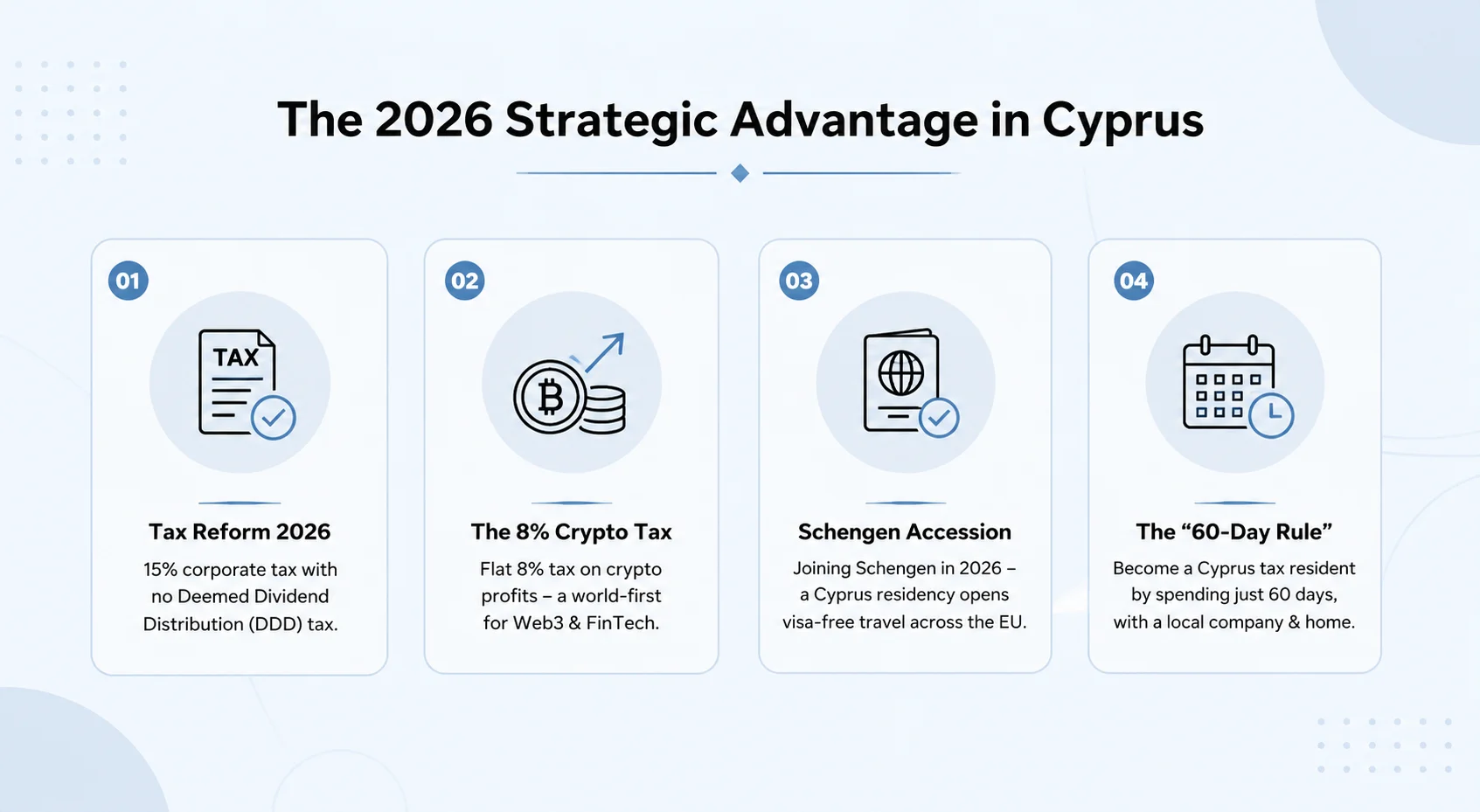
The 2026 Strategic Advantage in Cyprus
- Tax Reform 2026 – While the corporate tax rate has moved to 15% (to align with global OECD standards), the government has balanced this by abolishing the Deemed Dividend Distribution (DDD) tax. This allows companies to reinvest profits without penalty.
- The 8% Crypto Tax – In a world-first move, Cyprus has introduced a flat 8% tax on crypto-asset profits, positioning itself as the premier hub for Web3 and FinTech.
- Schengen Accession – As Cyprus joins the Schengen Zone in 2026, a Cyprus residency permit is now a “golden ticket” to visa-free travel across the entire EU.
- The “60-Day Rule” – You can still become a Cyprus tax resident by spending just 60 days on the island, provided you have a local company and home.
How Our Formation Services Bridge the Gap
Setting up a business in a foreign jurisdiction is rarely just about paperwork – it requires an understanding of the local legal, regulatory, tax, and commercial environment. Whether you are looking to register a company in Cyprus or establish operations in Greece, UCI’s business consultancy services can support your wider international expansion strategy.
-
Remote Formation – We handle everything from tax ID (AFM/TIC) issuance to remote bank account opening.
-
Compliance First – We ensure your structure is compliant with the new 2026 EU tax transparency standards.
-
Strategic Growth – We don’t just “form” the company; we help you navigate the 2026 grant schemes and local incentives.
Ready to Expand into Strategic EU Markets?
Let UCI help you turn economic intelligence into action. Whether it’s setting up a subsidiary in Cyprus or managing regulatory compliance in Greece, we’re here to guide you.
Understanding the EU-IMF Bailout
Briefly explain what the bailout was and why it mattered.
Content
The EU-IMF bailout programs were introduced to stabilize the economies of Greece and Cyprus during the European debt crisis. Financial assistance came with strict economic reforms, fiscal discipline, and structural changes designed to restore investor confidence and long-term growth.
Key objectives included
- Reducing government debt
- Stabilizing the banking sector
- Encouraging foreign investment
- Improving public finances
- Restoring economic competitiveness
Today, both countries have largely completed these reforms, creating stronger foundations for businesses and investors.
Key Differences Between Greece and Cyprus in 2026
Instead of viewing both countries as identical recovery stories, investors should understand how each market offers distinct advantages.
| Greece | Cyprus |
|---|---|
| Larger domestic market | International business hub |
| Manufacturing & tourism | Financial services & holding companies |
| Growing startup ecosystem | Attractive corporate tax regime |
| Infrastructure investments | Gateway to Europe, Middle East & Africa |
Choosing between the two depends on your expansion strategy, industry, and long-term objectives.
Why International Businesses Are Watching These Markets
As debt pressures ease, international companies are increasingly considering both countries for expansion. Improved economic stability, greater investor confidence, access to the EU Single Market, skilled workforces, and growing digital infrastructure are strengthening their appeal. Businesses evaluating opportunities across these markets can work with UCI to explore international company formation and expansion options.
Businesses are attracted by
- Improved economic stability
- Greater investor confidence
- Access to the EU Single Market
- Skilled multilingual workforce
- Growing digital infrastructure
- Supportive government initiatives
- Strong tourism and service industries
These factors make Greece and Cyprus increasingly competitive destinations for international operations.
Industries Showing Strong Growth Potential
Several sectors are benefiting directly from economic reforms and increased investment.
Greece
- Technology startups
- Renewable energy
- Tourism & hospitality
- Logistics
- Maritime services
- Real estate
Cyprus
- Financial services
- FinTech
- Professional services
- Shipping
- Investment holding companies
- Intellectual property businesses
Businesses entering these sectors may find attractive opportunities supported by improving economic conditions.
What the 2026 Repayment Outlook Means for Businesses
The continued progress in debt repayment signals greater financial resilience rather than simply marking the end of a recovery period. For international entrepreneurs, stronger fiscal conditions can make it easier to assess Greece and Cyprus alongside other European jurisdictions. Businesses comparing potential destinations can also explore UCI’s guide to the best countries for company formation before deciding where to establish their next international operation.
For international businesses, this may translate into
- Lower economic uncertainty
- Increased foreign investment
- Improved access to financing
- Stronger consumer confidence
- More predictable business environment
- Enhanced long-term growth prospects
While no investment is without risk, the improving fiscal outlook positions both Greece and Cyprus as increasingly attractive destinations within Europe.
Conclusion
The repayment milestones achieved by Greece and the continued economic resilience of Cyprus demonstrate how both countries have transformed since the financial crisis. Their renewed focus on innovation, investment, and business-friendly reforms has strengthened confidence among international entrepreneurs. For companies seeking an EU presence, understanding these developments can help identify opportunities aligned with long-term growth and market expansion. If you are considering establishing or expanding a business in Greece or Cyprus, contact UCI to discuss your international company formation requirements.