

Italy provides several legal structures for entrepreneurs, investors and international companies establishing a presence in the country. Among the most important are the Società a Responsabilità Limitata (SRL), Società per Azioni (SPA) and Società Semplice (SS). Each structure operates under different rules concerning capital, shareholder liability, governance, incorporation and permitted business activities. Understanding these differences is essential before registering a company in Italy because the legal structure can influence management responsibilities, financing options, compliance obligations and the exposure of owners to business liabilities.
For foreign entrepreneurs in particular, selecting the correct structure should be based on the planned business activity, ownership model, investment requirements, expected scale of operations and long-term expansion strategy.
Understanding Italian Company Structures
Italian company law provides both capital companies and partnerships. The official Italian Business Register distinguishes società di capitali, including SRLs and SPAs, from società di persone, which include the SS and other partnership structures. Capital companies and partnerships are registered with the Italian Business Register, although an SS is generally entered in its special section.
The distinction is important because each structure determines how ownership works, how decisions are taken and how far owners may be personally responsible for business obligations.
Businesses considering an Italian presence can explore UCI Ltd’s company formation services to understand the incorporation and ongoing requirements that may apply to their proposed activities.
What Is an SRL in Italy?
A Società a Responsabilità Limitata – SRL is Italy’s standard limited liability company structure.
An SRL has a legal identity separate from its shareholders, and shareholders are generally exposed to business risk only within the limits of their investment, subject to circumstances where personal liability may arise under applicable law.
The structure is particularly relevant for
- Small and medium-sized businesses
- Family-owned businesses
- Foreign investors establishing an Italian subsidiary
- Privately held companies
- Entrepreneurs seeking limited liability
- Businesses that do not require a public shareholding structure
The SRL generally provides greater flexibility than an SPA when organising ownership and governance, making it suitable for many privately owned businesses.
SRL Capital Requirements
The traditional SRL capital benchmark is €10,000, but Italian law also permits an ordinary SRL to be incorporated with capital below €10,000, subject to specific contribution and reserve rules.
Italy also provides the SRLS – Società a Responsabilità Limitata Semplificata, or simplified limited liability company. An SRLS may have capital starting from €1 and below €10,000. Its shareholders must be natural persons, and its incorporation follows a statutory standard model.
The SRLS should therefore not be treated as identical to an ordinary SRL. Businesses requiring customised articles, corporate shareholders or a more sophisticated ownership structure will normally need to consider the ordinary SRL framework instead.
What Is an SPA in Italy?
A Società per Azioni – SPA is an Italian joint-stock company.
It is designed for businesses that require a more structured corporate framework and may need to accommodate larger numbers of shareholders, significant investment or more sophisticated financing arrangements.
An SPA is generally more appropriate for
- Large businesses
- Companies expecting substantial outside investment
- Corporate groups
- Businesses planning significant capital raising
- Companies requiring shares rather than SRL-style quotas
- Businesses considering access to capital markets
Shareholder liability is generally limited to the amount invested in the company.
SPA Capital Requirements
An SPA generally requires a minimum share capital of €50,000.
Its capital is divided into shares rather than the participation quotas typically associated with an SRL. This distinction can make the SPA better suited to businesses where ownership interests may need to be transferred or structured among multiple investors.
The SPA also operates under more extensive corporate governance requirements than an ordinary SRL, including rules concerning corporate bodies, shareholder decision-making, accounts and statutory controls.
What Is an SS in Italy?
The Società Semplice – SS is the simplest Italian partnership structure. Unlike an SRL or SPA, an SS is not designed for carrying on ordinary commercial business activities. According to Italy’s National Council of Notaries, it can be used only for non-commercial economic activities and is therefore particularly associated with activities such as agriculture and certain forms of asset management. There is no statutory minimum capital requirement for an SS. This simplicity, however, comes with a significant difference in liability.
Partners are generally subject to unlimited joint and several personal liability for partnership obligations. Italian law allows liability to be restricted in certain circumstances for partners who have not acted on behalf of the partnership, but such arrangements must satisfy applicable requirements to be effective against third parties. Therefore, an SS should not be selected merely because it has simpler capital requirements.
Also read – VAT Registration Across Europe
SRL vs SPA vs SS – Main Differences
| Feature | SRL | SPA | SS |
|---|---|---|---|
| Full name | Società a Responsabilità Limitata | Società per Azioni | Società Semplice |
| General category | Capital company | Capital company | Partnership |
| Liability | Generally limited | Generally limited | Generally unlimited personal liability |
| Capital | €10,000 standard benchmark, with lower-capital structures permitted | Minimum €50,000 | No statutory minimum |
| Ownership | Participation quotas | Shares | Partnership interests |
The appropriate structure therefore depends on far more than incorporation cost. Businesses should assess liability protection, investment plans, management requirements and future expansion before deciding.
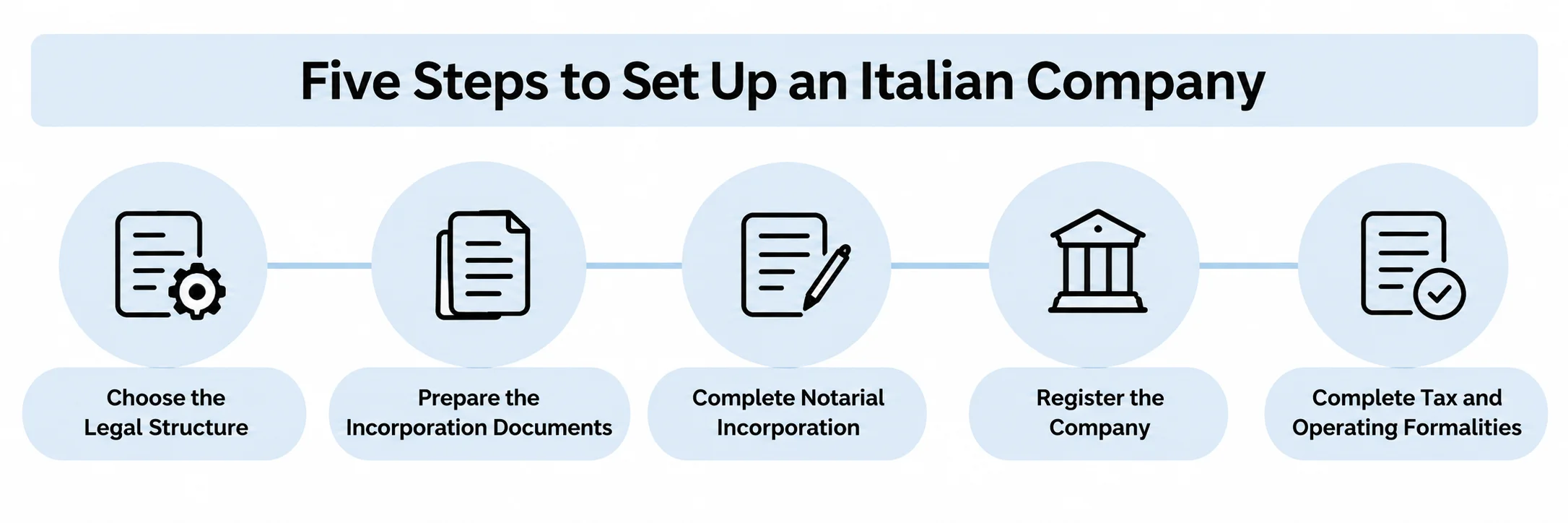
Five Steps to Set Up an Italian Company
Step 1 – Choose the Legal Structure
The first step is deciding whether an SRL, SPA or another available structure fits the intended activity.
Consider
- Planned commercial activities
- Number and type of shareholders
- Required liability protection
- Initial investment
- Management structure
- Future investors
- Financing requirements
- Long-term expansion plans
An SS should only be considered where the intended economic activity is compatible with its non-commercial nature.
Step 2 – Prepare the Incorporation Documents
The founders must prepare the documents required for incorporation.
Depending on the structure, these can include the company’s proposed name, registered office, corporate purpose, shareholder information, capital details, management arrangements and constitutional documents.
Foreign shareholders may also need properly prepared identification or corporate documents, with translation, certification or legalisation requirements depending on their circumstances and country of origin.
Step 3 – Complete Notarial Incorporation
For Italian capital companies such as an ordinary SRL or SPA, incorporation normally involves an Italian notary.
The notary checks the incorporation documentation, identities of the parties, corporate provisions and relevant legal requirements before completing the public deed.
Professional advice at this stage is valuable because the articles of association determine important matters such as governance, shareholder rights and decision-making procedures.
Step 4 – Register the Company
After incorporation, the company must be registered with the competent Registro delle Imprese – Italian Business Register.
Italy uses the Comunicazione Unica system for several establishment formalities. Through this procedure, relevant formalities can include obtaining a tax code and VAT number, Business Register registration, INPS social security procedures, INAIL insurance requirements and, where applicable, the SCIA notification for the relevant SUAP office.
Digital filing procedures commonly require a qualified digital signature and a PEC certified electronic mailbox.
Step 5 – Complete Tax and Operating Formalities
Registration is only the beginning of ongoing compliance.
Depending on the company’s activities, the business may need to address
- VAT registration and reporting
- Corporate accounting
- Annual financial statements
- Payroll obligations
- Social security registration
- Employment compliance
- Industry-specific licences
- Regulatory approvals
- Corporate record keeping
- Ongoing Business Register filings
International shareholders should also consider how Italian operations interact with the wider accounting and tax obligations of their corporate group.
Governance Requirements for an Italian SRL
An SRL can provide considerable flexibility in the way its management arrangements are structured.
Depending on its constitutional documents, management may be entrusted to a sole director, multiple directors or a board of directors. The articles should establish the applicable powers, representation rights and decision-making procedures.
The need for statutory auditing or supervisory bodies depends on circumstances including the company’s characteristics and applicable statutory thresholds.
This flexibility is one reason the SRL is frequently considered for privately held businesses and foreign subsidiaries.
Governance Requirements for an Italian SPA
The SPA operates within a more formal corporate governance framework.
It is intended for organisations where ownership, management and corporate supervision may need to be clearly separated. The applicable governance model determines the relevant administrative and supervisory bodies.
This additional structure can increase administration, but it can also be valuable where a business has multiple shareholders, institutional investors or significant financing requirements.
An SPA should therefore generally be viewed as a structure for businesses whose scale or investment needs justify its more substantial governance framework.
Liability – Why the Difference Matters
Liability is one of the most important distinctions between these three structures.
With an SRL or SPA, the company itself generally bears responsibility for its obligations, while shareholder exposure is normally limited to their investment, subject to applicable exceptions.
An SS is fundamentally different. Partners can be personally liable for partnership debts. The National Council of Notaries describes SS partners as generally having unlimited joint and several personal liability, although specific limitations may be agreed for partners who have not acted in the partnership’s name when the legal conditions are satisfied.
Entrepreneurs should therefore consider potential business liabilities before choosing a partnership structure solely because it appears simpler to establish.
Requirements for Foreign Investors
Foreign investors can establish businesses in Italy, but their individual requirements may vary according to nationality, residence, proposed activities and ownership structure.
Practical matters may include
- Obtaining Italian tax codes
- Preparing shareholder identification
- Providing foreign corporate documents
- Appointing directors
- Establishing an Italian registered office
- Arranging a PEC address
- Completing digital signature requirements
- Registering for applicable taxes
- Opening appropriate banking arrangements
- Obtaining activity-specific licences or approvals
International businesses should review these requirements before incorporation so that missing documentation does not unnecessarily delay registration.
For businesses expanding across several countries, UCI Ltd provides international company formation and corporate support services across multiple jurisdictions.
Choosing Between an SRL, SPA and SS
There is no single structure suitable for every Italian business.
An SRL is generally appropriate where entrepreneurs want limited liability and a flexible privately held company structure.
An SPA is designed for larger organisations, more substantial investment requirements and structures where share-based ownership and formal governance are important.
An SS serves a fundamentally different purpose because it is limited to non-commercial economic activities and can expose partners to personal liability.
The decision should therefore consider not only incorporation requirements but also where the business expects to be in several years. Ownership transfers, new investors, financing, international expansion and succession planning can all influence the most appropriate structure.
Conclusion
Italian company law provides structures for businesses ranging from privately owned SMEs to larger joint-stock companies and non-commercial partnerships. The SRL combines limited liability with relatively flexible governance, the SPA provides a more formal structure for larger enterprises and substantial investment, while the SS is designed for non-commercial activities and carries different liability implications.
The right choice should reflect the company’s activities, ownership, capital requirements, risk profile and future strategy rather than incorporation cost alone. If you are planning to establish or expand a business in Italy, Contact Us to discuss the company formation and corporate support requirements applicable to your proposed structure.