
Choosing the right legal structure is one of the most important decisions when establishing a company in France. Two of the most widely used options are the Société par Actions Simplifiée – SAS – and the Société à Responsabilité Limitée – SARL. Both provide limited liability and can suit domestic and international businesses, but they differ significantly in governance, ownership rules, management flexibility, social-security treatment, and share transfers. Understanding these differences is essential before deciding which structure best supports your business model and long-term plans.
Understanding Business Structures in France
France offers several legal structures for entrepreneurs and international companies. The appropriate choice depends on factors such as the number of founders, ownership arrangements, investment plans, management structure, liability, tax treatment, and how profits will be distributed.
Companies entering France should therefore consider incorporation as part of a wider European strategy rather than treating legal structure as an administrative formality. Businesses planning their French operations can explore UCI’s international company formation solutions before determining the most appropriate structure.
Among the available options, SAS and SARL are particularly important for privately held commercial businesses.
What Is an SAS in France?
A Société par Actions Simplifiée is a simplified joint-stock company known for its flexible governance framework. France’s official business portal describes the SAS as the country’s most common commercial company form and highlights the freedom shareholders have to determine operating and decision-making arrangements through the articles of association.
A standard SAS requires at least two shareholders. Where there is only one shareholder, the structure becomes a Société par Actions Simplifiée Unipersonnelle – SASU. Shareholders can generally be individuals or legal entities.
Every SAS must have a president who represents the company. Additional management bodies and decision-making arrangements can be established through the articles where appropriate.
This flexibility makes the SAS particularly attractive to companies expecting external investors, multiple shareholders, changing ownership, or more sophisticated governance arrangements.
What Is a SARL in France?
A Société à Responsabilité Limitée is a private limited liability company operating under a more structured statutory framework.
A standard SARL generally requires between 2 and 100 partners. A business with one owner can instead operate through the single-member equivalent – the EURL.
The SARL is managed by one or more gérants – managers – who must meet the applicable requirements. Compared with an SAS, many aspects of governance and decision-making are more directly prescribed by French company law.
This can make the SARL attractive for closely held businesses where owners prefer established statutory rules instead of designing a highly customised governance system.
Businesses considering either structure can obtain assistance through UCI’s France company formation services to coordinate incorporation and related requirements.
SAS vs SARL – Key Differences
Although both structures offer limited liability, they operate differently in several important areas.
| Factor | SAS | SARL |
|---|---|---|
| Standard number of owners | 2 or more | 2 to 100 |
| Single-owner version | SASU | EURL |
| Minimum statutory capital | Capital freely determined | Capital freely determined |
| Main manager | President | Gérant |
| Governance | Highly flexible | More statutory rules |
| Ownership interests | Shares | Company interests – parts sociales |
| Manager’s social regime | Generally assimilated employee when remunerated | Depends on ownership/control |
| Transfer framework | Flexible and can be restricted through articles | Transfers to third parties generally subject to approval rules |
| Typical profile | Startups, investors, growth businesses, subsidiaries | SMEs, closely held and family businesses |
France’s official business guidance confirms these distinctions, including flexible capital for both structures, different management arrangements, and different rules governing transfers and social-security status.
1. Governance and Management Flexibility
One of the biggest differences between an SAS and SARL is governance.
SAS
The SAS provides shareholders with considerable contractual freedom. The articles of association can determine how many decisions are made, establish additional management bodies, define shareholder voting arrangements, and regulate transfers of shares.
A president is mandatory, but businesses can create additional management positions where appropriate.
This flexibility can be useful for
- International corporate groups
- Joint ventures
- Startups
- Businesses expecting investors
- Companies with several shareholder classes or sophisticated governance needs
However, flexibility also means that the articles must be carefully drafted.
SARL
SARL governance is more heavily regulated by French law. The company is managed by one or more gérants, and statutory provisions establish many of the rules governing relationships between partners and management.
This reduces the degree of customisation but can provide a predictable framework for businesses with straightforward ownership arrangements.
2. Share Capital Requirements
Both structures allow considerable flexibility when determining share capital. French official guidance identifies the capital of both SAS and SARL as freely determined rather than imposing a substantial fixed minimum.
There is, however, an important difference in how cash contributions are paid at incorporation.
For an SAS, at least 50% of cash contributions must generally be paid when the company is formed, with the balance payable within five years.
For a SARL, at least 20% of cash contributions must generally be paid initially, with the remaining amount payable within five years.
Founders should avoid selecting an unrealistically low capital figure merely because the law provides flexibility. The company should have sufficient resources for its planned operations.
3. Social-Security Treatment of Management
Management remuneration is one of the most important practical differences between SAS and SARL.
SAS President
A remunerated SAS president is generally affiliated with the French general social-security system as an assimilated employee. However, the corporate mandate does not automatically provide unemployment insurance coverage.
This regime can provide relatively broad social protection but may involve higher social charges than the regime applicable to some self-employed managers.
SARL Manager
The position depends on ownership.
A majority managing partner of a SARL generally falls under the social-security regime for self-employed workers. A minority manager is generally treated as an assimilated employee under the general social-security system.
This difference can materially affect the cost and structure of management remuneration and should be reviewed before incorporation.
4. Taxation of SAS and SARL Companies
Both SAS and SARL are generally subject to French corporate income tax – impôt sur les sociétés or IS.
Under qualifying circumstances, certain companies may have an option to use income-tax treatment for a limited period, subject to statutory eligibility conditions. Official French guidance identifies the possibility of an income-tax option for both SAS and SARL.
Tax considerations should extend beyond the headline corporate tax rate. International founders may also need to consider
- VAT
- Dividend taxation
- Management remuneration
- Withholding taxes
- Double-taxation treaties
- Transfer pricing
- Permanent establishment exposure
- Cross-border transactions
The most tax-efficient structure therefore depends on the company’s specific ownership and operating circumstances rather than simply whether it is an SAS or SARL.
5. Bringing Investors Into the Business
For companies expecting external investment, SAS often has a practical advantage.
Its flexible articles can be designed to address governance arrangements, investor rights, restrictions on transfers, approval mechanisms, and other shareholder relationships.
The SAS uses shares, while the SARL uses company interests known as parts sociales. French official guidance also notes that transfers of SARL interests to third parties are subject to partner approval rules, whereas SAS share-transfer arrangements offer greater contractual flexibility.
This is one reason the SAS is frequently considered by startups and businesses anticipating changes in their ownership structure.
6. Which Structure Is Better for International Businesses?
There is no universally superior option.
An SAS can be particularly attractive to international companies because its governance can be adapted to the requirements of foreign parent companies, investors, joint ventures, and future financing arrangements.
A SARL may be suitable when the ownership structure will remain relatively stable and the founders prefer a more prescribed framework.
Before choosing, international businesses should consider
- Number and type of shareholders
- Expected investment rounds
- Parent-company requirements
- Management remuneration
- Social-security implications
- Profit-distribution strategy
- Transfer of ownership
- Future sale or restructuring
- French and international tax implications
For companies comparing France with other European markets, the legal structure should ultimately support the wider international expansion plan.
Also read – Best Countries for Company Formation.
7. SAS or SARL for Startups?
For many growth-oriented startups, SAS may provide greater flexibility.
A startup may need to introduce new investors, restructure voting rights, change governance arrangements, or transfer shares as it grows. The flexibility of the SAS articles can accommodate more sophisticated shareholder arrangements.
That does not mean every startup needs an SAS. A small company with stable ownership and no immediate external fundraising plans could find a SARL appropriate.
The decision should reflect the expected future of the company rather than only its position on incorporation day.
8. SAS or SARL for Family Businesses and SMEs?
SARL can be attractive for closely held companies, particularly where ownership is expected to remain within a limited group.
Its more structured legal framework can make governance predictable and limit the need to design detailed bespoke rules.
A family business may also value the stronger statutory framework governing transfers to third parties.
SAS can still be appropriate for SMEs and family companies where greater flexibility is important. Company size alone should therefore not determine the decision.
Steps to Establish an SAS or SARL in France
Although requirements vary according to the company and activity, the formation process generally involves several key stages.
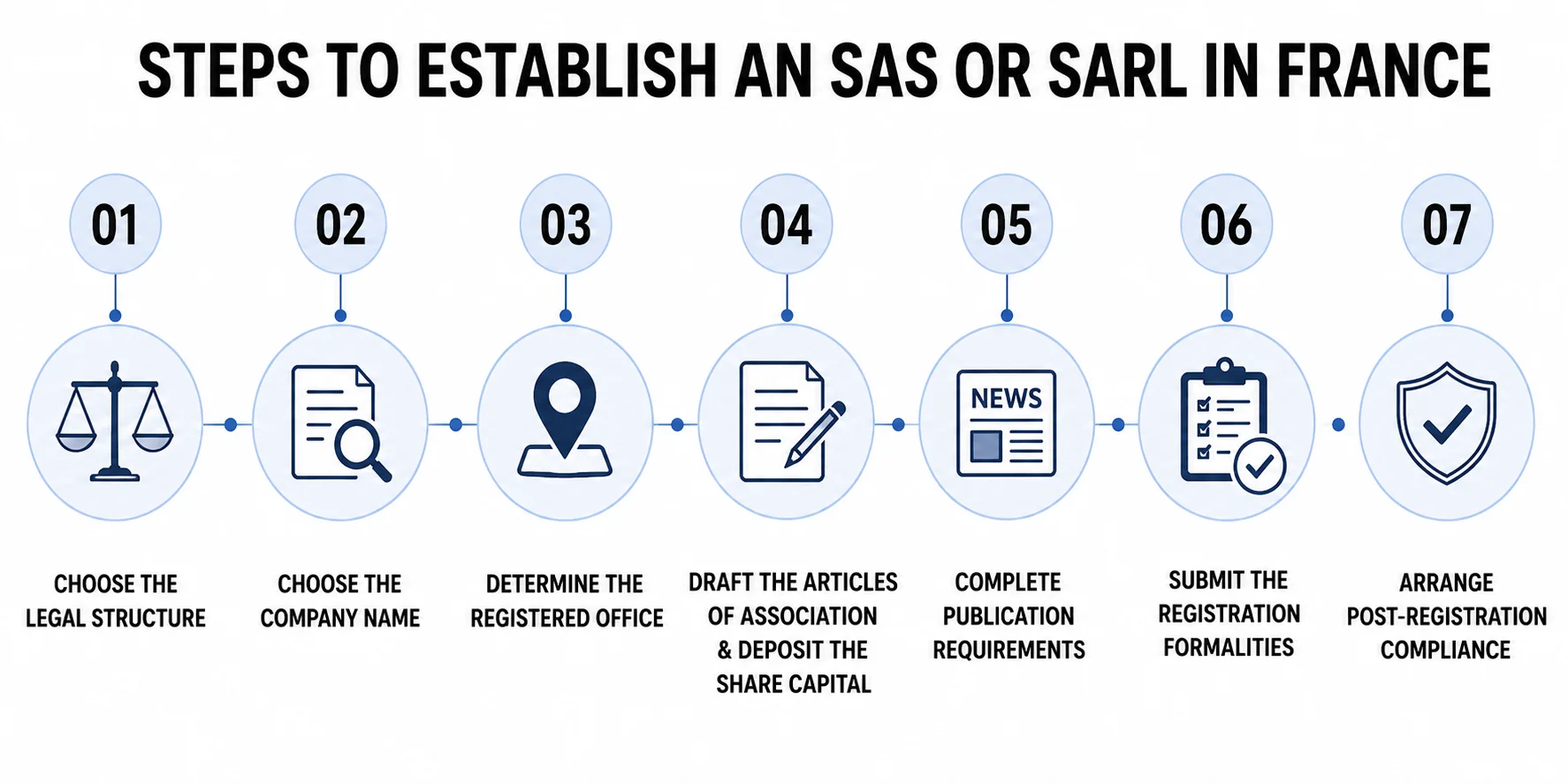
- Choose the legal structure – Compare SAS and SARL based on ownership, management, tax, social-security, and investment plans.
- Choose the company name – Check the proposed identity and potential intellectual property conflicts.
- Determine the registered office – Establish the company’s official French address.
- Draft the articles of association – Define the company’s purpose, capital, governance, and other required provisions.
- Deposit the share capital – Complete the applicable capital contribution requirements.
- Complete publication requirements – Arrange the required legal notice.
- Submit the registration formalities – Complete the required business-registration process and beneficial ownership information.
- Arrange post-registration compliance – Establish accounting, tax, VAT, payroll, and other ongoing processes where applicable.
Additional licences or authorisations may be required for regulated activities.
How UCI Can Help With French Company Formation
International entrepreneurs often need more than company registration. Establishing sustainable French operations may involve corporate documentation, accounting, taxation, VAT, payroll, compliance, registered-office arrangements, and coordination with a foreign parent company.
UCI can support businesses with
- SAS and SARL structure selection
- French company formation
- Corporate documentation
- Registered office arrangements
- Accounting and financial reporting
- VAT support
- Payroll coordination
- Legal and compliance requirements
- International expansion planning
- Ongoing corporate administration
Getting the structure right at the beginning can reduce the need for expensive restructuring as the business grows.
Conclusion
Both SAS and SARL provide credible structures for establishing a business in France, but they serve different priorities. The SAS generally offers greater governance and ownership flexibility, making it particularly attractive for startups, investment-backed businesses, international subsidiaries, and companies expecting future ownership changes. SARL provides a more prescriptive framework that can work well for SMEs and closely held businesses seeking greater structural predictability.
The decision should be based on ownership, governance, investment plans, management remuneration, taxation, social-security implications, and long-term expansion objectives rather than one factor alone. If you are considering establishing an SAS or SARL, contact UCI for assistance choosing and establishing the appropriate French company structure.