

Choosing the right legal structure is a critical step in starting or expanding a business. It affects ownership, liability, taxation, compliance, and future growth opportunities. Although LLC, Ltd, SAS, and GmbH all provide limited liability protection, each is designed for a different legal system and business environment.
The right choice depends on your jurisdiction, business objectives, ownership structure, and long-term plans. This guide compares LLC vs Ltd vs SAS vs GmbH, explains their key differences, and helps you choose the legal structure that best suits your business.
Why Choosing the Right Legal Structure Matters?
Before registering a company, entrepreneurs often focus on choosing a country or business name. However, selecting the right legal structure is equally important because it defines how your business will operate throughout its lifecycle.
Your legal structure determines
- Who owns the business?
- How decisions are made
- The liability of owners or shareholders
- Tax obligations
- Compliance requirements
- Investor confidence
- Expansion opportunities
A structure that works well for a technology startup seeking investment may not be suitable for a family-owned consultancy or an international trading company. Choosing carefully from the beginning helps avoid costly restructuring as your business grows.
Understanding the Four Legal Structures
Although LLC, Ltd, SAS, and GmbH all offer limited liability, they originate from different legal systems and are commonly used in different regions of the world.
| Structure | Full Name | Common Jurisdictions |
| LLC | Limited Liability Company | United States and selected jurisdictions |
| Ltd | Limited Company | United Kingdom and Commonwealth countries |
| SAS | Société par Actions Simplifiée | France |
| GmbH | Gesellschaft mit beschränkter Haftung | Germany, Austria and Switzerland |
Each structure offers unique advantages depending on your business objectives, ownership requirements, and where you intend to operate.
What Is an LLC?
A Limited Liability Company (LLC) is one of the most popular business structures in the United States. It combines limited liability protection with operational flexibility, making it a preferred option for entrepreneurs, small businesses, and privately owned companies.
Unlike many traditional corporate structures, an LLC allows members considerable freedom in deciding how the business is managed.
Key Features
- Separate legal entity
- Limited liability protection
- Flexible management structure
- One or multiple owners (members)
- Relatively straightforward administration
Common Uses
An LLC is commonly used by
- Startups
- Consultants
- Professional service providers
- E-commerce businesses
- Family-owned companies
What Is a Ltd Company?
A Limited Company (Ltd) is the standard private company structure used in the United Kingdom and many Commonwealth jurisdictions. It is a separate legal entity that protects shareholders by limiting their liability to the amount invested in the business. Ltd companies are widely recognised by banks, investors, and commercial partners, making them suitable for businesses of all sizes.
Key Features
- Separate legal entity
- Shareholder ownership
- Managed by directors
- Limited shareholder liability
- Established corporate governance framework
Common Uses
A Ltd company is commonly used by
- SMEs
- Professional firms
- Technology companies
- Trading businesses
- International subsidiaries
What Is an SAS?
The Société par Actions Simplifiée (SAS) is one of the most flexible corporate structures available in France. It gives shareholders significant freedom to determine how the company is managed through its articles of association.
Because of this flexibility, the SAS has become a popular choice for startups, growing businesses, and companies expecting external investment.
Key Features
- Flexible governance
- Limited shareholder liability
- Customisable shareholder arrangements
- Separate legal entity
- Suitable for multiple investors
Common Uses
An SAS is commonly chosen by
- Startups
- Technology companies
- Joint ventures
- Businesses seeking investment
- International subsidiaries operating in France
What Is a GmbH?
A Gesellschaft mit beschränkter Haftung (GmbH) is the standard private limited company structure in Germany and several neighbouring countries. It is known for its strong legal framework, structured governance, and excellent commercial reputation.
Many established businesses choose the GmbH because it offers credibility and stability when operating in German-speaking markets.
Key Features
- Separate legal entity
- Limited liability protection
- Formal governance structure
- Well-defined shareholder rights
- Strong commercial reputation
Common Uses
A GmbH is commonly used by
- Manufacturing companies
- Engineering firms
- Professional services
- International subsidiaries
- Established SMEs
Limited Liability – What All Four Structures Have in Common
Despite their differences, LLCs, Ltd companies, SAS companies, and GmbHs all share one important characteristic they provide limited liability protection. In general, this means that owners or shareholders are not personally responsible for the company’s debts or liabilities beyond their investment, subject to applicable laws and any personal guarantees they may have provided. This separation between personal and business assets is one of the primary reasons entrepreneurs choose to incorporate rather than operate as sole traders or partnerships.
Key Differences Between LLC, Ltd, SAS and GmbH
While these structures share the common goal of protecting owners from personal liability, the way they operate differs considerably. The following factors should be considered before selecting a legal structure.
Ownership Structure
Ownership structures vary across each legal entity. An LLC is owned by one or more members and offers flexible ownership arrangements through an operating agreement. A Ltd company is owned by shareholders, with ownership transferred through the sale or issue of shares.
An SAS also has shareholders but provides greater flexibility in voting rights and shareholder agreements, making it well suited to businesses seeking investment. A GmbH is owned by shareholders under a more structured legal framework, with ownership transfers typically involving more formal procedures.
Management and Decision-Making
Each legal structure follows a different approach to corporate governance. An LLC offers flexible management, allowing members to manage the business directly or appoint managers. A Ltd company is managed by directors who oversee operations on behalf of shareholders. An SAS provides significant flexibility, enabling shareholders to customise management and decision-making through its articles of association. A GmbH follows a more structured governance model with clearly defined responsibilities for managing directors.
Liability Protection
One of the primary reasons entrepreneurs incorporate is to protect their personal assets. All four structures generally provide limited liability, meaning owners or shareholders are not personally responsible for company debts beyond their investment, provided legal obligations are met and no personal guarantees have been given. This separation between personal and business assets reduces financial risk and provides greater security for business owners.
Taxation
Taxation should never be viewed in isolation when choosing a legal structure. The tax treatment of each entity depends on the laws of the jurisdiction in which it is established and where business activities are carried out.
An LLC may, depending on the jurisdiction, offer different tax treatment options under local legislation.
A Ltd company is generally taxed as a separate corporate entity under the corporation tax regime of its jurisdiction.
An SAS is subject to the corporate tax framework applicable in France, together with any available incentives or reliefs that may apply.
A GmbH is also taxed as a separate legal entity and must comply with the corporate tax and reporting requirements applicable in Germany.
Businesses operating internationally should also consider double taxation agreements and cross-border tax obligations before selecting a structure.
Compliance Requirements
Every incorporated business has ongoing legal responsibilities. Depending on the jurisdiction, companies may be required to
- Maintain statutory registers
- Prepare annual accounts
- File tax returns
- Submit annual confirmation statements
- Keep accounting records
- Report beneficial ownership information
- Renew licences or registrations where applicable
Understanding these obligations before incorporation helps businesses avoid compliance issues and unexpected administrative costs.
Raising Investment
The legal structure you choose can influence how easily your business attracts external investment.
An LLC is often well suited to privately owned businesses but may be less familiar to certain institutional investors depending on the jurisdiction.
A Ltd company is widely recognised by banks, venture capital firms, and private investors because of its established corporate framework.
The SAS is particularly popular among startups and investors due to its flexible governance and ability to create customised shareholder arrangements.
A GmbH is highly respected within European markets and is often preferred by businesses seeking long-term commercial stability.
International Expansion
Businesses planning to operate across multiple countries should consider how their chosen legal structure supports international growth.
A Ltd company is widely recognised internationally and is commonly used by businesses expanding into global markets.
An LLC is often suitable for businesses operating primarily in the United States or working with US-based clients and partners.
An SAS provides flexibility for businesses entering the French market or seeking investment within Europe.
A GmbH is particularly well suited to companies establishing a presence in Germany and other German-speaking markets, where it carries a strong commercial reputation.
Rather than selecting a structure based solely on familiarity or tax considerations, businesses should choose one that aligns with their operational needs, target markets, and long-term expansion strategy.
Advantages and Considerations
LLC
Advantages
- Flexible ownership and management
- Limited liability protection
- Suitable for startups and SMEs
- Relatively straightforward administration
Considerations
- Tax treatment varies by jurisdiction.
- May not be the preferred structure for some institutional investors.
- Rules differ between countries.
Ltd
Advantages
- Strong international credibility
- Familiar corporate structure
- Suitable for a wide range of industries
- Well recognised by banks and investors
Considerations
- Directors have ongoing legal responsibilities.
- Annual reporting and compliance obligations apply.
- Governance is more structured than an LLC.
SAS
Advantages
- Highly flexible governance
- Attractive for startups and investors
- Customisable shareholder agreements
- Excellent for businesses expecting growth
Considerations
- Articles of association require careful drafting.
- Governance arrangements should be clearly defined.
- Ongoing corporate compliance remains essential.
GmbH
Advantages
- Excellent commercial reputation
- Strong legal framework
- High level of credibility
- Suitable for long-term business operations
Considerations
- More formal governance requirements.
- Additional incorporation procedures may apply.
- Best suited to businesses operating within German-speaking markets.
Which Legal Structure Suits Your Business?
There is no single legal structure that is ideal for every business. The right choice depends on your business activities, where you plan to operate, your growth ambitions, funding requirements, and long-term expansion strategy.
Before making a decision, conside
- Where will your business operate?
- Do you plan to raise external investment?
- Will you have multiple shareholders?
- How important is management flexibility?
- Are you planning international expansion?
- What are your ongoing compliance capabilities?
The answers to these questions will help determine which structure is most appropriate.q
A Simple Checklist Before Choosing Your Legal Structure
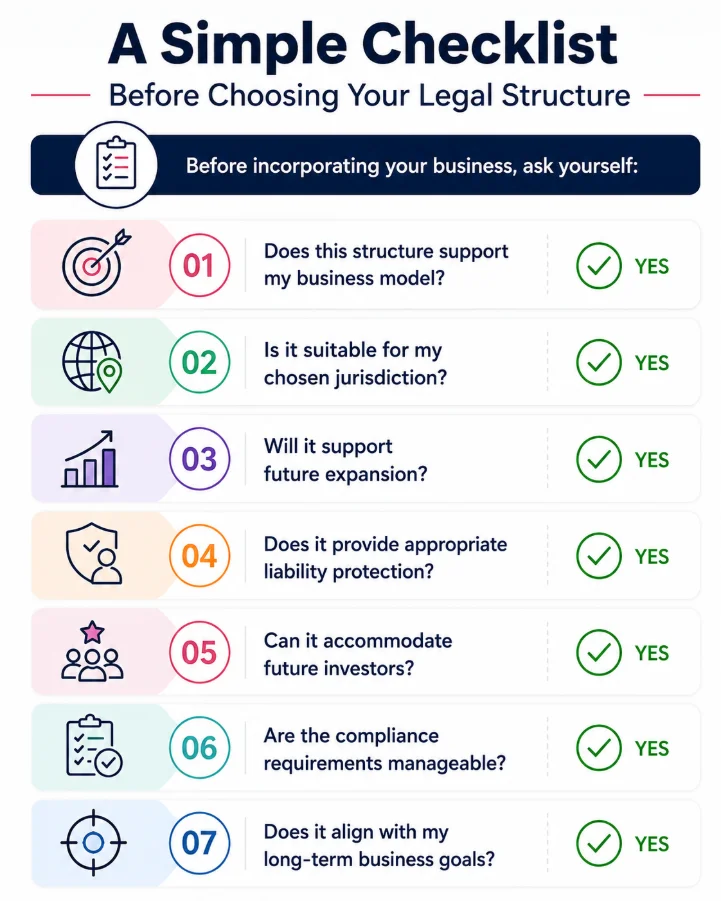
Before incorporating your business, ask yourself
✔ Does this structure support my business model?
✔ Is it suitable for my chosen jurisdiction?
✔ Will it support future expansion?
✔ Does it provide appropriate liability protection?
✔ Can it accommodate future investors?
✔ Are the compliance requirements manageable?
✔ Does it align with my long-term business goals?
If you can answer “yes” to each question, you’re more likely to choose a structure that supports sustainable growth.
How UCI Can Help?
Choosing the right legal structure is only one part of establishing a successful business. Every jurisdiction has different incorporation rules, governance requirements, tax obligations, and compliance standards, making professional guidance essential.
At UCI, we help entrepreneurs, startups, SMEs, and multinational businesses establish companies across 100+ countries. Our experienced advisors work closely with clients to recommend the most suitable legal structure based on their business objectives, ownership requirements, and expansion strategy.
Our services include
- International company formation
- Branch and subsidiary setup
- Company registration
- Business licensing and permits
- Registered office services
- Accounting and tax support
- Trademark registration
- Bank account opening assistance
- Ongoing corporate compliance
Whether you’re establishing your first company or expanding internationally, UCI provides end-to-end support throughout your business journey.
Final Thoughts
Choosing between an LLC, Ltd, SAS, or GmbH is about more than understanding legal definitions it’s about selecting the structure that best supports your business today and in the future. Each entity offers distinct advantages depending on your jurisdiction, ownership preferences, governance requirements, and long-term objectives.
Rather than focusing on a single feature such as taxation or flexibility, businesses should evaluate the complete picture, including compliance, investment potential, and international scalability. By choosing the right legal structure from the outset, and with the help of experts you can create a strong foundation for sustainable business growth while reducing future legal and operational challenges.