


Starting a business involves more than simply registering a company. From selecting the right jurisdiction and legal structure to meeting tax, licensing, and compliance requirements, every decision can affect your business’s long-term success. One of the first choices entrepreneurs face is whether to use a professional company formation service or complete the process themselves.
While DIY company formation may appear to reduce upfront costs, it often requires a thorough understanding of local regulations, documentation, and ongoing compliance obligations. A professional company formation service provides expert guidance, helping businesses avoid costly mistakes and establish a strong foundation for growth.
This guide compares a professional company formation service vs DIY, highlighting the advantages, limitations, and key considerations to help you choose the approach that best suits your business.
What Is a Professional Company Formation Service?
A professional company formation service assists businesses with establishing companies while ensuring the incorporation process complies with local legal and regulatory requirements. Rather than simply submitting registration documents, many providers offer guidance before, during, and after incorporation. Depending on the jurisdiction and business requirements, a professional company formation service may assist with
- Company formation and registration
- Jurisdiction selection
- Choosing the appropriate legal structure
- Business licences and permits
- Registered office services
- VAT and tax registration
- Bank account assistance
- Trademark registration
- Accounting and ongoing compliance
For businesses operating internationally, professional guidance can simplify complex requirements across multiple jurisdictions.
What Does DIY Company Formation Mean?
DIY company formation involves completing the incorporation process independently without engaging a professional service provider. This typically requires business owners to
- Research local company laws
- Select the appropriate legal structure
- Prepare incorporation documents
- Submit applications to the relevant authorities
- Register for tax where required
- Understand ongoing compliance obligations
For straightforward business setups in familiar jurisdictions, DIY incorporation may be a suitable option. However, businesses entering new markets or dealing with complex regulatory requirements should carefully assess the risks before proceeding.
Why Businesses Compare Professional Services and DIY?
Many entrepreneurs initially choose DIY incorporation because it appears to be the less expensive option. However, the total cost of company formation extends beyond registration fees. Incorrect documentation, choosing the wrong legal structure, missing regulatory requirements, or failing to meet ongoing compliance obligations can result in additional costs, delays, or legal complications.
A professional company formation service aims to minimise these risks by providing expert guidance throughout the process. When deciding between professional support and DIY incorporation, businesses should consider
- Cost
- Time
- Accuracy
- Compliance
- Business complexity
- International expansion plans
- Long-term support
Looking beyond the initial registration fee can help businesses make a more informed decision.
Factors to Consider Before Making Your Decision
Every business has different requirements, so there is no universal answer. Before deciding whether to use a professional company formation service or complete the process yourself, consider the following questions
- Are you incorporating in your home country or overseas?
- Do you understand the local legal and tax requirements?
- Will your business require licences or regulatory approvals?
- Do you plan to expand internationally?
- Will you need ongoing accounting or compliance support?
- How valuable is your time during the startup phase?
Answering these questions honestly can help determine whether professional support will provide long-term value for your business.
DIY Isn’t Always Simpler Than It Looks
Registering a company may appear straightforward, particularly in jurisdictions that offer online incorporation. However, successful company formation often involves much more than completing an application form.
Business owners may also need to consider
- Selecting the correct legal structure
- Preparing constitutional documents
- Understanding shareholder responsibilities
- Registering for VAT or other taxes
- Meeting annual reporting obligations
- Opening a business bank account
- Maintaining statutory records
Overlooking these responsibilities can create unnecessary administrative and compliance challenges later.
Professional Company Formation Service vs DIY – A Side-by-Side Comparison
Choosing between a professional company formation service and the DIY approach involves more than comparing registration costs. Businesses should consider the time involved, the risk of errors, compliance obligations, and the level of ongoing support they may need.
The table below highlights the key differences.
| Factor | Professional Company Formation Service | DIY Company Formation |
| Expert Guidance | ✔ Professional advice throughout | ✖ Self-research required |
| Time Required | Faster and more efficient | Can be time-consuming |
| Documentation | Prepared and reviewed professionally | Prepared independently |
| Compliance Support | Ongoing guidance available | Self-managed |
| Jurisdiction Advice | ✔ Yes | ✖ Limited |
| Legal Structure Guidance | ✔ Yes | ✖ Self-selected |
| Bank Account Assistance | Often available | Usually self-managed |
| International Expansion | Suitable for multi-country setups | More complex |
| Risk of Errors | Lower | Higher |
| Best For | Growing and international businesses | Simple local businesses |
Cost – Looking Beyond the Initial Fee
Many entrepreneurs choose DIY company formation because it appears to be the more affordable option. While it may reduce upfront service costs, it is important to consider the overall value rather than the initial registration fee alone.
A professional company formation service typically charges a fee for its expertise, but that fee often includes guidance, document preparation, and support throughout the incorporation process. DIY company formation may involve lower initial costs, but errors in documentation, incorrect registrations, or compliance issues can lead to additional expenses later.
Businesses should compare
- Registration costs
- Time investment
- Potential correction costs
- Professional advice
- Ongoing compliance requirements
The lowest-cost option is not always the most cost-effective in the long term.
Time and Efficiency
Starting a business often involves multiple priorities, from developing products and acquiring customers to securing funding and hiring employees. A professional company formation service manages much of the administrative work, allowing business owners to focus on launching and growing their business.
By contrast, DIY incorporation often requires significant time to research legal requirements, prepare documents, communicate with authorities, and resolve any issues that arise during the registration process. Professional support can streamline incorporation and help businesses become operational more quickly.
Accuracy and Documentation
Accurate documentation is essential during company formation. Professional service providers understand local incorporation requirements and can help ensure that applications are completed correctly before submission. DIY applicants are responsible for preparing and reviewing all documentation themselves.
While many registrations are completed successfully, mistakes such as incorrect shareholder information, missing documents, or selecting the wrong legal structure can delay incorporation. Submitting accurate documentation the first time helps reduce unnecessary delays and administrative complications.
Compliance Responsibilities
Registering a company is only the beginning of the business journey. Most jurisdictions require companies to meet ongoing compliance obligations such as
- Annual filings
- Accounting records
- Corporate tax returns
- VAT registration where applicable
- Statutory record keeping
- Licence renewals
A professional company formation service often provides ongoing compliance support or can connect businesses with specialists who help maintain regulatory requirements. With the DIY approach, business owners are responsible for understanding and meeting these obligations independently.
International Company Formation
Businesses expanding into overseas markets often face more complex incorporation requirements than domestic businesses. Different countries may have unique regulations relating to
- Company ownership
- Local directors
- Registered office requirements
- Licensing
- Tax registration
- Corporate reporting
Professional company formation providers with international expertise can help businesses navigate these differences and recommend the most suitable jurisdiction for their objectives. DIY company formation becomes increasingly challenging as the complexity of international regulations increases.
Business Banking Support
Opening a corporate bank account is often one of the final steps after incorporation. Many professional company formation providers assist businesses with preparing documentation, understanding banking requirements, and introducing suitable banking partners where available. Businesses choosing the DIY route must usually manage the banking process themselves, including gathering documentation and responding to financial institution due diligence requests.
Ongoing Business Support
A professional company formation service often continues to support businesses after incorporation. Additional services may include
- Accounting and bookkeeping
- VAT registration
- Corporate tax support
- Registered office services
- Company secretarial services
- Annual compliance
- Trademark registration
DIY incorporation generally ends once the company has been registered, leaving business owners to arrange these services separately as their business grows.
Advantages of Using a Professional Company Formation Service
Working with an experienced provider offers several advantages beyond company registration.
Benefits
- Expert guidance throughout the incorporation process
- Reduced risk of administrative errors
- Faster and more efficient registration
- Assistance with jurisdiction and legal structure selection
- Support with banking, tax, and compliance
- Ongoing corporate services as the business grows
Professional support is particularly valuable for businesses expanding internationally or operating in regulated industries.
Advantages of DIY Company Formation
DIY incorporation can also be appropriate in certain situations.
Benefits
- Lower upfront costs
- Complete control over the registration process
- Suitable for straightforward company formations
- Opportunity to understand incorporation requirements firsthand
For entrepreneurs establishing a simple business in a familiar jurisdiction, DIY incorporation may be a practical option if they are comfortable managing the administrative responsibilities.
Which Option Is Right for Your Business?
The right choice depends on your business goals, the complexity of your incorporation, and the level of support you require. While DIY company formation may work for straightforward domestic registrations, businesses with international ambitions or more complex requirements often benefit from professional guidance.
Startups
If you’re launching your first business, a professional company formation service can help you select the right jurisdiction, legal structure, and registration process, allowing you to focus on growing your business.
Recommended – Professional Company Formation Service
Small Businesses
Businesses operating locally with straightforward requirements may successfully complete the incorporation process themselves if they understand the legal and compliance obligations. However, professional support can still save valuable time and reduce administrative risk.
Recommended – DIY or Professional Service, depending on complexity
International Businesses
Expanding into overseas markets often involves different legal systems, tax regulations, licensing requirements, and ongoing compliance obligations.
Professional guidance helps businesses navigate these complexities and choose the most suitable jurisdiction.
Recommended – Professional Company Formation Service
Businesses Seeking Investment
Investors often expect businesses to have the correct legal structure, accurate corporate documentation, and strong governance practices.
Professional advisors can help establish a structure that supports future fundraising and long-term growth.
Recommended – Professional Company Formation Service
Highly Regulated Industries
Businesses operating in sectors such as finance, healthcare, education, or regulated professional services frequently require additional approvals or licences.
Professional assistance helps ensure these requirements are identified and addressed during the incorporation process.
Recommended – Professional Company Formation Service
Common Mistakes When Choosing the DIY Route
DIY company formation is possible, but entrepreneurs often underestimate the complexity of the process.
Common mistakes include
- Choosing the wrong legal structure.
- Selecting an unsuitable jurisdiction.
- Submitting incomplete or incorrect documentation.
- Missing tax or VAT registration requirements.
- Overlooking ongoing compliance obligations.
- Failing to obtain necessary licences or permits.
- Delaying business bank account applications.
These mistakes can lead to registration delays, additional costs, or future compliance issues.
A Simple Checklist Before Deciding
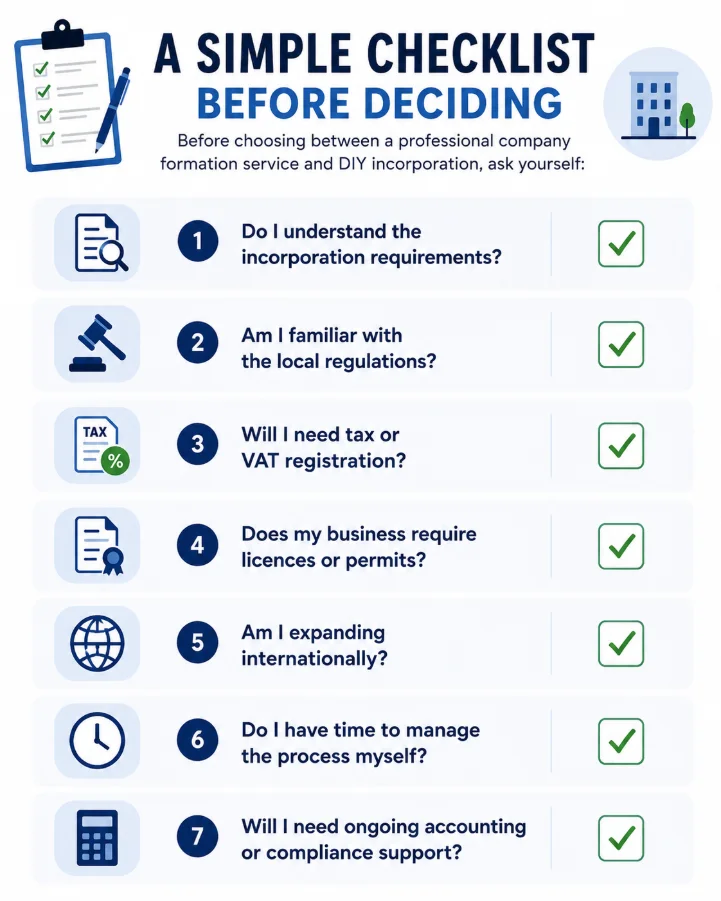
Before choosing between a professional company formation service and DIY incorporation, ask yourself
✔ Do I understand the incorporation requirements?
✔ Am I familiar with the local regulations?
✔ Will I need tax or VAT registration?
✔ Does my business require licences or permits?
✔ Am I expanding internationally?
✔ Do I have time to manage the process myself?
✔ Will I need ongoing accounting or compliance support?
If you’re unsure about any of these questions, professional guidance may help reduce risk and save valuable time.
How UCI Can Help?
Establishing a company involves far more than completing registration forms. Every jurisdiction has different legal requirements, incorporation procedures, tax obligations, and ongoing compliance responsibilities.
At UCI, we help entrepreneurs, startups, SMEs, and international businesses establish companies across 100+ countries. Our experienced specialists provide practical guidance throughout the entire business lifecycle, from selecting the right jurisdiction and legal structure to ongoing corporate support.
Our services include
- Company formation and registration
- Jurisdiction selection
- Ready-made companies
- Business licensing and permits
- Registered office and virtual office services
- VAT and tax registration
- Accounting and ongoing compliance
- Trademark registration
- Bank account opening support
Whether you’re establishing your first business or expanding internationally, UCI provides a reliable, end-to-end company formation solution.
Final Thoughts
Both DIY incorporation and professional company formation services have their place. For simple local registrations, DIY may be a practical option for entrepreneurs who understand the legal requirements and are comfortable managing the process independently.
However, as businesses become more complex, operate across multiple jurisdictions, or require ongoing compliance support, professional guidance can provide significant long-term value. Beyond reducing administrative burdens, it helps businesses establish the right foundation for sustainable growth. Choosing the right approach isn’t simply about saving money it’s about making informed decisions that support your business today and in the future.