


Romania has been steadily gaining attention as an emerging destination for entrepreneurs looking to expand their operations in Europe. With Its combination of affordable business costs, EU membership, and an increasingly skilled workforce, company formation in Romania has become an attractive option for foreign investors. However, like any jurisdiction, it comes with both benefits and challenges. Choosing where to establish your company is one of the most important decisions when pursuing international expansion. Each country has unique tax structures, regulatory requirements, and market advantages. For businesses considering Romania, weighing the pros and cons of setting up a company in Romania is key before making a move.
Why Romania Stands Out in Europe for Company Formation?
Romania has several characteristics that make it worth considering for international expansion, including EU market access, competitive operating costs, a growing skilled workforce, and opportunities across sectors such as technology, manufacturing, and professional services. International entrepreneurs evaluating Romania as part of a wider European strategy can work with UCI to understand their company formation and cross-border business options.
Strategic Location
Positioned in Eastern Europe, Romania acts as a bridge between Western Europe, the Balkans, and Central Asia. As an EU member state, companies gain access to the single market while benefiting from proximity to non-EU trade partners.
EU Membership and Stability
Romania has been part of the EU since 2007, ensuring compliance with European standards, a more stable political framework, and access to EU funding.
Competitive Business Environment
With a corporate tax rate among the lowest in the EU and various investment incentives, Romania appeals to cost-conscious startups and expanding corporations.
Key Benefits of Setting Up a Company in Romania
One of the most significant reasons foreign investors consider Romania is the host of advantages available to businesses.
Low Corporate Tax Rate
Romania applies a standard corporate tax rate of 16%, one of the most attractive in Europe. For small enterprises classified as micro-enterprises, special reduced taxation options exist, creating a favorable environment for entrepreneurs.
Access to the EU Market
As a member of the European Union, Romania provides businesses unrestricted access to the EU’s single market. This means free movement of goods, services, and capital, crucial for companies engaged in cross-border trade.
Skilled and Cost-Efficient Workforce
Romania boasts a highly educated workforce, particularly in engineering, IT, and financial services. Labor costs remain significantly lower than in Western European countries, giving businesses access to talent at competitive rates.
Affordable Operating Costs
Compared to markets such as the German business market or French corporate landscape, the cost of office space, salaries, and daily operations is much lower in Romania. This makes it an appealing destination for startups and SMEs seeking to maximise profitability.
Investment Incentives
Romania offers investment schemes targeted at industries like IT, research and development, and manufacturing. These incentives include grants, tax breaks, and access to EU funding programs designed to stimulate foreign investment.
Challenges of Starting a Business in Romania
While the benefits are compelling, it’s equally important to consider the cons of setting up a company in Romania.
Bureaucracy and Administrative Processes
Despite progress in digitalisation, Romania still struggles with bureaucratic hurdles. Delays in licensing, registration, and approvals are common without local expertise.
Language Barriers
Although English is widely spoken in business circles, dealing with government documents and procedures often requires Romanian language skills. This can be challenging for foreign entrepreneurs without local support.
Complex Regulations
Compliance with Romanian regulations can be complicated for newcomers. Frequent tax updates and changing administrative procedures may pose risks without expert legal and accounting support.
Comparisons with Other EU Countries
In some cases, Romania may offer lower taxes but less infrastructure or slower administrative processes compared to Western European hubs like Germany or the Netherlands.
Types of Companies You Can Register in Romania
Choosing between an SRL, SA, branch, subsidiary, or another structure should depend on factors such as ownership, liability, taxation, operational plans, and the expected scale of the business. Foreign investors can explore UCI’s Romania company formation services for assistance with establishing an appropriate corporate presence in Romania.
- SRL (Societate cu Răspundere Limitată) – Equivalent to a limited liability company, this is the most popular form for SMEs due to its flexibility and low capital requirements.
- SA (Societate pe Acțiuni) – A joint stock company suitable for larger enterprises and companies looking to list shares.
- Branch or Subsidiary – Foreign companies can expand into Romania through branches or subsidiaries.
- Micro-Enterprise – Designed for smaller businesses, micro-enterprises benefit from simplified taxation and reporting requirements.
Comparing Romania with Other European Jurisdictions
To better understand the pros and cons of setting up a company in Romania, let’s compare it with other European countries.
| Factor | Romania | Western Europe (UK/Germany/France) | Eastern Europe (Poland/Bulgaria/Hungary) |
| Corporate Tax Rate | 16% | 19–30% | 9–19% |
| Operating Costs | Low | High | Low–Moderate |
| Workforce Costs | Low | High | Low |
| Bureaucracy | Moderate | Lower | Moderate–High |
| EU Market Access | Yes | Yes | Yes |
| Investment Incentives | Strong in IT/R&D | Strong but costly entry | Growing incentives |
| Ease of Banking | Moderate | High | Moderate |
This comparison shows that Romania can provide a balance between competitive operating costs and access to the wider European market. However, entrepreneurs should compare taxation, workforce availability, administrative requirements, infrastructure, and long-term expansion opportunities before selecting a jurisdiction.
Also read – Best Countries for Company Formation
Step-by-Step Guide to Registering a Company in Romania
Setting up a business in Romania requires several formal steps
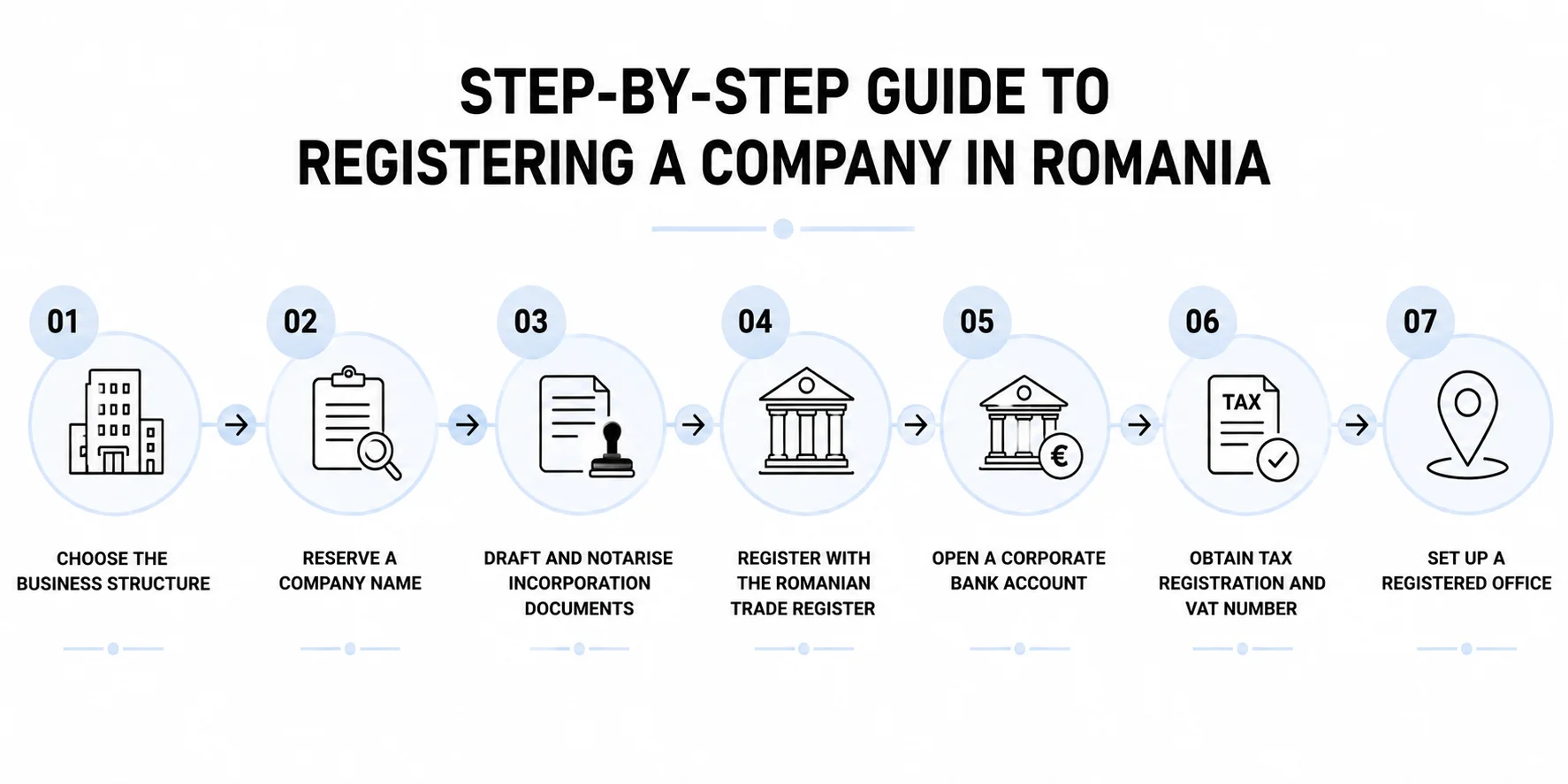
- Choose the Business Structure – Decide whether you will operate as an SRL, SA, or other entity based on your goals.
- Reserve a Company Name – Submit your chosen business name to the Romanian Trade Register for approval.
- Draft and Notarise Incorporation Documents – Articles of Association and other documents must be prepared and notarised.
- Register with the Romanian Trade Register – The official body responsible for company incorporation.
- Open a Corporate Bank Account – Required for capital deposit and ongoing operations.
- Obtain Tax Registration and VAT Number – Essential for conducting business in compliance with Romanian law.
- Set Up a Registered Office – Every Romanian company must have a legal address for correspondence.
Each step requires careful attention to detail, and UCI provides end-to-end support to ensure a smooth process.
Taxation and Accounting in Romania
- Corporate Tax – Standard rate of 16%, with reduced rates for qualifying micro-enterprises.
- VAT – Standard VAT rate is 19%, with reduced rates (5–9%) for certain goods and services.
- Dividend Tax – Dividends are generally subject to a 5% withholding tax, though EU directives may provide exemptions.
- Accounting Requirements – Romanian companies must adhere to local accounting standards and submit annual reports.
UCI’s accounting and tax support services ensure compliance with these requirements while helping businesses maximize available tax incentives.
Banking and Financial Considerations
Opening a corporate bank account in Romania is a mandatory step. Options include both local banks and international banks with a presence in Romania. Requirements often include company incorporation documents, proof of address, and director identification. UCI simplifies this process by working directly with banks and helping entrepreneurs avoid unnecessary delays.
How UCI Helps You Set Up a Business in Romania?
At UCI, we provide comprehensive support for entrepreneurs and companies exploring Romanian expansion
- End-to-End Company Formation – From legal documentation to incorporation.
- Registered Office & Nominee Services – Ensuring compliance and credibility in Romania.
- Banking & Financial Assistance – Helping open local or international accounts.
- Accounting & Tax Support – Handling VAT, corporate tax, and financial reporting.
- Immigration & Branch Setup – Supporting foreign directors and branch expansion.
Conclusion
Romania is increasingly seen as an attractive location for businesses seeking EU market access, competitive operating costs, skilled talent, and opportunities across growing sectors. However, entrepreneurs must also consider bureaucracy, language barriers, taxation, and ongoing regulatory requirements before establishing operations. Ultimately, whether Romania is the right choice depends on your industry, expansion objectives, and preferred corporate structure. If you are considering establishing a company in Romania, contact UCI to discuss your formation and ongoing compliance requirements.