
Hong Kong has long been a magnet for entrepreneurs and global businesses seeking expansion into Asian markets. Its strategic location, world-class infrastructure, and business-friendly policies make it an attractive destination for startups and established companies alike.
But is it the right choice for your business? This comprehensive guide evaluates whether Hong Kong truly stands out as a business hub in 2026 and provides the insights you need to make an informed decision about expanding your operations.
The reality is that Hong Kong presents a compelling case for business formation, but it is not a one-size-fits-all solution. Understanding the advantages, challenges, and specific scenarios where Hong Kong excels will help you determine if this jurisdiction aligns with your entrepreneurial goals and business model.
Why Hong Kong Stands Out as a Global Business Hub
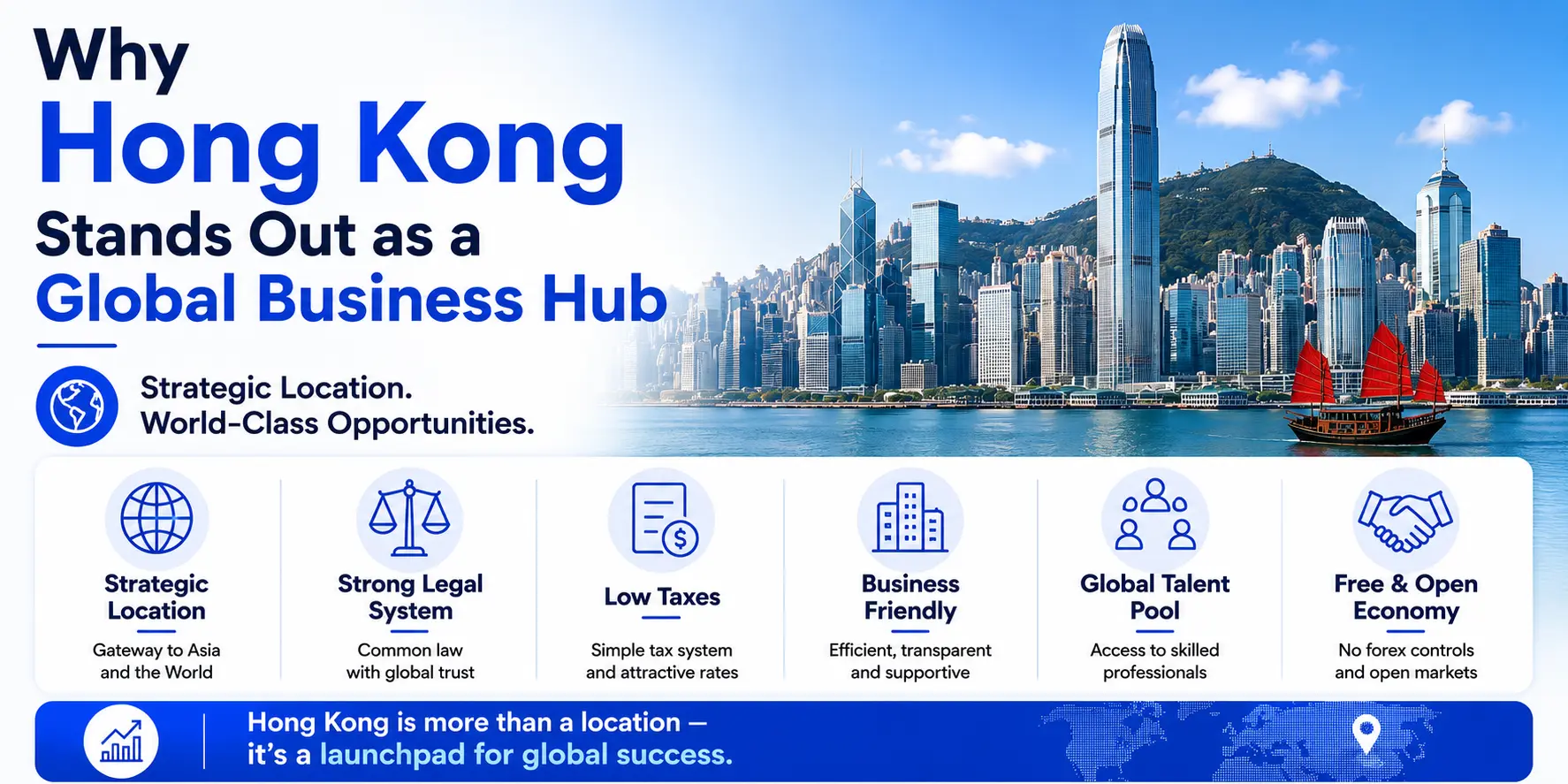
Hong Kong’s reputation as a top business destination is not accidental. Several critical factors position it uniquely in the Asian market and globally.
Strategic Location and Market Access Across Asia
Located at the crossroads of Asia, Hong Kong serves as a natural gateway to China’s vast economy while maintaining unrestricted access to global markets. The city’s proximity to Southeast Asia makes it ideal for companies targeting rapid regional expansion. This geographic positioning has made Hong Kong the preferred base for companies seeking to operate across multiple Asian countries while maintaining a single corporate headquarters.
The strategic advantage extends beyond mere proximity. Hong Kong’s deep-water ports, efficient shipping infrastructure, and centuries of trade history have created an ecosystem where import-export operations thrive naturally. Companies using Hong Kong as their operational base can leverage this established infrastructure to move goods, services, and capital across Asia and to global markets with remarkable efficiency.
Strong Financial Ecosystem and Banking Infrastructure
Hong Kong hosts the world’s fourth-largest stock exchange and more than 600 licensed banks. This robust financial infrastructure provides startups and established businesses with reliable access to capital and banking services. The depth of the financial market means that companies can access everything from traditional bank financing to venture capital, private equity, and specialized lending products tailored to international business needs.
Beyond banking, Hong Kong’s financial ecosystem includes sophisticated treasury management services, currency trading facilities, and alternative investment vehicles. These resources allow international businesses to optimize their financial structures, manage multi-currency operations, and access capital markets that would be unavailable in smaller financial centers.
Business-Friendly Environment and Regulatory Stability
The city ranks consistently high in global business ease-of-setup indices, with transparent regulations and minimal bureaucratic delays. The Companies Registry operates with remarkable efficiency, processing incorporation applications rapidly and maintaining clear, English-language documentation of all business regulations.
The regulatory environment is characterized by predictability and consistency. Unlike many jurisdictions where regulations change frequently, Hong Kong maintains stable business laws that have been refined over decades. This stability provides entrepreneurs with confidence that their business planning will not be undermined by sudden regulatory changes or bureaucratic obstacles.
Hong Kong’s Tax Advantages and System
One of Hong Kong’s biggest draws is its attractive tax structure, but understanding the nuances is crucial before making your business setup decision.
Corporate Tax Rate at 16.5 Percent
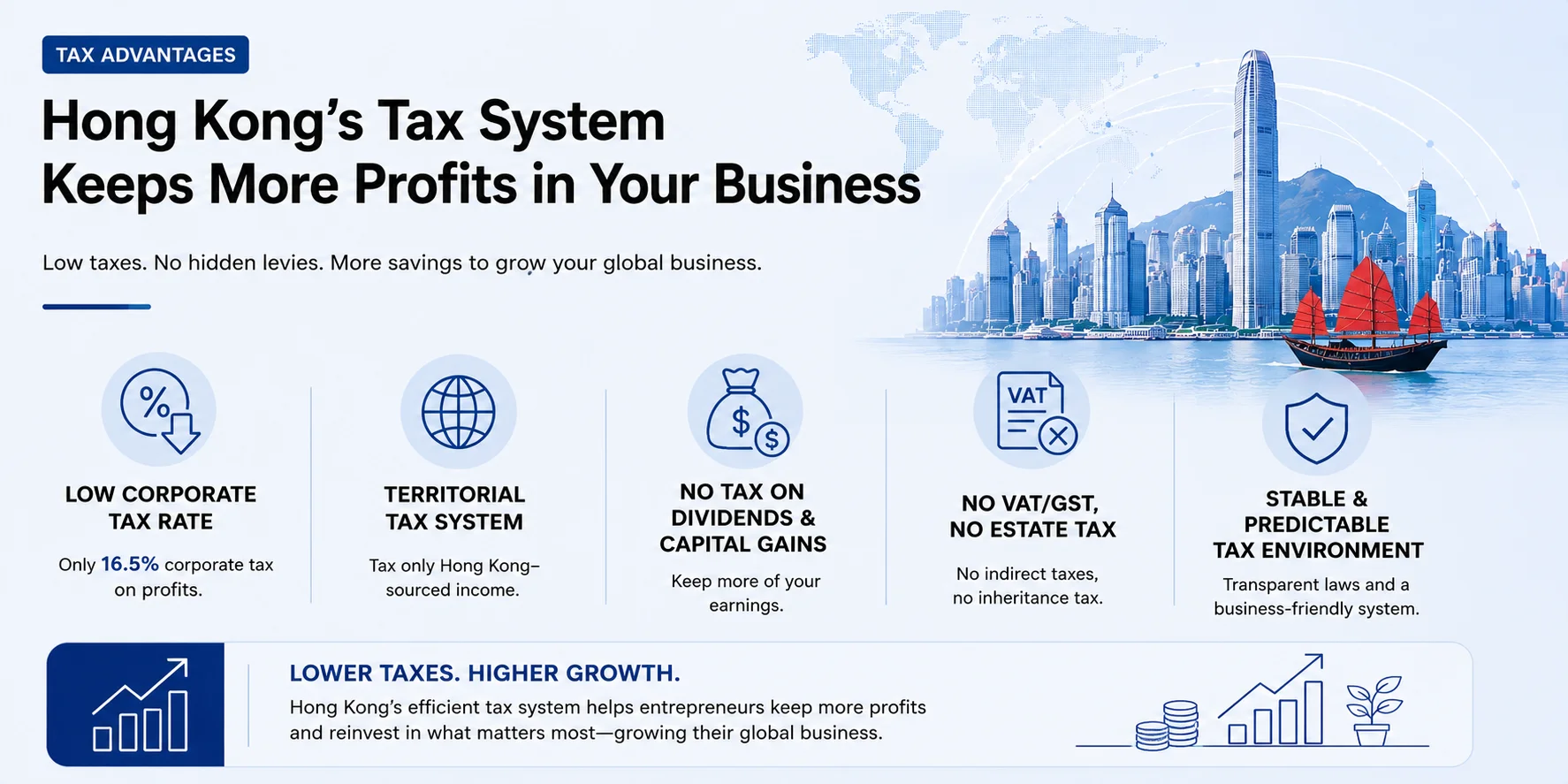
Hong Kong’s corporate tax is among the lowest in the world. Companies pay only 16.5 percent of profits, compared to significantly higher rates in many Western countries and regional competitors. This rate applies to profits earned in Hong Kong under the system of profits tax, which is calculated on an assessable profits basis.
The 16.5 percent rate applies to corporations that make profits from trading or business activities. This is substantially lower than the United States federal corporate tax of 21 percent, the United Kingdom rate of 25 percent, and other developed nations. Even compared to regional competitors like Singapore at 17 percent, Hong Kong offers competitive advantages through its tax structure design.
Territorial Tax System Explained and Its Benefits
This is a fundamental game-changer for international businesses. Hong Kong’s territorial tax system means you only pay tax on income earned within Hong Kong. Income derived from overseas operations is not taxable in Hong Kong, provided it remains offshore and is not brought into Hong Kong territory.
This distinction is critical for entrepreneurs building international businesses. If your company sources materials from Vietnam, manufactures in Thailand, and sells to clients in the United States, the profits from these transactions are not subject to Hong Kong taxation. Only income directly generated within Hong Kong or remitted into Hong Kong from overseas is taxable.
Example of Territorial Tax Benefits in Practice
Consider a trading company in Hong Kong that sources goods from Vietnam and sells to clients in the United States. The company purchases products for USD 50,000 and sells them for USD 100,000. The profit of USD 50,000 is not subject to Hong Kong tax because the income is not sourced in Hong Kong. However, if the same company maintained a warehouse in Hong Kong and charged customers for Hong Kong-based services, that portion of revenue would be taxable.
Additional Tax Benefits Beyond Corporate Tax
Hong Kong provides tax relief that competitors cannot match. Dividends received by shareholders are not taxed. Capital gains are not taxed. There is no value-added tax or goods and services tax. There is no estate or inheritance tax. There is no wealth tax.
This comprehensive tax structure creates a financial advantage that compounds over years of operations. While a trading company operating in a jurisdiction with 25 percent corporate tax, 20 percent dividend tax, and 17 percent capital gains tax might pay 40-50 percent of profits in total taxes, a comparable Hong Kong company might pay only 16.5 percent on its Hong Kong income.
Tax Feature Comparison Across Jurisdictions
| Tax Feature | Hong Kong | United States | Singapore |
| Corporate Tax Rate | 16.5 percent | 21 percent | 17 percent |
| Dividend Tax | None | 15-20 percent | 5-10 percent |
| Capital Gains Tax | None | 15-28 percent | None |
| VAT/GST | None | 7.25 percent average | 8 percent |
| Total Tax Burden | 16.5 percent | 43-49 percent | 25-35 percent |
Company Formation: How Simple Is It Really?
Many entrepreneurs are surprised by how quickly and easily companies can be formed in Hong Kong once they understand the process.
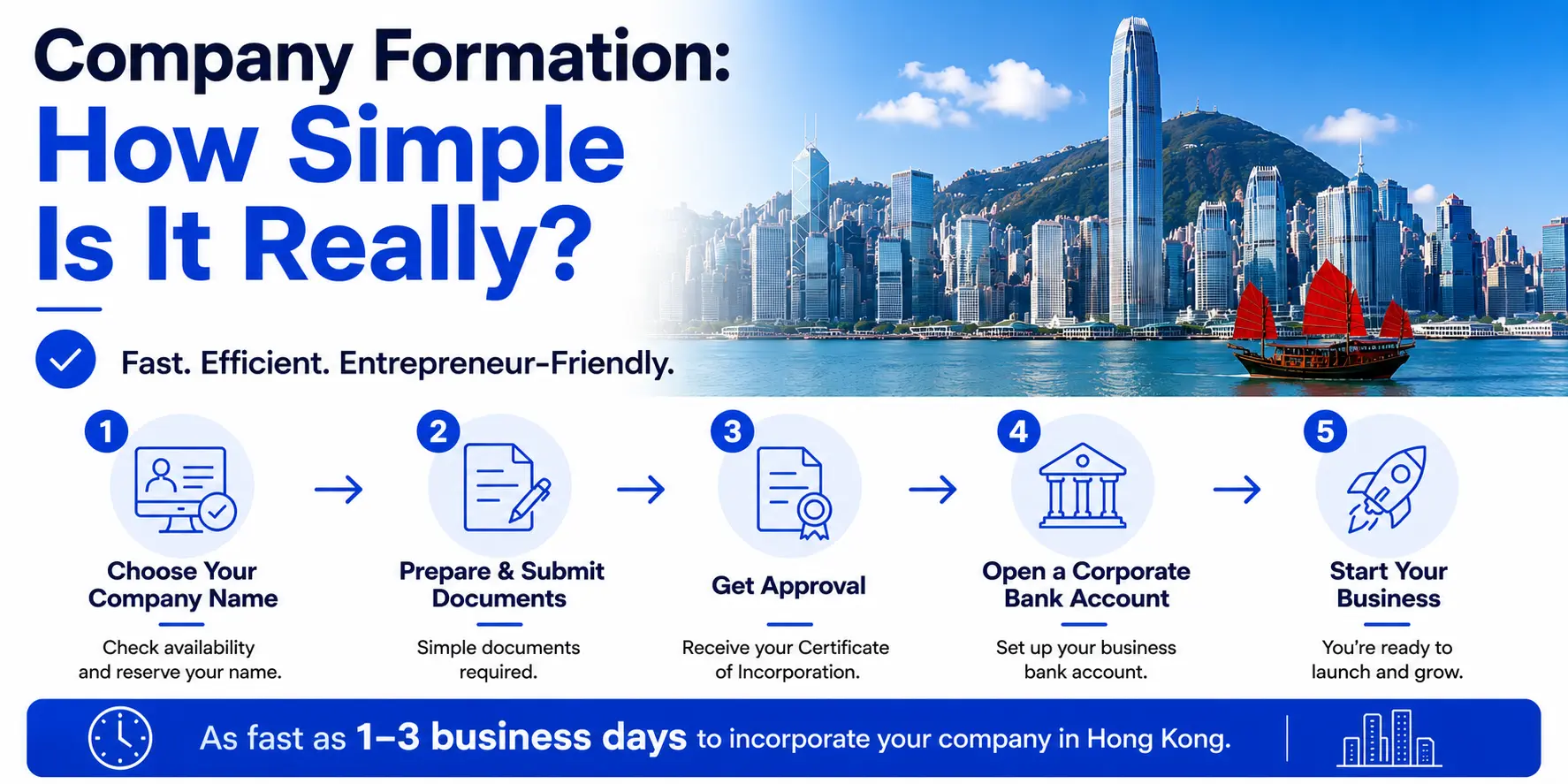
The Timeline: 1-3 Business Days for Incorporation
Most companies can be registered and operational within 24-72 hours. This is significantly faster than many other jurisdictions. The United States requires 5-7 business days on average. The United Kingdom requires 10-14 business days. Singapore requires 3-5 business days. Dubai requires 5-7 business days.
The speed is possible because Hong Kong’s Companies Registry has digitized its processes entirely. You can submit incorporation applications online, and approvals are granted electronically. The registry operates with remarkable efficiency, processing applications the same day they are submitted during business hours.
What You Need for Company Formation
To incorporate a company in Hong Kong, you will need identification documents such as a passport or national ID card from any country. You will need proof of address, which can be a utility bill or bank statement from any country. You will need business details including your proposed company name and the business activities your company will undertake. You will need director and shareholder information, which can be the same person.
The flexibility of Hong Kong incorporation is remarkable. You do not need to be a Hong Kong resident. You do not need to have worked in Hong Kong previously. You do not need local connections or references. You simply need valid identification and proof of your current address.
Key Advantages of Hong Kong Company Formation
One hundred percent foreign ownership is allowed, meaning no local partner is required. A single director is permitted, so you can be the sole director, secretary, and shareholder all in one person. No minimum share capital is required to establish a company. Minimal ongoing compliance is required compared to many jurisdictions. English language proceedings and documentation are standard throughout the system.
These advantages combine to make Hong Kong one of the easiest places in the world for an entrepreneur to establish a company with complete control and minimal bureaucratic friction.
Government Registration Fee for Incorporation
The government registration fee for standard incorporation is HKD 1,730, which converts to approximately USD 220. This flat fee includes the incorporation process, company registration certificate, business registration, and initial government services. This is significantly cheaper than incorporation in many other jurisdictions.
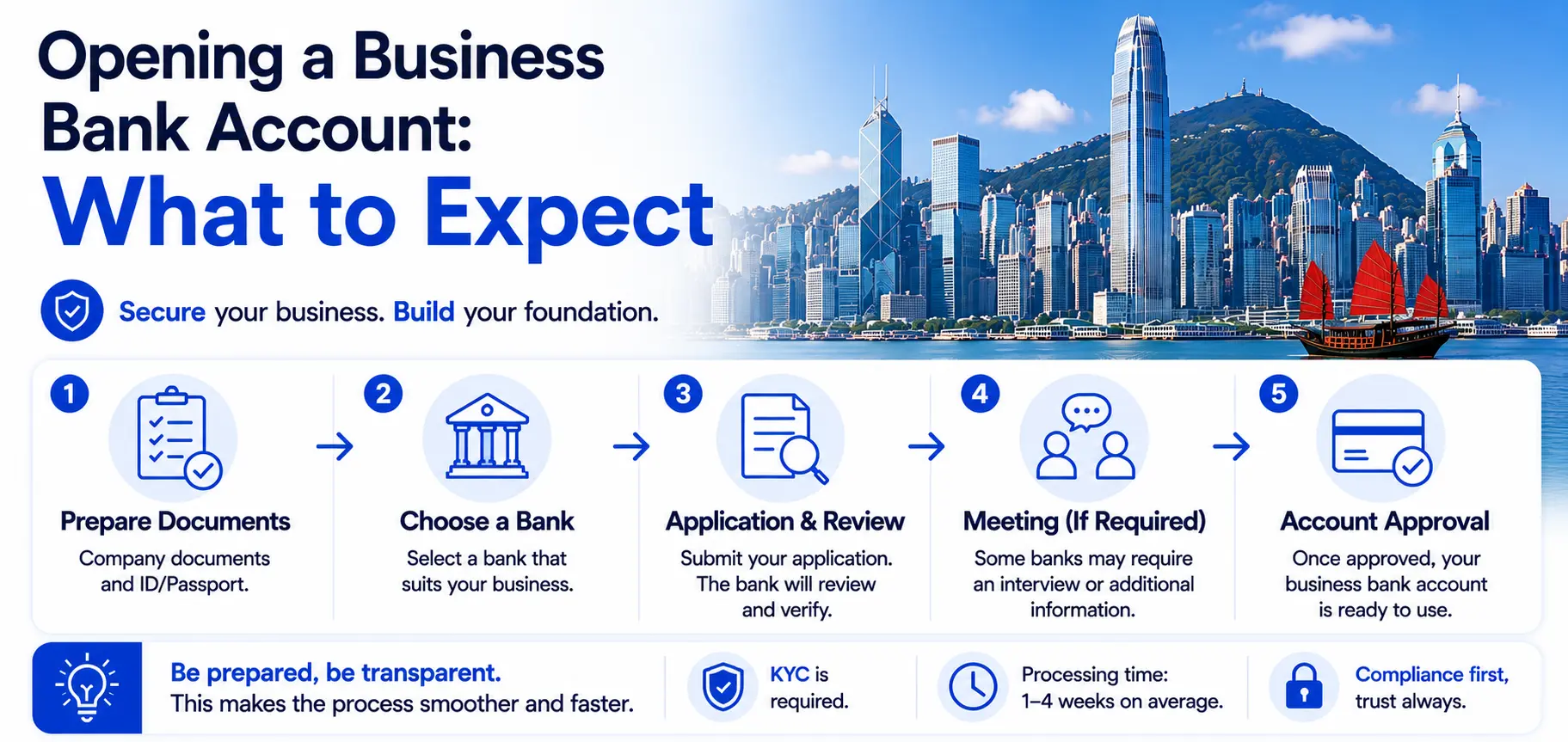
Opening a Business Bank Account: What to Expect
Why This Matters for Your Business Operations
A dedicated business bank account separates your personal and business finances legally and operationally. A business bank account is essential for maintaining compliance with Hong Kong tax and company law regulations. A business bank account is required by law for companies operating in Hong Kong. Without a business bank account, you cannot process payroll, pay suppliers, or collect from customers in a compliant manner.
The Challenge for Non-Residents Opening Accounts
Here is where many entrepreneurs encounter their first friction point in the Hong Kong setup process. Hong Kong banks have tightened Know Your Customer and Customer Due Diligence requirements in recent years, making it harder for non-residents to open accounts remotely. These requirements exist to comply with international anti-money-laundering and counter-terrorism-financing regulations.
Banks require extensive documentation to verify the legitimacy of the business, the source of funds, and the beneficial ownership structure. Providing insufficient documentation results in account rejection. Processing inadequate documentation leads to delays lasting weeks or months.
Documents Required by Major Hong Kong Banks
Banks require your company registration certificate, which is issued by the Companies Registry within 1-2 days of incorporation. Banks require your business registration, which is obtained from the Business Registration Office. Banks require your incorporation certificate as proof of company establishment and legal existence. Banks require the director’s identification, typically a passport or national identity card.
Banks require proof of address for the director, which must be a utility bill, bank statement, or government correspondence bearing your name and current address. Banks require proof of the company’s registered address, which can be a lease agreement, letter of office authorization, or virtual office service agreement. Banks request business plan documents showing the nature of your business, expected transaction volumes, customer types, and industry classification.
Banking Timeline and Expectations for Account Opening
Without professional assistance, opening a bank account typically requires 2-4 weeks and often involves one or more visits to Hong Kong to meet with bank representatives in person. With expert support from professional service providers, the timeline reduces to 5-10 business days. Some banks will accept detailed documentation packages without requiring in-person visits if the documentation package is comprehensive and professionally prepared.
Banks to Consider for Your Hong Kong Business Operations
Standard Chartered Bank Hong Kong offers business accounts with competitive fees and good online banking platforms. DBS Bank Hong Kong provides excellent digital banking and fast account opening for verified customers. HSBC Hong Kong is one of the largest banks and offers comprehensive business services. Hang Seng Bank is a major Hong Kong bank with strong local credibility. Bank of China Hong Kong offers accounts for trading companies and import-export businesses.
Each bank has different requirements, processing times, and fee structures. Professional service providers can recommend the most appropriate bank for your specific business type and situation.
Pro Tip on Banking and Account Setup
Expert service providers maintain established relationships with banks and understand current requirements in detail. They can expedite the process significantly, often reducing the timeline to under two weeks. They can prepare documentation packages that meet each bank’s current requirements precisely. They can communicate directly with bank relationship managers on your behalf. They can guide you through verification calls and address any information gaps immediately.
Legal Requirements and Compliance Obligations
Before setting up, understand what is required to stay compliant throughout each year of your company’s operation.
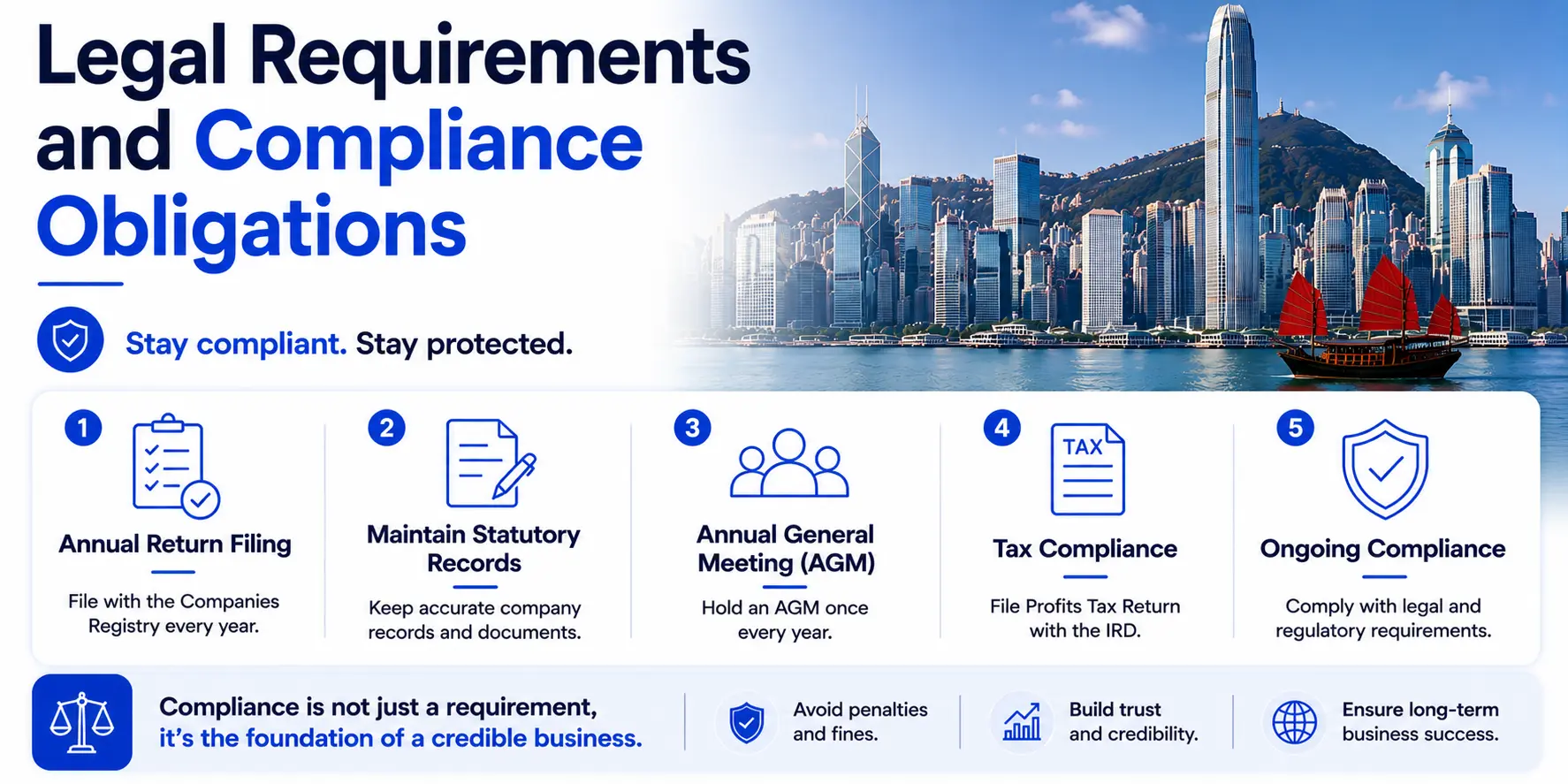
Annual Filing Requirements for Hong Kong Companies
Your company must file an annual return called Form AR1 with the Companies Registry every year. This filing is free when handled by a qualified company secretary. Your company must be audited annually if it meets certain size thresholds, which costs between HKD 3,000 and HKD 15,000 depending on company size and transaction complexity. Your business registration must be renewed annually for a fee of HKD 2,300, which converts to approximately USD 295.
Your company secretary must file a compliance report confirming that the company has complied with Companies Ordinance requirements, costing HKD 500 to HKD 1,500. These filings are straightforward once properly set up, but they must not be missed.
The Company Secretary Requirement Explained
Hong Kong requires every company to appoint a company secretary. This person is responsible for regulatory compliance, filing annual returns, maintaining statutory records, and ensuring the company meets all legal obligations.
The company secretary can be a director of the company, meaning if you are the sole director, you can also serve as your own company secretary if you have a residential address in Hong Kong. Alternatively, you can appoint an external professional firm to serve as your company secretary. External professional company secretary services cost HKD 3,000 to HKD 8,000 annually for typical small businesses.
Most non-residents appoint an external company secretary because the company secretary must have a residential address in Hong Kong, and handling compliance remotely is more complex than it appears.
Registered Address Requirement and Maintenance
Every company must have a registered address in Hong Kong. This must be a physical location such as an office, residential address, or virtual office. Official documents and legal papers can be served at this address. The registered address must be displayed on company correspondence, invoices, and business documents. The registered address serves as the official location where company records are kept.
A registered address must be current and valid at all times. If your registered address becomes invalid, you must update it within a specified period. Failure to maintain a valid registered address results in penalties and potential company dissolution.
Importance of Staying Compliant with All Regulations
Non-compliance with Hong Kong regulations can result in fines up to HKD 10,000, which converts to approximately USD 1,280. Non-compliance can lead to director disqualification, meaning you lose the right to serve as a company director. Non-compliance can result in company dissolution, meaning your company is struck off the registry. Non-compliance creates legal liability for directors personally, meaning you can be held personally responsible for company debts and obligations. Non-compliance damages your credit rating and business reputation.
The consequences of non-compliance are severe enough that every entrepreneur should prioritize proper setup and ongoing compliance from the beginning.
Office and Registered Address Options for Your Business
Your choice of physical versus virtual office depends on your business type, budget, operational needs, and growth plans.
Physical Office Space Considerations and Costs
A physical office costs between HKD 15,000 and HKD 50,000 monthly, depending on location, size, and amenities. Physical offices are best for companies needing client meetings, product storage, or team workspace. Popular locations include Central, which is the premium business hub with the highest costs. Kowloon offers good access for logistics and retail businesses. New Territories provides more space at lower costs. Sheung Wan is becoming a growing tech and startup hub.
Lease terms for physical office space are typically 1-3 years, though some landlords offer shorter terms at premium monthly rates. Physical offices provide legitimacy and presence but represent a significant ongoing expense.
Virtual Office Solutions and Their Benefits
A virtual office costs between HKD 1,500 and HKD 5,000 monthly. Virtual offices are ideal for e-commerce, trading, tech startups, and companies with remote teams. Virtual office services typically include a registered address where official documents can be served. Mail handling and mail forwarding to your preferred location. Meeting rooms available by appointment for client meetings. Phone answering services in some packages.
No long-term commitment is required for most virtual offices, allowing month-to-month flexibility as your business grows. Many virtual office providers now offer these services with professional reputations, making them legitimate for business operations.
Cost Comparison for Startups and Small Businesses
A virtual office can reduce your setup costs by HKD 100,000 or more annually compared to traditional office space. For a bootstrapped startup, this savings can be the difference between survival and failure during the critical early growth phase. The cost advantage of virtual offices has made them increasingly popular among entrepreneurs, even those who intend to establish physical offices later when their business grows.
Why Hong Kong Is Ideal for Global Expansion
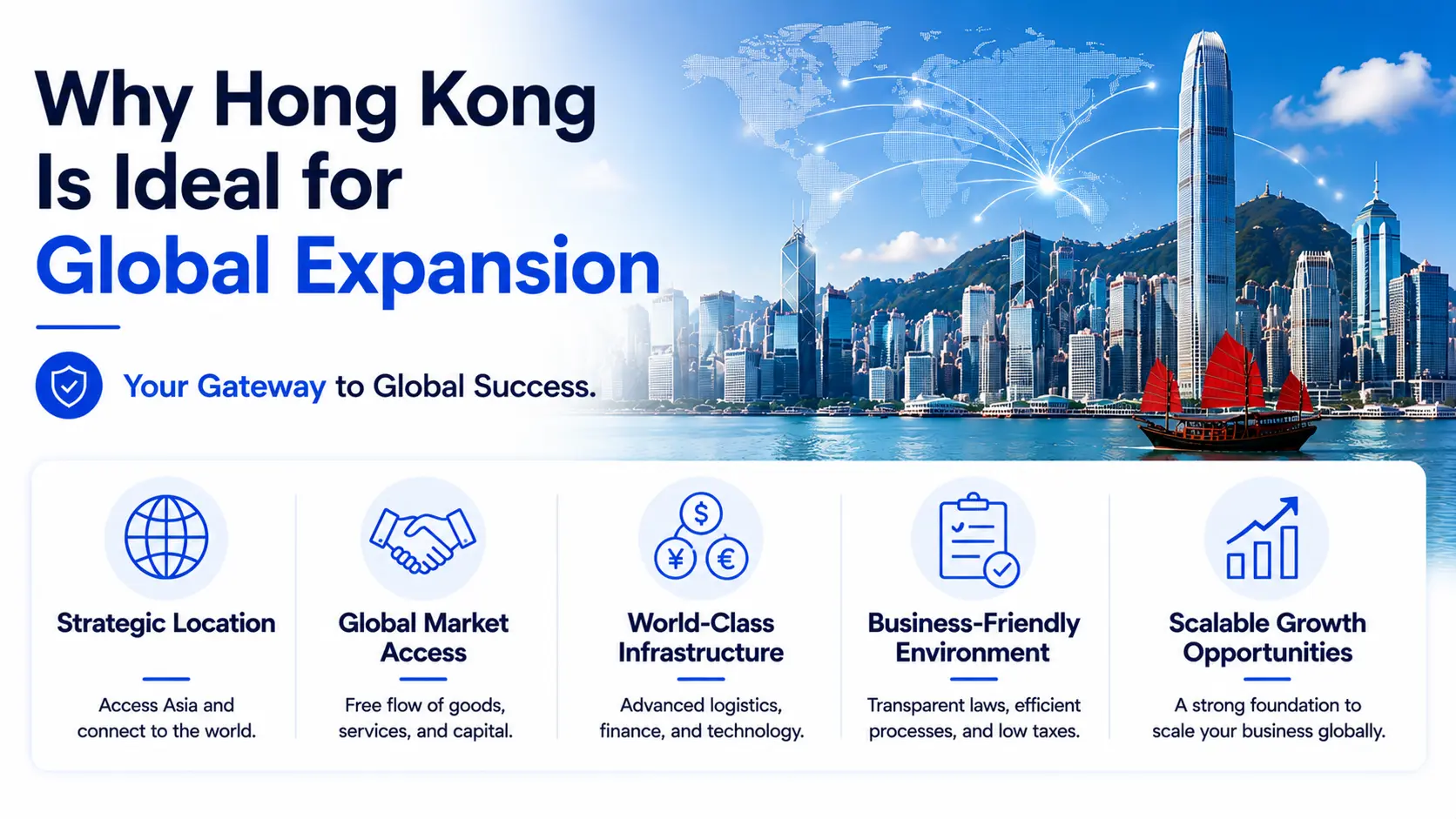
Access to International Markets and Trade Agreements
Hong Kong maintains Free Trade Agreement status with most countries and preferential trade relationships with major economic blocs. Goods exported from Hong Kong are often subject to lower tariffs than those from mainland China. This creates genuine competitive advantages for companies using Hong Kong as their operational base.
Trade Advantages for Exporters and Importers
Rules of Origin Benefits allow products manufactured or processed in Hong Kong to access special trade agreements and preferential tariff rates. A Re-export Hub strategy involves importing from China, repackaging, and exporting to ASEAN countries with preferential rates. Currency Flexibility lets you trade in multiple currencies with no exchange restrictions.
Hong Kong’s financial infrastructure supports multi-currency operations seamlessly. You can invoice customers in different currencies, receive payments in various currencies, and convert between currencies with minimal friction. This capability is invaluable for companies operating across multiple markets.
Reputation and Credibility in Global Markets
A Hong Kong company carries significant credibility in international business. The Hong Kong brand signals regulatory compliance and transparency to international partners. The Hong Kong brand indicates access to established financial systems and international banking relationships. The Hong Kong brand demonstrates international legal standing and enforceability of contracts.
When customers, suppliers, and partners see you are registered in Hong Kong, they immediately recognize that you operate under well-established international standards. This reputation advantage can be worth thousands of dollars in faster deal closures, better payment terms, and customer trust.
Ease of Cross-Border Transactions and Capital Movement
Hong Kong Dollar is fully convertible to any currency with no restrictions. Hong Kong has no capital controls, meaning you can move money in and out freely. International banking and payment systems are highly efficient, with SWIFT and international transaction support. Most banks and payment processors worldwide accept Hong Kong bank accounts and recognize Hong Kong companies without hesitation.
This freedom of capital movement and transaction efficiency makes Hong Kong ideal for companies operating across multiple countries.
Ideal Industries for Hong Kong Expansion
E-commerce and dropshipping businesses benefit enormously from Hong Kong’s trade advantages and tax structure. Import-export trading companies find Hong Kong provides both the infrastructure and tax benefits needed to thrive. Financial services and fintech companies operate within a well-regulated framework. Tech startups serving Asian markets find Hong Kong provides both market access and favorable regulations. Consulting and professional services firms benefit from the Hong Kong credential and international reputation.
Refer to UNIPRO Asia’s guide at https://uniproasia.com/why-hong-kong-is-the-smart-choice-for-expanding-your-business-in-asia/ for additional industry-specific insights.
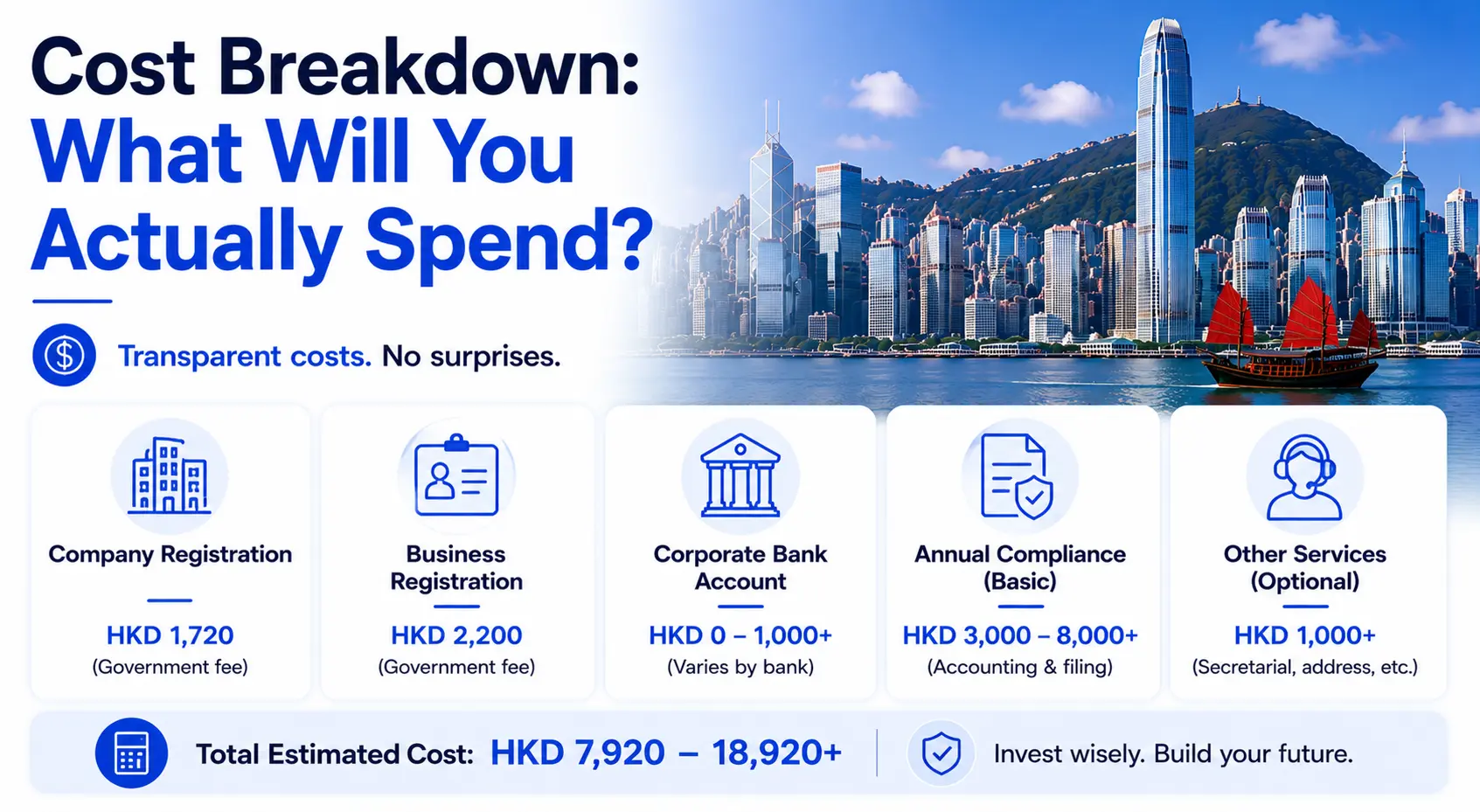
Cost Breakdown: What Will You Actually Spend?
Initial Setup Costs for Your First Year
Company Registration costs HKD 1,730, approximately USD 220. Business Registration costs HKD 2,300, approximately USD 295. Virtual Office for one year costs HKD 18,000 to HKD 60,000, or approximately USD 2,300 to USD 7,700 depending on location and services. Company Secretary Service for one year costs HKD 3,000 to HKD 8,000, approximately USD 385 to USD 1,025.
Bank Account Opening with professional assistance costs zero to HKD 3,000, or approximately zero to USD 385 depending on whether the bank charges account opening fees. Professional Consultation and Setup support costs HKD 5,000 to HKD 15,000, approximately USD 640 to USD 1,920.
Total First Year Budget Range: HKD 31,030 to HKD 90,030, or approximately USD 4,000 to USD 11,600.
Annual Ongoing Costs After Year One
Business Registration Renewal costs HKD 2,300. Virtual Office costs HKD 18,000 to HKD 60,000. Company Secretary costs HKD 3,000 to HKD 8,000. Audit, if required, costs HKD 3,000 to HKD 15,000. Professional support and advisory costs HKD 2,000 to HKD 5,000.
Total Annual Ongoing Cost Range: HKD 28,300 to HKD 90,300, or approximately USD 3,600 to USD 11,600.
How Hong Kong Costs Compare to Other Jurisdictions
| Jurisdiction | Year 1 Setup | Annual Cost |
| Hong Kong | USD 4,000-11,600 | USD 3,600-11,600 |
| Singapore | USD 1,200-2,500 | USD 2,500-5,000 |
| Dubai, UAE | USD 2,500-6,000 | USD 2,000-4,500 |
| United States | USD 500-3,000 | USD 1,500-5,000 |
| United Kingdom | USD 300-2,000 | USD 1,000-3,000 |
Hong Kong’s costs are moderate and higher than some jurisdictions, but the costs are justified by the tax benefits, market access advantages, and global credibility that the jurisdiction provides.
Pros and Cons: Is Hong Kong Right for You?
The Advantages of Choosing Hong Kong
Exceptionally Low Tax Burden
The 16.5 percent corporate tax combined with the territorial tax system means substantial savings for international businesses. No VAT, capital gains tax, or dividend tax creates an unmatched tax advantage.
Global Reputation and Credibility
The Hong Kong brand carries significant weight in international business. Competitors, customers, and partners recognize the jurisdiction’s credibility and stability.
Rapid Company Formation
1-3 business days to incorporation beats virtually all other jurisdictions globally. You can be operational within days.
Minimal Regulatory Burden
Annual compliance is straightforward involving filing one annual return, maintaining a company secretary, and keeping your registered address current. No complex filing requirements exist compared to United States or European Union jurisdictions.
One Hundred Percent Foreign Ownership
No local partners are required. You retain complete control of your company and its operations.
Currency and Capital Freedom
Full currency convertibility, no capital controls, and unrestricted fund transfers in and out provide financial flexibility.
Established Trade Infrastructure
Centuries of trading history have created an ecosystem where import-export operations thrive naturally.
The Challenges You Should Consider
Banking Complexity for Non-Residents
Opening accounts as a non-resident requires extensive documentation and often bank visits. The timeline without professional assistance is 2-4 weeks.
Ongoing Compliance Obligations
You must maintain a company secretary, registered address, and annual filings. Non-compliance carries penalties including fines and potential company dissolution.
Registered Address Requirement
Even virtual offices cost money. You cannot use an offshore address or a friend’s residential address indefinitely.
Limited Local Market Size
Hong Kong’s population is only 7.5 million. The local market is small, requiring export focus or international customer reach to achieve meaningful revenue.
Political and Economic Uncertainty
Recent geopolitical tensions and regulatory changes have created some uncertainty for international businesses considering Hong Kong as a base.
Service Provider Costs
Virtual offices, company secretaries, and accounting services add up. Full do-it-yourself setup is limited due to the mandatory company secretary requirement.
Language Requirements
While English is widely used in business, some government documents and official communications may be in Chinese, requiring translation services.
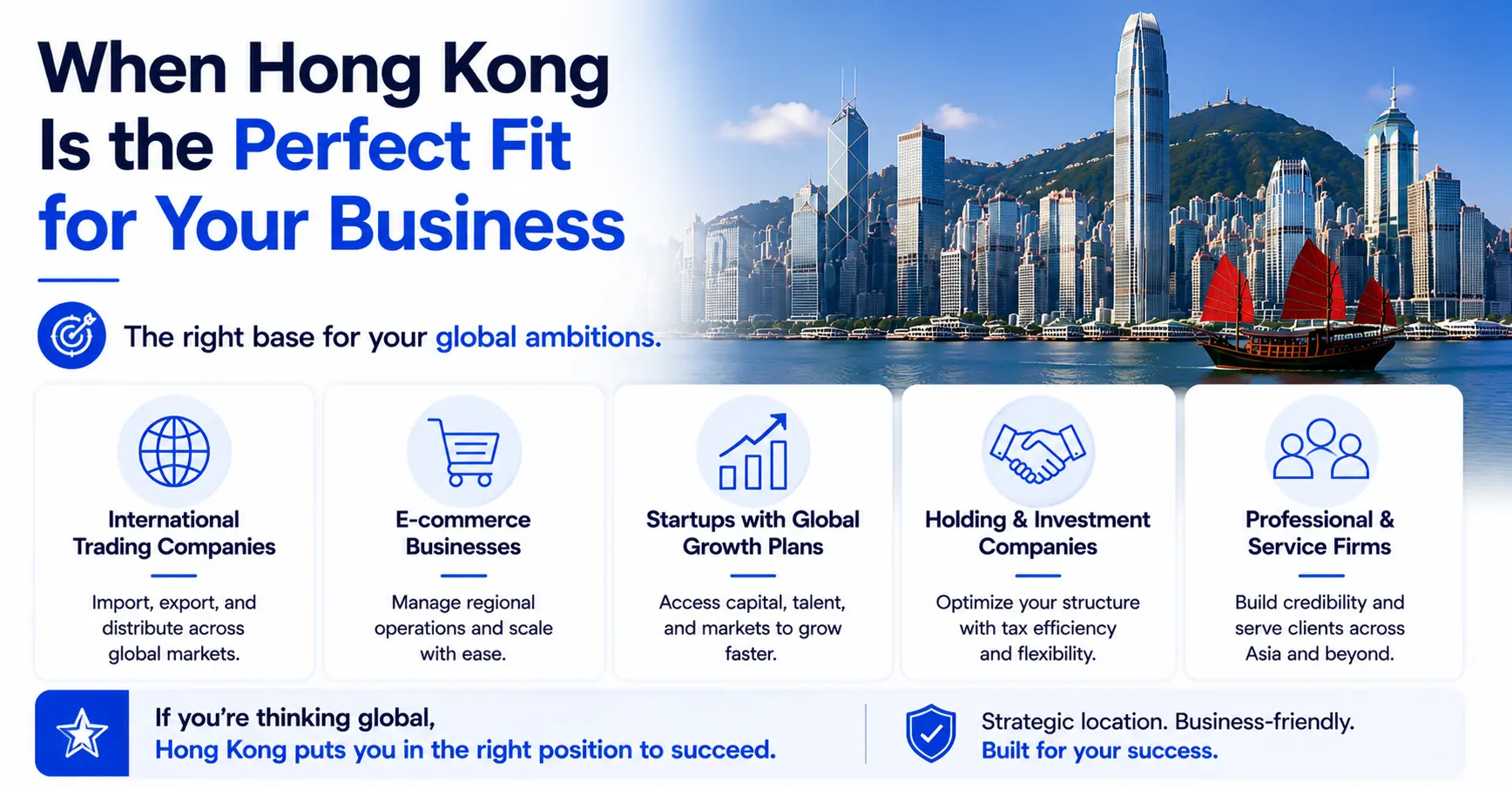
When Hong Kong Is the Perfect Fit for Your Business
Trading Companies and Importers-Exporters
Trading companies and importers-exporters thrive in Hong Kong because of Rules of Origin benefits and the territorial tax system where overseas trading profits are not taxed. The established infrastructure for shipping and logistics supports these businesses naturally.
E-Commerce and Dropshipping Businesses
E-commerce and dropshipping businesses benefit from low tax on overseas sales, easy payment processing, and currency conversion capabilities. Fast company registration means quick market entry.
Tech Startups Targeting Asian Markets
Tech startups targeting Asian markets find Hong Kong offers a gateway to Asian markets, access to venture capital and angel investors, and an English-language business environment.
Consulting and Professional Services Firms
Consulting and professional services firms appreciate that global clients value Hong Kong credentials highly. These businesses require minimal local inventory or operational needs, allowing remote team flexibility.
Financial Services and Fintech Operations
Financial services and fintech operations benefit from Hong Kong’s robust regulatory framework, access to banking relationships and infrastructure, and status as a preferred jurisdiction for Asian fintech operations.
When Hong Kong May Not Be Suitable
Purely Local Businesses Without International Operations
Purely local businesses with no import-export or international revenue may not justify Hong Kong’s setup and ongoing costs compared to local incorporation in their home country.
High-Volume Manufacturing Operations
High-volume manufacturing operations should consider mainland China or Vietnam instead, where labor costs are lower and manufacturing infrastructure is better developed.
Retail Businesses Requiring Physical Showrooms
Businesses requiring physical showrooms with high foot traffic may face challenges in Hong Kong due to high rental costs and limited local market size.
Bootstrapped Companies with Limited Budgets
Companies with constrained budgets unable to afford professional services may struggle with banking requirements and compliance obligations.
Operations Requiring Local Partner Networks
Operations requiring local partner networks within specific mainland China industries may face regulatory obstacles to market entry.
Should You Set Up in Hong Kong? Making the Final Decision
Hong Kong remains one of the world’s best jurisdictions for entrepreneurs seeking global expansion, particularly if your business involves international trade, e-commerce, or services targeting Asian markets.
Choose Hong Kong If
You are building an import-export or trading business. You want a minimal tax burden on international sales. You value rapid company formation and minimal compliance requirements. You need access to Asian markets and benefit from a global reputation. You prefer 100 percent control without mandatory local partners.
Explore Alternative Jurisdictions If
Your business is exclusively local to Hong Kong with no international operations. You require extensive local infrastructure and deep local partnerships. You are starting with minimal capital and cannot afford professional services. You prioritize absolute simplicity over tax optimization.
The jurisdiction’s combination of low taxes, fast setup, global credibility, and minimal ongoing compliance makes it an excellent choice for entrepreneurs serious about international business operations.
Final Thoughts on Your Hong Kong Business Journey
The decision to establish a company in Hong Kong should be based on a careful analysis of your business model, growth plans, and operational requirements. Hong Kong offers genuine advantages for certain business types, particularly those with international operations or ambitions.
The tax advantages alone can save your business thousands of dollars annually. The rapid setup process lets you begin operations within days. The global reputation builds trust with international customers and partners. The minimal compliance burden allows you to focus on growing your business rather than managing paperwork.
However, Hong Kong is not suitable for every business or every entrepreneur. Carefully evaluate the challenges, particularly banking requirements for non-residents and ongoing compliance obligations. Consider whether professional support services are accessible within your budget. Assess whether your business model truly benefits from Hong Kong’s specific advantages.
With proper planning and expert guidance, Hong Kong can become the launching pad for a successful global business. The entrepreneurs who thrive in Hong Kong are those who understand both the advantages and limitations, and who structure their business to capitalize on what Hong Kong does best.