


Expanding your business internationally is an exciting opportunity, but choosing the right jurisdiction is one of the most important decisions you’ll make. The country where you establish your company can affect taxation, legal compliance, banking, operating costs, and future growth.
There is no single jurisdiction that’s right for every business. The best choice depends on your business goals, target market, industry, and long-term expansion plans. This guide explores the key factors to consider, compares popular jurisdictions, and helps you choose the right location for successful international company formation.
What Is International Company Formation?
International company formation is the process of establishing a legal business entity in a country outside your home jurisdiction. Businesses choose to incorporate internationally for many reasons, including expanding into new markets, improving operational efficiency, accessing favourable business environments, protecting assets, or serving international customers more effectively.
Depending on the jurisdiction, businesses may establish
- A new limited company
- A branch office
- A subsidiary
- A representative office
- A ready-made (shelf) company
Each option serves different business objectives and comes with its own legal, tax, and operational considerations.
International company formation is commonly used by
- Startups entering global markets
- Technology companies
- E-commerce businesses
- Professional service firms
- Holding companies
- Manufacturing businesses
- International trading companies
- Investors managing cross-border operations
Choosing the right structure is just as important as choosing the right jurisdiction. The right structure determines how your business operates, while the right jurisdiction influences how it grows.
Why Choosing the Right Jurisdiction Matters?
The jurisdiction where your business is incorporated affects far more than your registration certificate. It influences how your business operates on a daily basis and how easily it can grow over time. Some jurisdictions are recognised for their efficient incorporation processes, while others are known for strong financial systems, access to international markets, competitive tax frameworks, or investor-friendly regulations.
Selecting an unsuitable jurisdiction can create unnecessary administrative burdens, increase operating costs, or limit future expansion opportunities. When evaluating international company formation options, businesses should consider both their immediate requirements and their long-term strategic objectives.
A well-chosen jurisdiction can help businesses
- Build credibility with customers and investors
- Access international banking services
- Simplify regulatory compliance
- Support tax efficiency within legal frameworks
- Improve operational flexibility
- Facilitate international expansion
The goal is not simply to register a company quickly, but to establish a business in a jurisdiction that supports sustainable growth.
Key Factors to Consider When Choosing the Right Jurisdiction
Every country has its own legal framework, tax regulations, reporting requirements, and incorporation procedures. Understanding these differences will help you identify the jurisdiction that best supports your business objectives.
Business Objectives
The first question to ask is why you want to establish a company internationally.
Your objectives might include
- Entering a new market
- Serving international customers
- Protecting intellectual property
- Reducing operational complexity
- Expanding your global presence
- Supporting international investors
- Establishing regional headquarters
Clearly defining your goals will narrow your jurisdiction options significantly. For example, a company focused on European expansion may prioritise market access, while an international consultancy may place greater importance on operational flexibility and reputation.
Legal and Regulatory Environment
A stable legal system provides businesses with greater certainty and confidence. When evaluating jurisdictions, consider
- Corporate laws
- Investor protections
- Contract enforcement
- Dispute resolution processes
- Political stability
- Transparency of regulations
Businesses generally benefit from jurisdictions with predictable legal frameworks and well-established regulatory systems.
Tax Considerations
Tax should be an important consideration, but not the only one.
Businesses often compare
- Corporate tax rates
- VAT or GST requirements
- Double taxation agreements
- Withholding taxes
- Capital gains treatment
- Dividend taxation
While jurisdictions with competitive tax environments can offer advantages, decisions should always consider the broader legal and commercial environment rather than focusing solely on tax rates. Professional tax advice is essential when evaluating international structures to ensure compliance with applicable laws in all relevant jurisdictions.
Ease of Company Formation
Some jurisdictions allow businesses to incorporate within days, while others require longer approval processes or additional documentation.
Consider factors such as
- Incorporation timelines
- Government filing procedures
- Digital registration services
- Documentation requirements
- Local director or shareholder requirements
- Minimum capital requirements
A streamlined incorporation process can help businesses become operational more quickly. It also reduces delays, allowing businesses to focus on launching and growing their operations sooner.
Banking and Financial Infrastructure
Opening a business bank account is often one of the most important steps after incorporation. Not every jurisdiction offers the same level of banking accessibility.
Businesses should evaluate
- Availability of business banking
- International payment capabilities
- Multi-currency banking options
- Banking reputation
- Financial stability
- Compliance requirements for account opening
Strong financial infrastructure supports smoother day-to-day operations, particularly for businesses serving international clients.
Ongoing Compliance Requirements
Company formation is only the beginning. Every jurisdiction has ongoing obligations that businesses must satisfy to remain compliant.
These may include
- Annual returns
- Financial reporting
- Accounting requirements
- Tax filings
- Licence renewals
- Corporate record maintenance
- Beneficial ownership reporting
Understanding these responsibilities before incorporation helps businesses avoid unexpected costs and compliance issues.
Market Access and Business Opportunities
The right jurisdiction should support your commercial objectives.
Consider
- Proximity to customers
- Trade agreements
- Regional market access
- Industry clusters
- Local partnerships
- Talent availability
- Infrastructure
For businesses planning international expansion, strategic location can provide significant long-term advantages beyond incorporation itself.
Reputation and Business Credibility
Your jurisdiction can influence how customers, suppliers, investors, and financial institutions perceive your business.
Well-established business jurisdictions often offer
- Strong international recognition
- Greater investor confidence
- Easier access to financing
- Improved commercial credibility
While every business has different priorities, reputation remains an important consideration when selecting where to incorporate.
Popular Jurisdictions for International Company Formation
Every jurisdiction offers a different combination of tax benefits, regulatory requirements, business costs, and market access. The best location depends on your industry, expansion strategy, and long-term objectives rather than a single advantage such as low taxation.
Below are some of the most popular jurisdictions for international company formation.
United Kingdom
The United Kingdom remains one of the world’s most recognised business destinations. Its transparent legal framework, established financial sector, and straightforward incorporation process make it attractive for both startups and international businesses.
The UK is particularly suitable for
- Technology startups
- Professional service firms
- International trading businesses
- Holding companies
Key Advantages
- Strong international reputation
- Efficient company registration process
- Access to a mature financial ecosystem
- Stable legal and regulatory environment
Considerations
- Ongoing filing and reporting obligations
- Corporation tax and other applicable taxes
- Annual compliance requirements
United Arab Emirates (UAE)
The UAE has become a leading destination for international businesses thanks to its strategic location, business-friendly environment, and world-class infrastructure. Businesses can establish operations in mainland, free zones, or offshore jurisdictions depending on their objectives.
The UAE is well suited for
- Regional headquarters
- Trading companies
- Professional services
- Technology businesses
- International investors
Key Advantages
- Strategic gateway between Europe, Asia, and Africa
- Modern infrastructure
- Wide range of free zones
- Business-friendly regulatory environment
Considerations
- Different rules apply across mainland and free zones
- Some activities require additional approvals or licences
- Compliance obligations vary by jurisdiction
Singapore
Singapore consistently ranks among the easiest places in the world to do business. It offers political stability, a highly skilled workforce, and a strong legal system, making it an attractive destination for companies expanding into Asia.
Singapore is ideal for
- FinTech companies
- SaaS businesses
- Regional headquarters
- Investment firms
- Technology startups
Key Advantages
- Excellent global reputation
- Efficient incorporation procedures
- Strong banking sector
- Strategic location within Asia-Pacific
Considerations
- Local compliance obligations
- Corporate governance requirements
- Industry-specific licensing for regulated sectors
Hong Kong
Hong Kong remains a preferred jurisdiction for businesses engaged in international trade and investment. Its simple corporate framework and global connectivity continue to attract entrepreneurs and multinational companies.
Suitable for
- Trading businesses
- Import and export companies
- Investment holding companies
- Professional services
Key Advantages
- International financial centre
- Strong legal framework
- Efficient incorporation process
- Excellent global connectivity
Considerations
- Annual compliance and reporting obligations
- Industry-specific regulatory requirements
- Banking due diligence procedures
Estonia
Estonia has built a reputation as one of the world’s most digitally advanced business jurisdictions. Its e-Residency programme allows many entrepreneurs to establish and manage businesses remotely.
It is particularly suitable for
- Digital businesses
- Software companies
- Online agencies
- Freelancers
- Remote-first businesses
Key Advantages
- Digital company management
- Online government services
- Efficient incorporation
- Innovation-friendly environment
Considerations
- Businesses with physical operations elsewhere should consider cross-border tax implications
- Local compliance requirements still apply
United States (Delaware)
Delaware is widely recognised for its business-friendly corporate laws and is often chosen by startups seeking investment.
Commonly used by
- Venture-backed startups
- Technology companies
- Holding companies
- International businesses entering the US market
Key Advantages
- Flexible corporate legislation
- Well-established legal framework
- High level of investor familiarity
- Strong corporate reputation
Considerations
- Federal and state compliance obligations
- Tax responsibilities vary depending on business activities
- Additional registrations may be required in other US states
How to Compare Jurisdictions?
Rather than focusing on a single factor, compare jurisdictions using a balanced approach.
| Factor | Questions to Ask |
| Business Goals | Does the jurisdiction support my expansion strategy? |
| Tax Environment | What corporate and indirect taxes apply? |
| Banking | Can I easily access reliable business banking? |
| Compliance | What are the annual filing and reporting obligations? |
| Market Access | Does this location provide access to my target customers? |
| Reputation | Will this jurisdiction strengthen business credibility? |
| Costs | What are the setup and ongoing operating costs? |
| Licensing | Does my business activity require special approvals? |
Evaluating these factors together helps businesses make informed decisions instead of selecting a jurisdiction based on one perceived benefit.
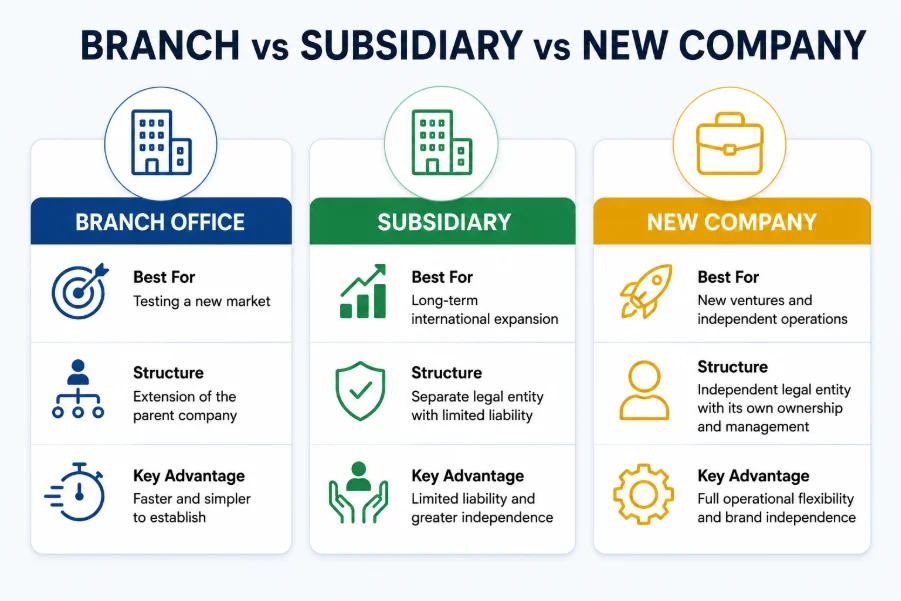
Branch Office vs Subsidiary vs New Company
Choosing the right business structure is just as important as choosing the right jurisdiction. Each option offers different levels of independence, liability, and operational flexibility.
| Structure | Best For | Key Characteristics |
| Branch Office | Businesses testing a new market | Operates as an extension of the parent company and is generally not a separate legal entity. |
| Subsidiary | Long-term international expansion | A separate legal entity that provides greater operational independence and limited liability. |
| New Company | New ventures and standalone operations | Established as an independent business with its own ownership and management structure. |
The most suitable structure depends on your commercial objectives, level of investment, and plans for future growth.
How UCI Simplifies International Company Formation?
Expanding internationally involves more than choosing a jurisdiction, it requires careful planning, accurate documentation, and ongoing compliance. Working with an experienced company formation partner can simplify the process and help you avoid costly mistakes.
At UCI, we support entrepreneurs, startups, SMEs, and international businesses with company formation and corporate services across 100+ countries. Our team works closely with clients to understand their objectives and recommend solutions that align with their business goals.
Our services include
- Company formation across multiple jurisdictions
- Branch and subsidiary setup
- Ready-made company solutions
- Registered office services
- Business licensing and permits
- Accounting and tax support
- Legal and compliance assistance
- Bank account opening support
- Trademark registration
- Ongoing corporate services
Whether you’re entering a new market, establishing a regional presence, or expanding your global operations, UCI provides end-to-end support throughout the process.
Conclusion
Choosing the right jurisdiction with the help of the right experts is one of the most important decisions you’ll make when expanding internationally. While factors such as taxation, incorporation costs, and setup timelines are important, they should be considered alongside legal stability, banking access, compliance requirements, and your long-term business objectives.
There is no universal solution that fits every business. The best jurisdiction depends on your industry, growth strategy, target markets, and operational needs. Taking the time to evaluate your options carefully can help you build a strong foundation for sustainable international success.
With the right jurisdiction, business structure, and professional guidance, international company formation can become a strategic advantage that supports your company’s growth for years to come.