
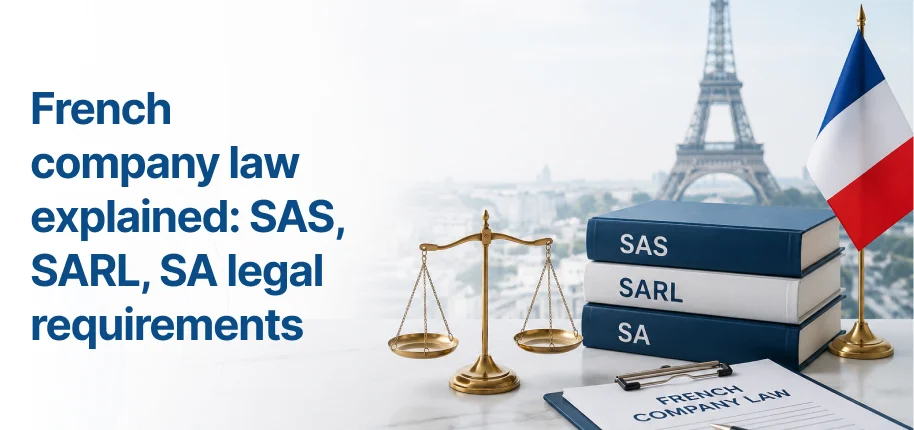
Understanding French company law is essential when setting up a business in France. Choosing the right legal structure affects ownership, management, capital requirements and ongoing compliance. Three of the main options are the Société par Actions Simplifiée (SAS), Société à Responsabilité Limitée (SARL) and Société Anonyme (SA). Each offers limited liability but has different governance and legal requirements. This guide explains the key requirements of SAS, SARL and SA companies to help businesses understand which structure may best suit their needs.
Key Takeaways
- SAS offers the greatest governance flexibility.
- SARL provides a more structured framework.
- SA is generally suited to larger companies.
- SAS and SARL have no general statutory minimum capital.
- SA requires €37,000 minimum share capital.
- Each structure has different management requirements.
- French companies must meet ongoing compliance obligations.
- The right structure depends on ownership and business goals.
What Is an SAS in France?
The Société par Actions Simplifiée (SAS) is a simplified joint-stock company and is widely used by businesses that want flexibility in their corporate governance. An SAS can have one shareholder, in which case it is known as an SASU (Société par Actions Simplifiée Unipersonnelle). There is no general statutory maximum number of shareholders.
SAS Share Capital Requirements
French law does not impose the €37,000 minimum capital requirement that applies to an SA. The amount of capital for an SAS is generally determined by the shareholders and stated in the company’s articles. At least half of cash contributions must normally be paid when the company is formed, with the balance payable within the following five years.
Capital may generally consist of cash contributions and contributions in kind. The company’s particular circumstances should be reviewed where non-cash contributions are involved.
SAS Management Requirements
Every SAS must have a president (président) who represents the company in dealings with third parties. The president can be an individual or, subject to applicable requirements, a legal entity. The articles may also establish other management positions, such as one or more directors-general, and determine how authority is divided internally.
The SAS president falls within the French general social security regime as an assimilated employee when remunerated, although this status does not itself provide unemployment insurance coverage.
Why Is the SAS Considered Flexible?
One of the main features of an SAS is the freedom shareholders have to establish governance arrangements through the articles of association. The articles can address matters such as
- Decision-making procedures
- Shareholder voting rights
- Management responsibilities
- Conditions applying to transfers of shares
- Approval provisions for new shareholders
- Governance bodies
- Different rights attached to shares
This flexibility can make the SAS particularly relevant to startups, joint ventures, investment-backed businesses and companies expecting changes in their ownership structure. However, flexibility also means the articles need to be carefully drafted. Poorly designed governance provisions can create uncertainty or disputes later.
What Is a SARL in France?
A Société à Responsabilité Limitée (SARL) is a private limited liability company with a more regulated governance framework than an SAS. A standard SARL may have between one and 100 partners. Where there is only one partner, the structure is known as an EURL (Entreprise Unipersonnelle à Responsabilité Limitée).
SARL Share Capital Requirements
There is no general statutory minimum amount of share capital for an SARL. The partners determine the amount appropriate to the company. For cash contributions, at least one-fifth must generally be paid at incorporation. The remainder can be paid within five years. This differs from an SAS and SA, where at least half of cash contributions must be paid at formation.
SARL Management Requirements
An SARL is managed by one or more gérants, who must be natural persons. The manager’s powers are partly governed by French law and partly by the articles of association. Compared with an SAS, the statutory framework provides less freedom to redesign the basic governance model.
The social security position of an SARL manager can also depend on their ownership position. In particular, a majority manager is generally treated differently from a minority or equal-share manager for social security purposes.
Transfer of SARL Shares
SARL ownership interests are represented by parts sociales rather than shares in the same sense as an SAS or SA. Transfers to an outside third party are subject to statutory approval requirements. This can provide existing partners with greater control over who becomes an owner of the company, but it can make ownership transfers less flexible. For this reason, an SARL may appeal to businesses that value a more controlled ownership structure.
- Set Up Your French Company with Expert Support
What Is an SA in France?
The Société Anonyme (SA) is a more formal joint-stock company generally suited to larger businesses and companies requiring a more structured governance framework. It is also the structure among these three that can have shares admitted to trading on a regulated market, subject to applicable securities and listing requirements.
SA Shareholders and Minimum Capital
An SA generally requires at least two shareholders. Where its securities are admitted to trading on a regulated market, the minimum rises to seven shareholders. Unlike the SAS and SARL, an SA has a statutory minimum share capital of €37,000.
At least half of cash contributions must be paid when the company is established, with the balance payable within five years. Contributions in industry, such as providing work or expertise instead of capital, are not permitted as contributions to the SA’s share capital.
SA Governance Requirements
An SA has significantly more formal governance requirements than an SAS or SARL. It can generally operate under one of two models
Board of directors model
The company has a board of directors and a chairman. Executive management is organised within the statutory framework applicable to this governance model.
Management board and supervisory board model
Alternatively, the SA can separate executive management from supervision through a management board (directoire) and supervisory board (conseil de surveillance). These requirements make an SA more administratively demanding, but its structure may be appropriate for larger organisations with complex governance or financing needs.
SAS vs SARL vs SA: Key Legal Differences
The three structures can be compared as follows
| Requirement | SAS | SARL | SA |
| Minimum owners | 1 | 1 | 2, or 7 for listed SA |
| Maximum owners | No general statutory maximum | 100 | No general statutory maximum |
| Minimum capital | No statutory minimum | No statutory minimum | €37,000 |
| Main manager | President | Gérants | Formal board structure |
| Cash capital paid initially | At least 50% | At least 20% | At least 50% |
| Ownership interests | Shares | Parts sociales | Shares |
| Governance flexibility | High | More regulated | Highly formalised |
| Regulated market listing | No | No | Yes |
These differences mean there is no universally “best” French company structure. The right option depends on the business.
Incorporation Requirements for French Companies
Whichever of these structures is selected, several core formation steps are generally required.
Draft the Articles of Association
The articles establish the company’s legal framework and include essential information such as its name, legal form, registered office, business purpose, capital and duration. For an SAS in particular, careful drafting is important because many governance arrangements are determined through the articles.
Establish a Registered Office
A French company must have a registered office (siège social). This is its official legal address and determines matters such as its nationality and the competent courts. The company will need appropriate evidence supporting the use of its registered address when applying for registration.
Deposit the Share Capital
Where applicable, cash contributions must be deposited before registration. The depositary provides evidence of the capital deposit for the incorporation procedure.
Publish the Formation Notice
A notice announcing the creation of the company must be published through an authorised legal announcements medium.
Declare Beneficial Owners
The company must identify and declare its beneficial owners as part of the formalities process. Beneficial ownership information forms part of France’s anti-money laundering and corporate transparency framework.
Since July 2024, public access to beneficial ownership information has been restricted, although authorised parties and persons demonstrating a legitimate interest may have access under the applicable rules.
Complete Registration
The incorporation application is submitted electronically through the Guichet unique. Depending on the company type and circumstances, documents can include
- Signed articles of association
- Evidence of the registered office
- Evidence of publication of the incorporation notice
- Beneficial ownership information
- Documents relating to directors or managers
- Evidence required for regulated activities
The precise documentation depends on the legal form and business activity.
Ongoing Legal and Compliance Requirements
Incorporation is only the beginning of a French company’s compliance responsibilities. Commercial companies generally need to maintain appropriate accounting records, prepare annual accounts, comply with applicable corporate decision-making requirements and complete required tax filings. Changes to matters such as the registered office, directors, capital or articles may also require formal corporate approval, publication and filing through the Guichet unique.
The requirement to appoint a statutory auditor (commissaire aux comptes) depends on the company’s circumstances and applicable statutory thresholds or other triggering conditions. It should therefore be assessed individually rather than assumed to apply to every SAS, SARL or SA.
Which French Company Structure Should You Choose?
An SAS may be suitable where governance flexibility, investment and future ownership changes are important.
A SARL may be more appropriate for businesses seeking a structured legal framework, particularly closely held businesses where control over transfers of ownership is important.
An SA is generally more relevant to larger businesses requiring substantial capital, formal governance or potential access to regulated capital markets.
International founders should also consider tax residence, cross-border ownership, employment obligations, banking, beneficial ownership requirements and any sector-specific regulation before deciding.
Conclusion
Understanding French company law is essential before establishing a business in France. Although the SAS, SARL and SA all offer limited liability, their legal requirements and practical implications differ significantly. The SAS provides greater governance flexibility, the SARL offers a more structured framework for closely held businesses, and the SA is generally suited to larger companies with more formal governance requirements.
The right structure depends on the company’s ownership, investment plans, management model and long-term objectives. With the help of experienced company formation experts, businesses can better understand these requirements, choose an appropriate structure and navigate the incorporation process with greater confidence.