

France is one of Europe’s largest economies and offers an established environment for entrepreneurs, startups, and international businesses looking to expand into the European market. With its developed infrastructure, skilled workforce, and access to European Union markets, France provides opportunities across technology, manufacturing, retail, professional services, and other industries.
However, understanding how to register a company in France is essential before starting operations. The registration process involves selecting an appropriate legal structure, preparing incorporation documents, establishing a registered office, depositing share capital, and completing the necessary administrative formalities. Foreign entrepreneurs must also consider taxation, regulatory compliance, and immigration requirements where applicable.
This article explains the French company registration process, including legal structures, required documents, registration costs, and the responsibilities businesses must fulfil after incorporation.
Why Register a Company in France?
France provides businesses with access to a substantial domestic market and opportunities to operate across the European Union. Its established commercial infrastructure and regulatory environment make it an attractive destination for businesses seeking a long-term European presence.
Through professional company formation services in France, international entrepreneurs can receive assistance with incorporation procedures, corporate documentation, and regulatory requirements.
Access to the European Market
A French company can provide a base for serving customers throughout France and other European Union countries. Businesses can benefit from EU market arrangements, although cross-border activities remain subject to applicable VAT, customs, employment, and sector-specific regulations.
Established Business Infrastructure
France offers developed transportation networks, financial services, telecommunications infrastructure, and access to skilled professionals.
Its major commercial centres support industries ranging from financial services and technology to manufacturing, logistics, and international trade.
Opportunities for International Investors
Foreign investors can generally establish and own French companies without requiring a French shareholder.
However, business ownership does not automatically provide immigration rights, and certain regulated activities may require additional authorisations.
Types of Companies You Can Register in France
Choosing the correct legal structure is one of the most important decisions when establishing a business in France. Each structure has different requirements concerning ownership, management, taxation, capital, and corporate governance.
Société par Actions Simplifiée – SAS
An SAS is a simplified joint-stock company that provides considerable flexibility in its governance arrangements.
It is commonly considered by startups, growing businesses, and companies planning to attract external investors.
Société à Responsabilité Limitée – SARL
An SARL is a private limited liability company generally suited to small and medium-sized businesses.
It operates under a more prescribed legal framework and is often considered by family businesses and closely held companies.
Société par Actions Simplifiée Unipersonnelle – SASU
An SASU is the single-shareholder version of an SAS.
It allows an individual or corporate shareholder to establish a company with limited liability while retaining the governance flexibility associated with the SAS structure.
Entreprise Unipersonnelle à Responsabilité Limitée – EURL
An EURL is the single-member version of an SARL.
It may be suitable for entrepreneurs seeking a limited liability company with a more structured management framework.
Comparison of French Business Structures
| Structure | Ownership | Minimum Capital | Suitable For |
|---|---|---|---|
| SAS | One or more shareholders | €1 possible | Startups and growing businesses |
| SARL | 2-100 members | €1 possible | SMEs and family businesses |
| SASU | One shareholder | €1 possible | Individual founders |
| EURL | One member | €1 possible | Owner-managed businesses |
| SA | Generally at least 2 shareholders | €37,000 | Larger businesses |
Although several structures can legally be established with minimal share capital, businesses should consider their actual operating expenses and financing requirements before deciding how much capital to contribute.
Also read – French Company Law Explained
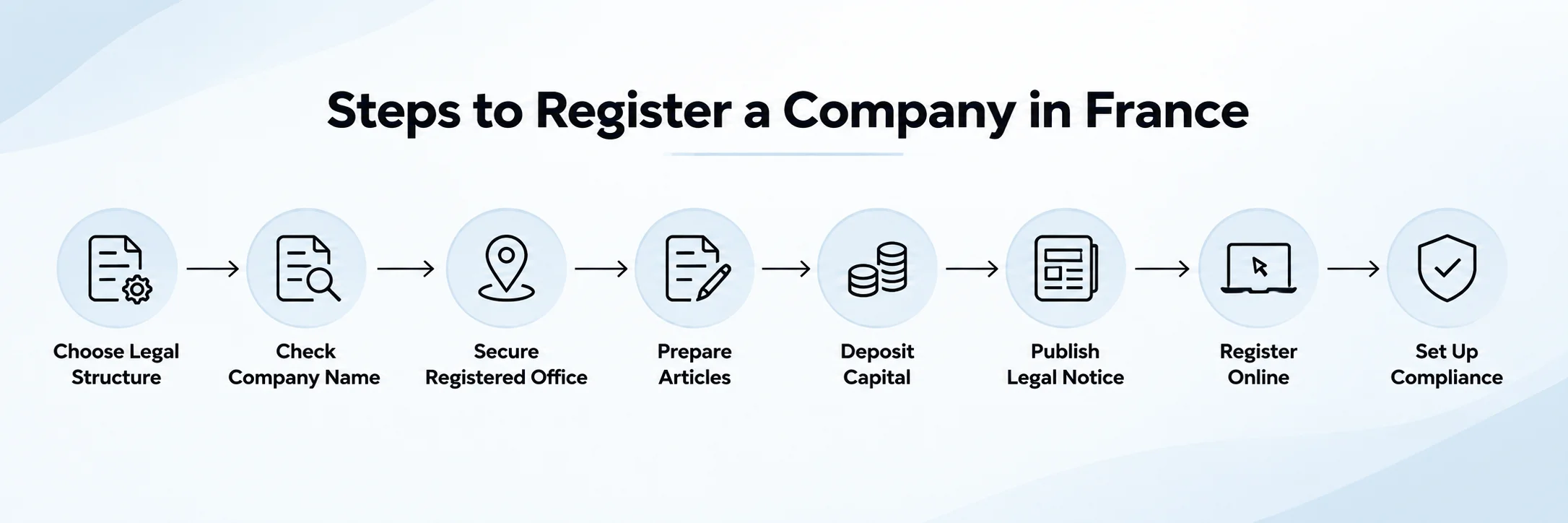
How to Register a Company in France – Step-by-Step Process
The French company registration process involves several legal and administrative stages. Although specific requirements depend on the chosen structure and business activity, most commercial companies follow a similar incorporation procedure.
Step 1 – Choose the Appropriate Legal Structure
The first step is selecting a company structure that reflects your business objectives, ownership arrangements, and long-term expansion plans.
Before making a decision, consider
- Number of shareholders or business partners
- Share capital and funding requirements
- Management and decision-making arrangements
- Corporate tax and social security implications
- Future investment and expansion opportunities
Selecting an appropriate structure from the beginning can reduce the need for costly restructuring later.
Step 2 – Select and Verify Your Company Name
Every registered company must have an identifiable legal name, known as its dénomination sociale.
Before proceeding with incorporation, check whether the proposed name conflicts with existing businesses or protected trademarks.
Entrepreneurs should review relevant company registers, trademark databases, and domain name availability.
Registering a company name does not automatically provide comprehensive trademark protection. Businesses seeking to protect their commercial identity can consider professional trademark registration services.
Step 3 – Establish a Registered Office in France
A French company must have an official registered office address, known as its siège social.
This address is used for legal correspondence, administrative communication, and determining certain aspects of the company’s legal jurisdiction.
Depending on eligibility and business requirements, companies may use
- Commercial office premises
- An authorised business domiciliation provider
- An eligible director’s residential address
- Suitable shared office arrangements
The registered office must be established before submitting the incorporation application, and supporting documentation is generally required.
Step 4 – Prepare the Articles of Association
The articles of association, known as statuts, establish the company’s legal and organisational framework.
These documents generally include
- Registered company name
- Legal structure and business purpose
- Registered office address
- Share capital and ownership arrangements
- Management and decision-making provisions
The articles must comply with the legal requirements applicable to the selected company structure.
For an SAS, careful drafting is particularly important because shareholders have considerable flexibility to determine internal governance arrangements.
Step 5 – Deposit the Required Share Capital
Companies must determine their share capital and complete the applicable contribution requirements before registration.
For structures such as SAS and SARL, the shareholders determine the capital amount, subject to the relevant legal rules.
Cash contributions must generally be deposited with an eligible depositary, which provides documentation confirming the deposit.
For an SAS, at least 50% of subscribed cash capital must generally be paid at incorporation. For an SARL, the initial requirement is generally 20%. The remaining balance must be paid within the applicable statutory period.
Step 6 – Appoint Company Directors or Managers
The company must appoint the individuals responsible for its management and legal representation.
The management structure depends on the selected legal form.
For example, an SAS requires a president, while an SARL is managed by one or more gérants.
The appointment documentation and identification details of the relevant officers are generally required during registration.
Step 7 – Publish a Legal Incorporation Notice
French commercial companies must generally publish a notice announcing their establishment.
The notice must appear in an authorised legal announcements publication within the department where the registered office is located.
It normally includes information such as the company’s name, legal structure, registered address, capital, business purpose, and management.
Once published, the authorised publication provides confirmation that can be submitted with the registration application.
Step 8 – Submit the Company Registration Application
After completing the preliminary formalities, the incorporation application is submitted through France’s Guichet unique des formalités des entreprises, operated by INPI.
The application includes the required corporate documentation and information about the company’s beneficial owners.
Once the application is approved, the business is entered in the relevant registers and receives its official identification details.
These generally include a SIREN number identifying the business and a SIRET number identifying each establishment.
Commercial companies are also registered with the Registre du Commerce et des Sociétés (RCS).
Step 9 – Complete Tax and Operational Registrations
Following incorporation, the company must ensure that its tax, accounting, and operational arrangements are appropriate for its activities.
Depending on the circumstances, this may involve:
- Confirming VAT registration obligations
- Establishing accounting and bookkeeping systems
- Completing employer registrations
- Arranging required insurance
- Obtaining sector-specific licences or authorisations
Businesses operating internationally should also consider cross-border tax obligations and reporting requirements.
Professional VAT consultancy services can help businesses assess their registration and compliance responsibilities.
Documents Required for Company Registration in France
Preparing accurate documentation is essential for completing the French company registration process efficiently.
Although requirements vary depending on the business structure and the circumstances of its shareholders and managers, the following documents are commonly required:
- Signed articles of association
- Proof of the registered office address
- Identification documents for company officers
- Evidence of the required share capital deposit
- Confirmation of publication of the legal notice
- Beneficial ownership information
- Relevant appointment and non-conviction declarations
Additional documents may be required where shareholders are corporate entities, activities are regulated, or foreign documentation needs translation or certification.
How Much Does It Cost to Register a Company in France?
The total cost of establishing a French company depends on the selected legal structure, location, publication requirements, and professional assistance required.
For a standard commercial company, the official registration fee is currently €33.83, with an additional €19.33 for the beneficial ownership declaration.
Other expenses may include legal announcement publication, registered office services, banking arrangements, document preparation, and professional advisory support.
Share capital should be budgeted separately because it represents funding contributed to the company rather than an administrative registration fee.
Businesses should confirm applicable charges before submitting their application, as official fees and publication tariffs may change.
How Long Does Company Registration Take in France?
The time required to register a company in France depends on the complexity of the business structure, document preparation, capital deposit arrangements, and the completeness of the application.
A straightforward application may be processed relatively quickly once all documentation has been submitted correctly.
However, additional time may be necessary for
- Banking and capital deposit procedures
- Verification of foreign corporate documents
- Corrections to incomplete applications
- Regulated business authorisations
- Additional administrative checks
Entrepreneurs should therefore allow sufficient preparation time rather than assuming that incorporation will be completed within a fixed number of days.
Can Foreigners Register a Company in France?
Yes. Foreign individuals and corporate entities can generally establish companies in France, subject to applicable legal and regulatory requirements.
Foreign shareholders do not necessarily need to reside in France to own a French company.
However, entrepreneurs planning to relocate to France or personally conduct business activities there may require an appropriate visa or residence authorisation.
International investors should also consider banking requirements, beneficial ownership disclosures, taxation, and the documentation needed to establish a business presence.
Tax and Compliance Requirements After Registration
Registering a company is only the beginning of its legal and administrative responsibilities.
French businesses must maintain appropriate accounting records, meet tax obligations, and comply with relevant corporate reporting requirements.
Corporate Income Tax
France’s standard corporate income tax rate is generally 25%.
Eligible small and medium-sized businesses may qualify for a reduced 15% rate on a specified portion of taxable profits, subject to statutory conditions.
Value Added Tax – VAT
The standard VAT rate in metropolitan France is generally 20%, although reduced rates apply to certain goods and services.
Whether a company must charge VAT depends on its activities, turnover, transactions, and eligibility for applicable exemptions.
Accounting and Financial Reporting
Companies must maintain accurate financial records and prepare the required annual accounts.
Depending on their legal form and circumstances, businesses may also need to approve and file annual financial statements.
Professional accounting services can support businesses with financial recordkeeping, reporting, and ongoing compliance obligations.
How UCI Supports Company Registration in France
Establishing a company in another jurisdiction involves legal documentation, administrative procedures, and regulatory obligations that may be unfamiliar to international entrepreneurs.
UCI provides company formation and corporate support services for businesses entering international markets, including France.
Its services can assist with selecting an appropriate business structure, preparing incorporation documentation, coordinating registration requirements, and arranging ongoing corporate support.
Businesses can also seek assistance with accounting, VAT compliance, registered office arrangements, and other administrative requirements relevant to their operations.
Conclusion
Understanding how to register a company in France helps entrepreneurs approach incorporation with greater clarity and confidence. From choosing the appropriate legal structure to preparing documents, depositing capital, and completing registration, each stage contributes to establishing a legally compliant business.
France offers opportunities for domestic and international entrepreneurs, but successful company formation requires careful attention to corporate governance, taxation, documentation, and ongoing compliance.
For professional assistance with French company formation and related corporate services, Contact Us to discuss your business requirements and establish an appropriate foundation for operating in France.