

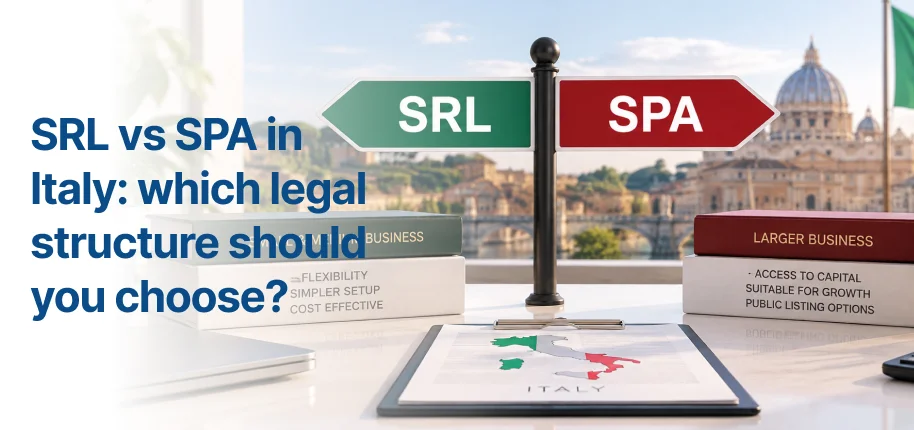
Choosing the right legal structure is one of the most important decisions when establishing a company in Italy. Two of the principal limited-liability corporate forms are the SRL – Società a Responsabilità Limitata and the SPA – Società per Azioni. Both can provide shareholders with limited liability, but they are designed for different ownership structures, capital needs, governance requirements, and growth strategies.
For entrepreneurs, foreign investors, SMEs, and international groups entering Italy, understanding the differences between an SRL and an SPA can help establish a corporate structure that supports both current operations and future expansion.
Key Takeaways
- An SRL generally offers greater flexibility for SMEs and privately held companies.
- An SPA is designed for larger or more capital-intensive businesses.
- The standard SRL capital benchmark is €10,000, with formation below this amount possible under specific rules.
- An SPA requires minimum share capital of €50,000.
- The right structure depends on ownership, investment, governance, and long-term growth plans.
What Is an SRL in Italy?
An SRL – Società a Responsabilità Limitata is an Italian limited liability company. It is one of the most commonly considered structures for SMEs, privately owned companies, subsidiaries, and international entrepreneurs establishing operations in Italy.
The structure creates a legal entity separate from its shareholders, with shareholder liability generally limited to their contributions, subject to applicable law and specific circumstances.
An SRL can be particularly suitable for businesses that want limited liability without adopting the more formal corporate framework associated with an SPA. UCI also identifies the SRL as the most popular structure for foreign investors using its Italy company formation services.
What Is an SPA in Italy?
An SPA – Società per Azioni is an Italian joint-stock company. It is typically associated with larger businesses, companies requiring significant investment, and organisations that need a more sophisticated ownership and governance framework.
Rather than participation interests used in an SRL, an SPA’s capital is divided into shares. This structure can make it more appropriate for businesses expecting a broader shareholder base, significant external investment, or more complex corporate financing.
Italy’s official investment agency states that an SPA requires minimum share capital of €50,000, compared with the lower capital requirements available to an SRL.
SRL vs SPA in Italy – Main Differences
Although both structures provide a corporate framework with limited liability, their practical requirements differ considerably.
| Factor | SRL | SPA |
|---|---|---|
| Full name | Società a Responsabilità Limitata | Società per Azioni |
| Typical business | SMEs and private companies | Larger and capital-intensive companies |
| Standard capital level | €10,000, although lower capital is possible under specific rules | Minimum €50,000 |
| Ownership | Participation interests or quotas | Shares |
| Governance | Generally more flexible | More formal and structured |
| Administration | Usually simpler | More extensive corporate formalities |
| Investment structure | Suitable for closely held ownership | Better adapted to complex equity structures |
| Typical foreign use | SMEs and subsidiaries | Larger international investments |
Italy’s official investment information confirms the €50,000 SPA minimum and explains that an SRL may be incorporated below the standard €10,000 level, with a minimum value of €1 under the applicable conditions.
Businesses comparing corporate forms across several European jurisdictions should consider how governance, ownership and capital rules differ from country to country.
Also read – LLC vs Ltd vs SAS vs GmbH
- Ready to Establish the Right Company Structure in Italy?
Share Capital Requirements – SRL vs SPA
Capital is one of the clearest distinctions between the two structures.
SRL Share Capital
The standard capital benchmark associated with an ordinary SRL is €10,000. However, Italian rules allow an SRL to be established with capital below €10,000, potentially from €1, subject to specific contribution and reserve requirements.
The lowest legally permitted capital is not necessarily the most commercially suitable amount. Businesses should consider their expected operating expenses, banking requirements, employees, inventory, premises, supplier commitments, and working capital before deciding how much capital to contribute.
SPA Share Capital
An SPA requires minimum share capital of €50,000.
The higher threshold reflects the SPA’s role as a corporate structure intended for businesses with larger investment and financing requirements.
For foreign investors, the decision should therefore be based on the actual financial and operational needs of the business rather than simply choosing the structure with the lowest incorporation threshold.
Ownership and Investment Structure
Ownership requirements can have a major impact on whether an SRL or SPA is appropriate.
An SRL is commonly suitable where ownership will remain relatively concentrated. This can include founder-owned companies, family businesses, international subsidiaries, professional businesses, e-commerce operations, and SMEs.
An SPA provides a share-based ownership framework that can be more appropriate where the company expects a larger or evolving investor base.
Businesses expecting significant equity investment, multiple rounds of financing, or more complex changes in ownership may therefore consider whether the SPA framework better accommodates their long-term plans.
International companies establishing an Italian entity as part of a larger group can also consider UCI’s subsidiary formation services when planning the ownership and corporate structure.
Governance and Management
Governance is another important difference between an SRL and SPA.
SRL Governance
An SRL generally provides greater flexibility in determining how the company will be managed. Its constitutional documents can establish arrangements appropriate to the size, ownership, and activities of the business.
This flexibility can make an SRL attractive to privately owned companies where shareholders want a relatively straightforward decision-making structure.
SPA Governance
An SPA operates within a more formal corporate governance framework.
The structure is intended to accommodate larger organisations and potentially more complex relationships between shareholders, directors, management, and supervisory functions.
This additional formality may be appropriate where the business has substantial operations or investment requirements, but it can also create additional administrative and compliance responsibilities.
Formation and Documentation Requirements
Both SRLs and SPAs require proper incorporation and registration procedures in Italy.
The process generally involves determining the ownership and governance structure, preparing constitutional documentation, arranging the required share capital, executing incorporation through the relevant notarial process, and registering the company with the Italian Business Register.
Foreign shareholders or directors may also require an Italian codice fiscale, while overseas corporate documents may need translation, apostille, legalisation, or other authentication depending on the circumstances.
UCI’s document management services can support international businesses dealing with incorporation documents, notarisation, apostilles, legalisation, and cross-border corporate documentation.
Which Businesses Are Better Suited to an SRL?
An SRL can be appropriate for a broad range of privately owned businesses.
Typical examples include:
- Small and medium-sized enterprises
- Foreign-owned Italian subsidiaries
- E-commerce companies
- Technology businesses
- Consulting and professional-service companies
- Trading businesses
- Family-owned companies
- Startups with relatively straightforward ownership
The SRL’s combination of limited liability, comparatively flexible governance, and lower capital requirements makes it particularly relevant where a business does not require the more extensive corporate structure of an SPA.
UCI’s current Italy formation information describes the SRL as the most popular form for foreign investors and notes its comparatively simple setup and governance requirements.
Which Businesses Are Better Suited to an SPA?
An SPA is more commonly considered by larger organisations and companies with substantial financing requirements.
It may be appropriate for
- Large corporations
- Capital-intensive businesses
- Businesses with significant external investors
- Companies requiring sophisticated governance
- Businesses expecting a broader shareholder structure
- Companies planning substantial long-term expansion
UCI describes the SPA as a structure used for larger corporations and capital-intensive businesses.
The SPA should not automatically be selected simply because a company expects to grow. The additional governance, capital, and compliance requirements should provide a practical benefit for the company’s actual ownership and financing model.
Tax and Accounting Considerations
Choosing between an SRL and SPA should not be based only on incorporation requirements.
Both structures operate within the Italian corporate tax and accounting system, and businesses need to consider corporate taxation, VAT, financial reporting, bookkeeping, annual accounts, payroll, and other obligations applicable to their activities.
International groups may have additional issues involving transfer pricing, withholding taxes, cross-border transactions, double-taxation treaties, and group reporting.
Businesses operating across several countries can use professional accounting and finance services to coordinate bookkeeping, VAT, financial reporting, and other ongoing financial obligations.
The appropriate tax treatment always depends on the company’s activities and circumstances, so legal structure should be considered alongside professional tax and accounting advice.
SRL vs SPA – Compliance and Administration
An SRL is generally associated with a more flexible corporate structure, while an SPA is designed around more formal governance.
However, neither structure eliminates ongoing compliance responsibilities.
Italian companies may need to maintain accounting records, prepare annual financial statements, submit corporate and tax filings, maintain company records, update ownership information, and comply with employment, social-security, VAT, and sector-specific requirements where applicable.
Larger companies can also face additional audit or governance obligations depending on their characteristics and applicable thresholds.
For international founders, compliance should therefore be planned before incorporation rather than treated as an issue to address after the company begins trading.
How to Choose Between an SRL and SPA
The decision should begin with the commercial plans of the business rather than simply comparing incorporation costs.
Consider the following questions:
What Is the Expected Scale of the Business?
For many SMEs and privately owned companies, an SRL may provide sufficient flexibility and legal protection.
A substantially larger or more capital-intensive operation may have reasons to consider an SPA.
How Much Capital Will the Business Require?
An SPA requires at least €50,000 in share capital, while an SRL provides significantly greater flexibility regarding initial capital.
Businesses should consider actual funding needs rather than relying solely on statutory minimums.
How Complex Will Ownership Become?
A relatively small or closely held shareholder group may work effectively within an SRL.
Where ownership is expected to involve numerous investors or a more complex share structure, the SPA framework may warrant consideration.
What Governance Structure Is Required?
An SRL can generally provide more flexibility for privately managed businesses.
An SPA has a more formal governance structure that may better suit larger corporate organisations.
What Are the Long-Term Investment Plans?
Businesses should consider where they expect to be in several years rather than choosing a structure solely for immediate convenience.
UCI’s business consultancy services can help international businesses assess corporate structures alongside their expansion, organisational, and investment objectives.
Can an SRL Be Converted Into an SPA Later?
A business’s legal structure does not necessarily have to remain unchanged throughout its entire life.
As an Italian company expands, attracts new investment, or develops more sophisticated governance requirements, restructuring may become appropriate.
An SRL may potentially be transformed into an SPA where the applicable corporate requirements are satisfied. However, such a transformation requires proper corporate procedures, documentation, capital planning, and professional legal and tax assessment.
For this reason, founders should consider future financing and ownership plans during the original formation process, even when an SRL is currently the more practical structure.
How UCI Can Support Italian Company Formation
Establishing the right corporate structure in Italy requires coordination between company formation, documentation, notarial procedures, tax registration, accounting, and ongoing compliance.
UCI supports international entrepreneurs and businesses establishing operations across Italy and other European jurisdictions. Services can include company formation planning, corporate documentation, registered-office arrangements, Business Register registration support, VAT and tax setup, banking assistance, accounting, payroll, and ongoing corporate services.
This can be particularly useful where shareholders or directors are based outside Italy and several cross-border requirements need to be coordinated.
Conclusion
The SRL and SPA both provide established corporate structures for operating in Italy, but they serve different business requirements. An SRL generally offers a more flexible framework for SMEs, subsidiaries, privately held companies, and many foreign investors, while an SPA provides a more formal share-based structure for larger and more capital-intensive organisations.
Before incorporating, businesses should assess capital requirements, ownership, governance, investment plans, compliance responsibilities, and future expansion. Choosing a structure that reflects both current operations and long-term objectives can help create a more sustainable foundation for doing business in Italy.