


Are you considering starting a business in Portugal? If so, you have come to the right place, as Company Formation in Portugal is pretty simple. Portugal has become one of Europe’s most attractive destinations for entrepreneurs, thanks to its strategic location, robust infrastructure, and business-friendly regulations. Over the past few years, the country has seen impressive economic growth and increasing investment in innovation and technology. With a growing consumer base and a supportive startup environment, Portugal offers a golden opportunity for anyone looking to expand into European markets. Whether launching a new venture or scaling an existing one, now is the perfect time to take advantage of what Portugal offers.
This article will elucidate the benefits of starting a business in Portugal, the necessary procedures to follow, and more.
Steps to Start a Business in Portugal?
Setting up a company in Portugal involves several important stages, from selecting the appropriate business structure to completing registration, taxation, banking, and compliance requirements. International entrepreneurs planning their European expansion can work with UCI to understand the corporate requirements involved in establishing and maintaining an overseas business.
Choose Business Type
Before registering your business in Portugal, you need to choose the type of business entity you wish to establish. The basic options include sole proprietorship, partnerships, limited liability companies (LLC), and public limited companies (PLC).
Choose a Business Name
Choose a unique name for starting a Business in Portugal. Make sure that it is not already taken by someone else.
Procure a Fiscal Number
You would require a fiscal number for tax purposes.
Open a Bank Account
Afterwards, you would need to open a business bank account in Portugal. This will allow you to manage your finances and business transactions properly.
Register Your Business
You must register your business with the Portuguese commercial registry. However, this also includes the submission of mandatory documents and payment of the registration fees.
Comply with Licensing and Permits
You would require licenses or permits based on your business type and industry. It is important to note that you comprehend and comply with all legal requirements. You would require licenses or permits based on your business type and industry. It is important to note that you comprehend and comply with all legal requirements.
Register for Social Security
You must register your business with the Portuguese social security system to keep staff.
Tax Registration
You must register your business for taxation with the Portuguese Tax Authority, which includes procuring a VAT number (NIF-IVA) if applicable.
Hiring Employees
You must understand Portugal’s labour and employment laws and regulations to hire employees
Stay in the loop
You must keep updated about Portugal’s latest business laws and regulations to ensure everything is compliant.
Benefits of Expanding your business to Portugal
Portugal has recently gained popularity and is recognised as the ideal country for investment. Let’s explore why Portugal is no longer just a tourist paradise but also an admirable destination for launching a business.
Access to the European Market
If you are a member of the European Union and the Schengen Area, then Portugal could be the best start for your Company Formation. Many investors choose this country due to its Golden Residence Permit Program. This permits foreigners to move there easily, and one of the investment options is launching a business and creating at least five full-time jobs. The minimum investment amount for this option is £500,000.
However, there are other options too for the investors to get a Portuguese Golden Visa that include:
- Supporting arts and cultural heritage £250,000
- Purchasing investment fund units £500,000
- Investing in research£500,000
- Transferring capital £1,500,000
The best part about getting a Portugal Golden visa is that it does not require you to learn Portuguese. Moreover, a foreigner must spend 7 days a year in Portugal to maintain residency, and investors can get Portuguese citizenship in just 5 years. In addition to this, there is also no need to reside in the country to qualify for the passport.
Advanced Infrastructure
The advanced infrastructure permits businesses to transport goods easily and promptly. It also offers numerous companies the opportunity to travel to Europe, as visiting Madrid or Paris in a few hours is easy. London, which is known as the world’s financial capital, could also be reached within 3 hours. However, along with discounts, bus and railway tickets are also budget-friendly in Portugal.
Multiple Residence Permits
If you are an outsider and wish for Company Formation in Portugal, then procuring a residence permit is one of the first things to consider. The permit is specifically made for entrepreneurs and investors, making the permit-making process easy and quick. However, the Start-up visa is a residence permit designed for international entrepreneurs and investors. Suppose you wish to be eligible for this. In that case, you need to show that your business idea is innovative and has the potential to offer jobs and contribute to the Portuguese economy. Another option is for entrepreneurs who aspire to start a. Business in Portugal or for remote workers who come all the way to live in Portugal. Enjoying all these benefits means making it possible to enjoy the fact that Portugal offers as a destination for entrepreneurship and innovation.
Skilled Workforce
One of the most significant factors making Portugal the best choice is the substantial government investment in education and research. Portuguese universities and research centres educate individuals, enabling them to become engineers, scientists, and managers, while also acquiring other top talent. The workforce in Portugal is both productive and skilled, and they speak fluent English.
Lower Business Cost
Portugal is one of Europe’s most affordable countries. Lisbon is considered the cheapest city to live in compared to other capitals like Rome or Paris. The typical cost of registering a business in Portugal is around 400 pounds. If you are seeking an affordable business structure in Portugal, your options include a Private Limited Company or an LDA.
Complete Safety & Stability
Portugal is known as one of the safest countries in the world. The crime rate is low, and people are welcoming, inclusive, and tolerant. Portugal’s Mediterranean climate, fine gastronomy, and renowned wines make it one of the best countries for expatriates’ quality of life. Moreover, its stability is the main factor in attracting foreign investment, and the safest social environment complements a stable and reasonable political environment
Trusted Partners
Investing in a foreign country can be challenging sometimes, requiring proper local information, experience, and attentive and thorough follow-up. However, we can help you get complete services to establish and maintain your investments in Portugal’s best country. We can help you with everything so you can focus on your business without worrying about administrative, tax, or legal issues.
How to Set Up a Company in Portugal?
Portugal has become an increasingly attractive destination for entrepreneurs, investors, and international companies looking to establish a presence in Europe. Its access to the European Union market, developed infrastructure, business-friendly environment, and strategic location make it an appealing jurisdiction for companies seeking international growth.
Whether you are launching a new business, expanding an existing company, or establishing a European subsidiary, setting up a company in Portugal can provide access to a wider customer base and new commercial opportunities.
However, company formation involves more than simply registering a business name. Entrepreneurs need to choose the appropriate legal structure, define their business activity, prepare the required documentation, register with the relevant authorities, and ensure ongoing tax and accounting compliance.
This guide explains the steps to start a business in Portugal, the key benefits of expanding your business to Portugal, and the important considerations international entrepreneurs should understand before establishing a Portuguese company.
Steps to Start a Business in Portugal
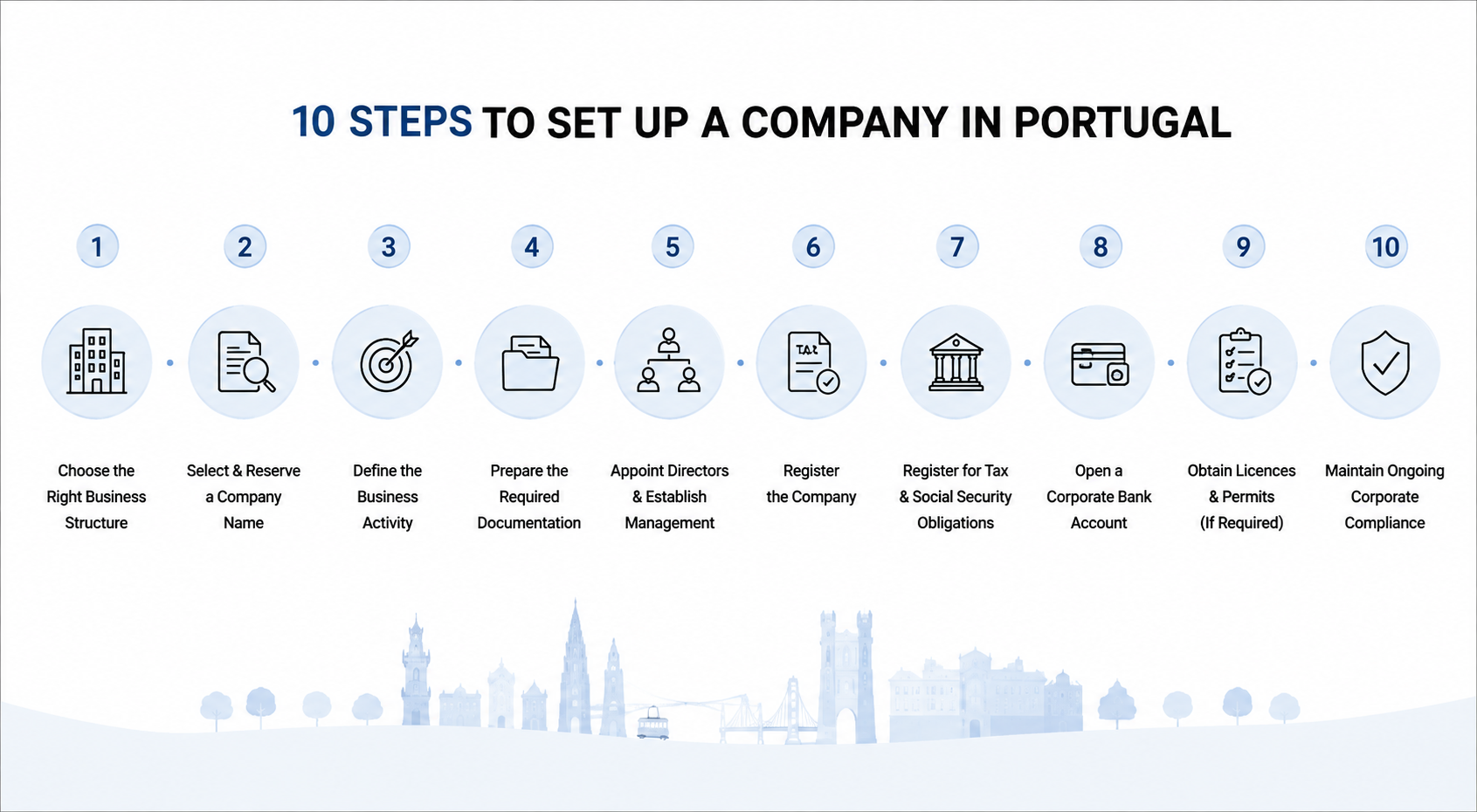
Setting up a company in Portugal involves several important stages. While the exact requirements can vary depending on the type of business and ownership structure, the following steps provide a practical overview of the company formation process.
1. Choose the Right Business Structure
The first step is deciding which legal structure is appropriate for your business.
International entrepreneurs commonly consider structures such as a Private Limited Company (Sociedade por Quotas – Lda.) or a Public Limited Company (Sociedade Anónima – S.A.), depending on the size, ownership, investment requirements, and long-term objectives of the business.
An Lda. is often suitable for small and medium-sized businesses because it provides limited liability while offering a relatively straightforward corporate structure.
A Sociedade Anónima may be more appropriate for larger businesses or companies that intend to attract significant investment or operate with a more complex shareholder structure.
Choosing the correct structure at the beginning is important because it can affect governance, liability, taxation, reporting requirements, and future expansion.
2. Select and Reserve a Company Name
Once the business structure has been determined, entrepreneurs need to select an appropriate company name.
The proposed name must comply with Portuguese naming requirements and should be sufficiently distinct from existing registered businesses. Depending on the formation route, the name may need to be approved or selected from an officially available list.
Entrepreneurs should also consider whether the proposed name is suitable for branding, domain registration, and future international expansion.
Conducting a name availability check before proceeding can help avoid delays during incorporation.
3. Define the Business Activity
The company’s intended business activities must be clearly established during the formation process.
Portugal uses activity classifications to identify the economic activities carried out by businesses. Selecting the correct activity classification is important because it can influence licensing, regulatory obligations, taxation, and other compliance requirements.
If your business operates in a regulated sector, additional permits, approvals, or professional qualifications may also be required.
For this reason, international entrepreneurs should determine their exact commercial activities before submitting incorporation documents.
4. Prepare the Required Documentation
Company formation requires a range of corporate and identification documents.
Depending on the ownership structure and whether shareholders are individuals or companies, documents may include
- Identification documents for shareholders and directors
- Proof of address
- Company formation documents
- Details of the company’s registered office
- Information regarding shareholders and ownership percentages
- Details of the company’s management
- Description of the intended business activities
- Corporate documents for shareholder companies, where applicable
Documents issued outside Portugal may need to be appropriately certified, legalized, or accompanied by an acceptable translation.
Preparing documentation correctly from the beginning can make the incorporation process considerably more efficient.
5. Appoint Directors and Establish the Management Structure
A Portuguese company must have an appropriate management structure based on its chosen legal form.
The founders need to determine who will manage the company and define the responsibilities of its directors or managers.
For international businesses, it is particularly important to understand local management, representation, and compliance requirements before incorporation.
A clear management structure can also make banking, contracting, tax administration, and day-to-day business operations easier.
6. Register the Company
After the required information and documentation have been prepared, the company can be formally incorporated through the relevant Portuguese registration process.
The incorporation process establishes the company’s legal identity and records key information such as
- Company name
- Legal structure
- Registered office
- Shareholders
- Directors or managers
- Share capital
- Business activities
Once registered, the company becomes a separate legal entity where the selected corporate structure provides limited liability.
7. Register for Tax and Social Security Obligations
Company formation does not end with incorporation.
A Portuguese company may need to complete the relevant tax registrations and comply with applicable social security obligations.
Businesses should understand their responsibilities regarding:
- Corporate taxation
- VAT
- Payroll
- Employee-related contributions
- Invoicing
- Accounting records
- Annual reporting
- Tax returns
The exact obligations depend on the company’s activities, turnover, employees, and other circumstances.
Maintaining accurate accounting records from the beginning is therefore essential for avoiding compliance problems later.
8. Open a Corporate Bank Account
Once the company has been incorporated, entrepreneurs may need to establish a dedicated corporate banking arrangement.
A business bank account allows the company to manage its operational finances separately from the personal finances of its owners.
Banks typically carry out their own customer due diligence and may request information about:
- The company’s business activities
- Beneficial owners
- Directors
- Source of funds
- Expected transaction activity
- Commercial relationships
- Corporate structure
International shareholders should therefore prepare appropriate corporate and personal documentation before approaching a bank.
9. Obtain Licences and Permits Where Required
Not every business requires a special licence, but certain sectors are subject to additional regulation.
Depending on the activity, businesses may need specific permits or approvals before beginning operations.
Examples can include sectors involving financial services, healthcare, tourism, transportation, food, professional services, or other regulated activities.
Entrepreneurs should confirm whether their intended business activity requires additional authorization before commencing operations.
10. Maintain Ongoing Corporate Compliance
After incorporation, the company must continue meeting its legal, accounting, and tax obligations.
This can include maintaining corporate records, submitting tax returns, preparing financial statements, maintaining accounting records, updating company information, and meeting applicable filing deadlines.
For international business owners, working with local professional advisers can help ensure that ongoing requirements are properly managed.
Benefits of Expanding Your Business to Portugal
Portugal offers several advantages for companies looking to establish a European presence.
1. Access to the European Union Market
One of the biggest advantages of establishing a company in Portugal is its position within the European Union.
A Portuguese company can provide an established European corporate presence and make it easier for international businesses to develop relationships with customers, suppliers, investors, and commercial partners across Europe.
For companies from outside the EU, establishing a Portuguese entity can therefore form part of a broader European expansion strategy.
2. Strategic Location
Portugal’s location at the western edge of Europe provides access to European, Atlantic, and international markets.
The country has strong connections with other European economies while also maintaining historical and commercial relationships with Portuguese-speaking markets around the world.
This can be particularly valuable for companies planning to develop an international customer base.
3. Business-Friendly Environment
Portugal has developed a modern business environment supported by digital services, established infrastructure, professional services, and a growing entrepreneurial ecosystem.
Entrepreneurs can establish businesses across a wide range of industries, including technology, consulting, tourism, e-commerce, professional services, manufacturing, and international trade.
The country’s developing start-up and innovation ecosystem can also provide opportunities for businesses seeking to build partnerships and access new markets.
4. Attractive Destination for International Entrepreneurs
Portugal has attracted entrepreneurs and international investors from different parts of the world.
Its combination of European market access, quality infrastructure, international connectivity, and lifestyle advantages makes it an appealing destination for business owners considering European expansion.
For entrepreneurs who want to operate internationally while maintaining a base within the EU, Portugal can be an attractive option.
5. Strong Infrastructure and Connectivity
Portugal benefits from developed transportation, telecommunications, banking, and digital infrastructure.
Major cities such as Lisbon and Porto have developed into important business and technology hubs, supporting companies in sectors ranging from technology and professional services to tourism and international commerce.
Reliable infrastructure is particularly important for businesses that operate internationally or serve customers across multiple markets.
6. Opportunities in Growing Sectors
Portugal has opportunities across several industries.
Technology, renewable energy, tourism, real estate-related services, professional services, digital commerce, manufacturing, and innovation are among the areas that can offer opportunities for international businesses.
Entrepreneurs should nevertheless conduct market research before entering a particular sector to understand competition, customer demand, licensing requirements, and operating costs.
7. European Credibility and Commercial Presence
For some international businesses, establishing a European company can strengthen their commercial positioning.
A Portuguese corporate presence may help businesses establish relationships with European customers, suppliers, distributors, and strategic partners.
However, entrepreneurs should remember that incorporation alone does not guarantee access to banking, financing, customers, or specific regulatory benefits. These depend on the company’s activities and individual circumstances.
8. Suitable Base for International Expansion
Portugal can also serve as part of a wider international expansion strategy. A business may establish a Portuguese subsidiary or operating company as one element of a broader European corporate structure, particularly when expanding into multiple jurisdictions.
Also read – How to Set Up a Company in Portugal
This can be particularly relevant for multinational companies and growing SMEs that want to establish operations in multiple jurisdictions while maintaining a clear corporate structure.
Important Considerations Before Setting Up a Company in Portugal
Before incorporating a company, international entrepreneurs should consider more than just the registration process.
Taxation
Businesses should understand the applicable corporate tax, VAT, payroll, and other tax obligations before commencing operations.
Tax treatment can vary depending on the company’s activities, income, structure, and circumstances.
Accounting and Reporting
Portuguese companies are subject to accounting and reporting requirements. Maintaining accurate financial records and meeting filing deadlines is essential for maintaining good corporate standing.
Registered Office
The company generally needs an appropriate registered address in Portugal. Entrepreneurs should determine the address requirements applicable to their chosen structure and business activity.
Local Compliance
Certain industries are subject to additional regulatory requirements. Businesses should establish whether their activities require licences, registrations, or professional authorizations.
Banking and KYC
Opening a business bank account is a separate process from incorporating the company. Financial institutions conduct their own KYC and AML checks and may request detailed information about the company and its beneficial owners.
Professional Support
For non-resident entrepreneurs, navigating Portuguese incorporation and ongoing compliance can be challenging without local knowledge. Professional assistance can simplify company formation, documentation, accounting, tax registration, corporate administration, and recurring compliance obligations. Businesses can explore UCI’s company formation services for support with establishing an international corporate presence.
Conclusion
If you are considering setting up a company in Portugal, obtaining professional guidance before incorporation can help you understand the applicable requirements and avoid unnecessary delays or compliance issues. With the right planning and local support, Portugal can provide a strong foundation for building and expanding an international business in Europe. Contact UCI to discuss your Portugal company formation requirements.