


The United Kingdom’s construction sector is a major contributor to the national economy, generating billions annually and employing over two million people. As of 2025, the UK construction industry is regaining momentum post-Brexit and post-COVID, offering strong opportunities for startups and foreign investors. If you’re planning to start construction business in UK, understanding the legal framework, licensing requirements, and financial considerations is crucial. This guide provides a comprehensive roadmap to help you establish your construction business with confidence.
Market Overview – The UK Construction Industry
The UK construction industry spans residential, commercial, and infrastructure development, with notable investment in green projects, smart buildings, and regeneration zones.
- Key sectors include homebuilding, commercial developments, and public infrastructure like roads, hospitals, and schools.
- Trends include modular construction, off-site manufacturing, and sustainable building practices.
- Post-Brexit trade deals and government-led investment in infrastructure offer fresh opportunities for new businesses.
The demand for skilled contractors, eco-friendly projects, and smart technology integration continues to rise, making this a strong market for new construction businesses. Foreign entrepreneurs and established companies planning to enter the UK can work with UCI to understand their company formation options and build an appropriate structure for their operations.
Choosing the Right Legal Structure
Selecting the correct legal structure is your first big decision.
| Legal Structure | Pros | Cons |
| Sole Trader | Simple to set up, full control | Full personal liability |
| Partnership | Shared responsibilities and funding | Shared liability, potential disputes |
| Limited Company (Ltd) | Limited liability, professional image | More complex setup and compliance |
Most construction startups prefer forming a limited company because of its professional image and separation between personal and business liabilities. Registration is completed through Companies House, with ongoing corporate responsibilities applying after incorporation. Entrepreneurs who need support establishing their company can explore UCI’s company formation services before starting operations in the UK.
Step-by-Step – How to Start a Construction Business in the UK?
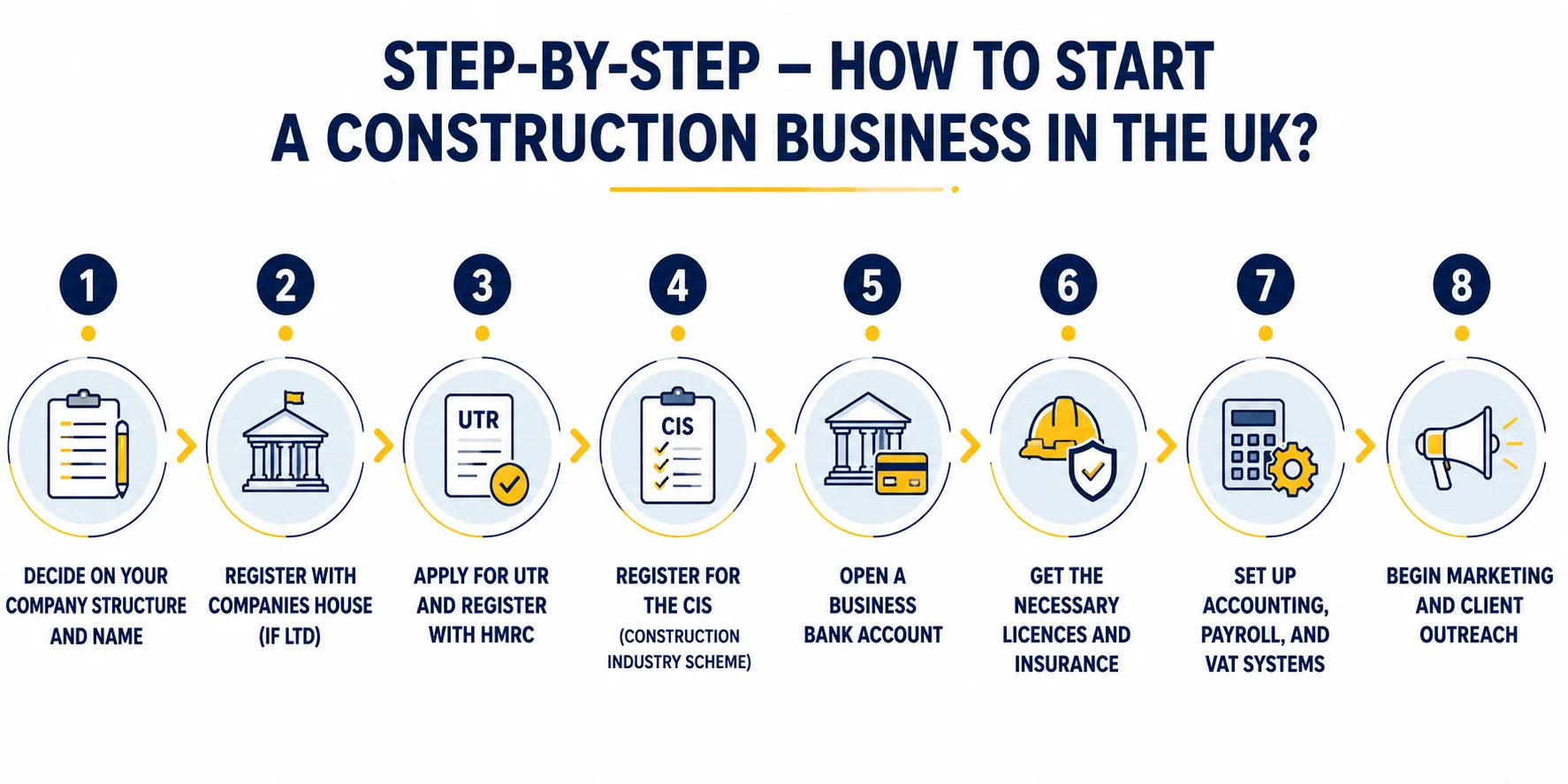
1. Decide on your company structure and name
Choose a name that reflects your services and ensure it’s unique on the Companies House register.
2. Register with Companies House (if Ltd)
This process includes submitting incorporation documents, appointing directors, and issuing shares.
3. Apply for UTR and register with HMRC
A Unique Taxpayer Reference (UTR) is essential for tax registration. Register for Corporation Tax within 3 months of trading.
4. Register for the CIS (Construction Industry Scheme)
Contractors and subcontractors must register under CIS. This affects how you deduct or receive payments.
5. Open a business bank account
Keeping your finances separate is essential for compliance and accounting purposes.
6. Get the necessary licences and insurance
Depending on your trade, you may require local licences or cards (e.g., CSCS cards).
7. Set up accounting, payroll, and VAT systems
Accurate records and payroll processing are legal requirements in the UK.
8. Begin marketing and client outreach
Build your online presence, join trade platforms, and network in your region.
Construction Licences and Certifications
Licensing varies based on the type of construction services you offer
- CSCS Cards –(Construction Skills Certification Scheme) Mandatory for site workers.
- Trade Licences – Electricians and plumbers often need local authority approval or Part P certification.
- CHAS or SafeContractor Accreditation – Improves credibility and is required by many public sector clients.
- Planning Permission – Required for new builds or significant structural changes.
- Building Control Approval – Ensures that construction work complies with building regulations.
Make sure your workforce is qualified and certified under the necessary schemes.
CIS Registration and Tax Obligations
The Construction Industry Scheme (CIS) regulates how subcontractors are paid
- Contractors must deduct tax from subcontractor payments (20% or 30% for unregistered).
- Subcontractors receive deductions but can reclaim them through their tax return.
- Monthly returns must be submitted to HMRC outlining payments and deductions.
Other tax obligations include
- Corporation Tax (typically 19%-25% depending on profit).
- VAT Registration if your turnover exceeds £90,000.
- PAYE and National Insurance if you employ staff.
A qualified construction accountant can help you manage these obligations and avoid penalties.
Insurance Requirements
Insurance is non-negotiable in construction
- Employer’s Liability Insurance – Mandatory if you hire staff.
- Public Liability Insurance – Covers third-party injuries or damage.
- Professional Indemnity Insurance – Required if you provide design or advisory services.
- Tools and Plant Insurance – Covers your equipment against theft or damage.
- Contract Works Insurance – Protects unfinished projects against fire, theft, or storms.
Insurers will assess your activities, staff numbers, and project sizes when issuing cover.
Employment Law and Health & Safety Compliance
Hiring practices in the UK must align with employment law
- Staff vs. Subcontractors – Ensure proper contracts are in place for both.
- Wages and Working Hours – Comply with the National Minimum Wage and Working Time Regulations.
- Health and Safety Compliance – The Health & Safety Executive (HSE) enforces strict rules. You must
-
- Conduct risk assessments
- Display site safety signage
- Provide PPE and training
Fines for breaches can be significant. Ensure all staff are trained and registered.
Opening a Business Bank Account
To open a business account in the UK, you will need
- Company registration documents
- Proof of identity and address
- A clear explanation of business activities
Major banks like HSBC, Barclays, or Lloyds cater to construction businesses. UCI can assist with remote or fast-track account setup, especially for overseas clients entering the UK market.
Bookkeeping, VAT, and Financial Management
Sound financial management is critical
- Accounting Software – Use systems like Xero or QuickBooks for invoicing, expense tracking, and payroll.
- VAT – Mandatory if turnover exceeds the threshold; construction services usually fall under the 20% rate.
- Job Costing – Break down costs by project to assess profitability.
- Cash Flow – Delayed payments are common in construction keep reserves and monitor debtors.
Hiring a bookkeeper or accountant can free up your time and improve financial accuracy as your construction business grows. Companies should also establish reliable processes for financial reporting, tax records, VAT, payroll, and other recurring obligations. Businesses that want to strengthen these processes can read UCI’s international accounting compliance guide for further guidance on maintaining compliant financial operations.
Marketing and Getting Your First Contracts
Your next challenge is getting noticed
- Website and Google Business Profile – Showcase projects, qualifications, and client testimonials.
- Trade Directories – Register on platforms like Checkatrade, TrustATrader, and Rated People.
- Networking – Connect with local developers, architects, and contractors.
- Tenders – Respond to opportunities posted by local authorities or developers. Accreditation (CHAS, Constructionline) improves your chances.
Building credibility early can accelerate your growth through word of mouth and reviews.
Common Mistakes to Avoid
Avoid these costly errors when you start construction business in UK
- Not registering for CIS on time – May lead to tax penalties or over-deductions.
- Inadequate insurance – Leaves you exposed to legal or financial risk.
- Poor bookkeeping – Leads to tax issues and missed opportunities.
- Non-compliant employment contracts – Results in tribunal cases and reputational harm.
Proactive compliance and planning will keep your business legally secure and financially healthy.
How Can UCI Help?
UCI offers end-to-end solutions to help you start a construction business in the UK with confidence and compliance. We assist with company formation by helping you choose the right legal structure and registering with Companies House. Our experts ensure you’re enrolled in the Construction Industry Scheme (CIS) from the outset to meet all HMRC obligations. We also provide guidance on the necessary licences and certifications and can connect you with trusted insurers for employer’s liability, public liability, and contract works cover.
Our accounting and tax services are tailored to businesses operating in the construction sector, covering areas such as VAT registration, payroll, financial reporting, and ongoing compliance. Beyond setup, UCI can provide support as your business develops, whether you are expanding your workforce, entering new markets, or reviewing your international structure. Contact UCI to discuss your plans for establishing and growing a construction business in the UK.
Conclusion
To start a construction business in UK, you need more than just tools and ambition. From registering your company and obtaining insurance to hiring workers and winning contracts, each step demands attention to detail and legal compliance. By understanding the regulatory landscape and adopting best practices from day one, you can establish a strong foundation for growth. With UCI’s support, launching your construction firm in the UK becomes simpler, faster, and more secure. Let us help you turn your vision into a thriving business.