
Sweden offers an attractive environment for entrepreneurs and international companies looking to establish a presence in Northern Europe. Its highly digital economy, skilled workforce, transparent regulatory system, strong infrastructure, and access to the wider European market make it a practical location for startups, established businesses, and overseas investors.
However, starting a business in Sweden involves more than registering a company. Entrepreneurs need to select an appropriate legal structure, understand capital and governance requirements, complete tax registrations, assess VAT obligations, maintain accounting records, and comply with employment and industry-specific regulations. Understanding these requirements from the beginning can make Swedish market entry considerably more manageable.
Why Start a Business in Sweden?
Sweden has developed a strong international reputation for innovation, technology, sustainability, manufacturing, financial services, life sciences, and digital entrepreneurship. Businesses operating there also gain access to Sweden’s domestic market and opportunities across the EU.
International entrepreneurs can use UCI’s company formation services in Sweden to understand incorporation requirements and establish an appropriate corporate structure.
Sweden’s highly developed digital public administration also simplifies many business procedures. Verksamt.se brings together services and information from several Swedish authorities, while tax registrations are handled through the Swedish Tax Agency – Skatteverket.
Main Legal Structures for Businesses in Sweden
Choosing the correct structure is one of the most important decisions when starting a business in Sweden. The structure affects liability, taxation, administration, ownership, capital requirements, and future expansion.
Sole Trader – Enskild Näringsidkare
A sole trader structure is suitable for individuals operating a business independently. Legally, there is no clear separation between the individual owner and the business, meaning the owner is personally responsible for the business.
It can work well for consultants, freelancers, professionals, and small-scale entrepreneurs who want a relatively straightforward structure.
Sole traders normally register with the Swedish Tax Agency and can apply for F-tax or FA-tax, depending on whether they also receive employment income.
Limited Company – Aktiebolag
An Aktiebolag – commonly abbreviated as AB – is a separate legal entity and one of the most important structures for businesses seeking limited liability and long-term expansion.
A private AB requires at least SEK 25,000 in share capital. Shareholders are normally not personally liable for company debts beyond their investment.
A public limited company has substantially different requirements, including minimum share capital of SEK 500,000.
Trading Partnership – Handelsbolag
A Handelsbolag is established by two or more partners. Unlike shareholders in a limited company, partners can face personal responsibility for partnership obligations.
This structure can suit smaller businesses operated jointly, although liability implications should be carefully assessed before registration.
Limited Partnership – Kommanditbolag
A Kommanditbolag is a form of partnership involving different levels of partner liability. At least one general partner carries broader liability, while limited partners generally have liability connected to their agreed contribution.
Economic Association – Ekonomisk Förening
An economic association is another recognised Swedish business structure and is generally designed around the economic interests of its members.
The Swedish Tax Agency identifies sole traders, limited companies, trading partnerships, limited partnerships, and economic associations among the principal forms available when starting a Swedish business.
Swedish Business Structures Compared
| Structure | Separate Legal Entity | Liability | Minimum Capital | Common Use |
|---|---|---|---|---|
| Sole Trader | No | Personal | No statutory share capital | Freelancers and individual entrepreneurs |
| Private AB | Yes | Generally limited | SEK 25,000 | Startups, SMEs and international businesses |
| Handelsbolag | Yes | Partners can be personally liable | No statutory share capital | Businesses with multiple partners |
| Kommanditbolag | Yes | Depends on partner type | No general statutory share capital | Partnership-based ventures |
| Economic Association | Yes | Generally limited | Depends on structure | Member-owned enterprises |
The appropriate structure should be selected based on commercial objectives, ownership arrangements, financing requirements, risk exposure, and expected growth rather than registration simplicity alone.
F-Tax Registration in Sweden
F-tax – F-skatt – is an important concept for businesses operating in Sweden.
When a business is approved for F-tax, it generally takes responsibility for paying its own preliminary tax and applicable social contributions rather than requiring the customer to deduct tax from payments for work.
This can be particularly important for consultants, contractors, service companies, and foreign businesses carrying out assignments in Sweden.
A sole trader who simultaneously receives employment income may instead need FA-tax, which combines F-tax with A-tax treatment.
Companies expanding internationally should also consider how Swedish tax registration interacts with taxation in other jurisdictions.
Also read – International Accounting Compliance
Corporate Tax in Sweden
Understanding taxation is essential when planning a Swedish company.
A Swedish limited company currently pays 20.6% corporation tax on its taxable surplus. Taxable surplus is broadly determined by taxable income less expenses that are deductible under Swedish tax rules.
Businesses should maintain accurate records of revenue, expenditure, assets, liabilities, payroll, and relevant transactions so that taxable results can be calculated correctly.
Cross-border businesses should pay particular attention to issues such as permanent establishment, transfer pricing, withholding taxes, tax treaties, and transactions with related companies.
VAT Requirements in Sweden
Swedish VAT – known as moms – applies to many goods and services.
The Swedish Tax Agency states that businesses carrying out VAT-liable economic activities generally need to register when annual turnover exceeds SEK 120,000, although exemptions and special situations can apply.
Some activities are VAT-exempt, including certain healthcare, social care, banking, and insurance activities.
International businesses should assess VAT carefully because cross-border supplies, imports, exports, EU transactions, digital services, and distance sales can involve different rules.
Professional accounting support can help companies maintain appropriate records and manage ongoing financial and tax reporting obligations.
Steps to Start a Limited Company in Sweden
For entrepreneurs choosing a private limited company, the incorporation process generally involves several important stages.
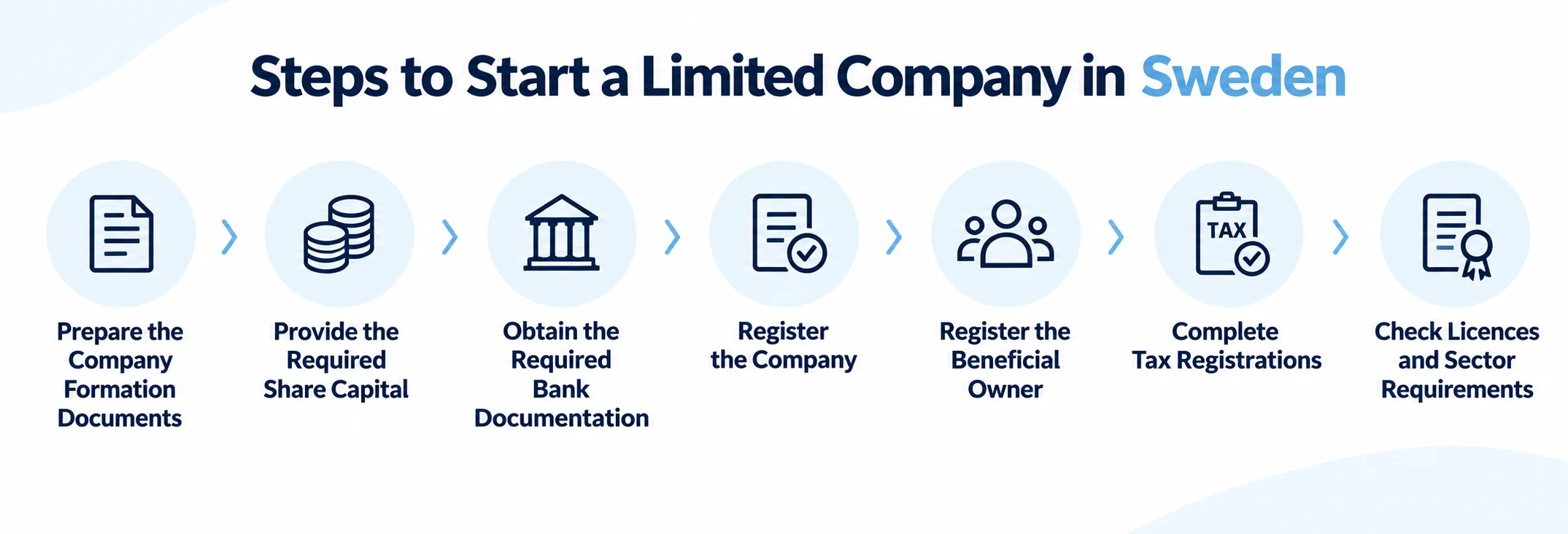
1. Prepare the Company Formation Documents
The founders must prepare a memorandum of association and articles of association. These documents establish essential details about the company, including its shares, founders, board, business name, and activities.
2. Provide the Required Share Capital
A private limited company requires at least SEK 25,000 in share capital. Capital can generally be contributed in cash or, subject to applicable requirements, through qualifying property contributed in kind.
3. Obtain the Required Bank Documentation
When capital is paid in cash, appropriate banking documentation is required to demonstrate that the share capital has been provided. Bolagsverket states that the bank certificate can come from a Swedish bank or a bank within the EEA, subject to its requirements.
4. Register the Company
The company must be registered with Bolagsverket – the Swedish Companies Registration Office. Once registration is completed, the company receives its registration number and becomes a legal entity.
5. Register the Beneficial Owner
Most newly established limited companies must also provide beneficial ownership information to Bolagsverket.
6. Complete Tax Registrations
Depending on its operations, the company may need to apply for F-tax approval and register for VAT and as an employer with the Swedish Tax Agency.
7. Check Licences and Sector Requirements
Certain activities require permits, registrations, professional qualifications, or regulatory approvals. These should be checked before trading begins.
Hiring Employees in Sweden
If a Swedish business hires employees, additional registration and reporting requirements apply.
Businesses with employees generally need to register as employers, deduct preliminary tax from salaries where applicable, report payroll information, and account for employer contributions.
For a limited company, even an owner working as an employee of their company can create employer registration obligations.
Employment contracts, working conditions, leave, pensions, insurance, workplace obligations, and applicable collective arrangements should also be reviewed before building a workforce.
Can Foreigners Start a Business in Sweden?
Foreign entrepreneurs can establish and operate businesses in Sweden. The Swedish Tax Agency specifically notes that it is possible to register a business even without a Swedish personal identity number.
However, forming or owning a company should not be confused with having permission to live or work in Sweden.
Non-Swedish businesses operating in Sweden may also need F-tax, VAT, employer registration, or a Swedish corporate identity number depending on their circumstances.
International founders should therefore consider company law, immigration status, tax residence, permanent establishment, payroll, and social security separately.
Accounting and Annual Compliance Requirements
Company registration is only the beginning of Swedish corporate compliance.
Businesses must maintain proper accounting records and meet the reporting requirements applicable to their legal structure. Swedish limited companies are required to prepare and submit annual reports to Bolagsverket.
Ongoing responsibilities may include
- Bookkeeping and financial records
- Annual financial statements
- Corporate income tax returns
- VAT reporting
- Payroll reporting
- Employer contributions
- Annual reports
- Beneficial ownership updates
- Maintaining corporate records
Requirements differ according to company type, size, activities, and other circumstances.
How UCI Can Support Your Swedish Business
Establishing a Swedish business becomes easier when company formation, tax, accounting, and ongoing compliance are considered as part of one structure rather than separately.
UCI can assist international entrepreneurs and companies with Swedish company formation, corporate structuring, accounting requirements, tax registration considerations, documentation, and ongoing compliance. This is particularly useful for international founders managing businesses, shareholders, or commercial activities across multiple jurisdictions.
Conclusion
Starting a business in Sweden offers entrepreneurs access to a stable, digital, and internationally connected economy, but successful establishment requires careful attention to legal structure, company registration, F-tax, VAT, corporate taxation, accounting, and employment obligations.
Choosing the appropriate structure and addressing compliance requirements from the outset can create a stronger foundation for sustainable expansion. For tailored assistance with Swedish company formation and international business structuring, Contact Us to discuss your requirements with UCI.